Dimitri
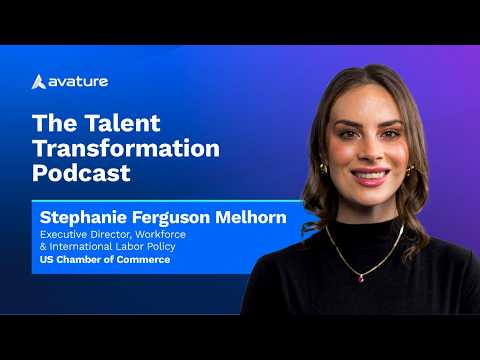
Welcome to another episode of the Talent Transformation podcast. Today, we have Stephanie Ferguson Melhorn, Executive Director of Workforce and International Labor Policy at the US Chamber of Commerce. Stephanie, thanks for joining us.
Stephanie Ferguson
Thank you for having me. Dimitri.
Dimitri
Stephanie, I wonder if we could start by maybe unpacking that title a little bit. Could you explain the mission?
Stephanie Ferguson
Absolutely. So at the U.S. Chamber of Commerce, we’re the world’s largest business federation, and we represent employers and entrepreneurs in the United States. So my job is helping employers navigate workforce issues and international labor issues. As the international labor piece goes, it’s really representing business at the International Labor Organization and understanding what’s happening in labor chapters and trade agreements.
For the workforce side, that policy portfolio covers education, workforce development issues and barriers that prevent individuals from joining or staying in the labor force.
Dimitri
Okay. So, focusing on individuals staying in the labor force for a minute. Maybe give us a little snapshot of what you are seeing right now in the US market.
Stephanie Ferguson
Absolutely. So, as far as the data goes, there are a couple of things that are happening. Our labor force participation rate has been declining for many years. And so we know that there are workers who are sitting out on the sidelines or who have just retracted from the labor force altogether.
Nationally, the data shows that we don’t have a national labor shortage. That means that there are about an equal number of individuals who are unemployed compared to the number of open jobs. So if every unemployed individual were to receive a job offer tomorrow, we technically wouldn’t have many open jobs left over.
Dimitri
Right.
Stephanie Ferguson
Where the data becomes interesting is if you look at this from a state level and an industry level. So some states have a severe labor shortage, like the Dakotas, for example, which have the most challenging labor market right now, where they have about 40 available workers for every 100 open jobs.
Dimitri
In the Dakotas?
Stephanie Ferguson
In the Dakotas. Yes. But in…
Dimitri
I wouldn’t have known that. I wouldn’t have guessed that either.
Stephanie Ferguson
No, of course not, because in the national headlines, you’re seeing that there’s no labor shortage, right? You’re seeing that perhaps unemployment is rising. So the national averages don’t really tell the local stories.
Dimitri
Right.
Stephanie Ferguson
But there are different challenges in other states, like in California, for example, there are about 145 available workers for every 100 open jobs. So those states are experiencing a much different issue.
Dimitri
Right. But I think from a labor perspective, having more people in California looking for jobs makes sense because the California economy is extremely robust. I think it’s the sixth-largest economy in the world. Then you go to the Dakotas, and the types of industries they have there haven’t really changed over the last decade or two decades. Is it is it the demographic trends that are really driving that shortage?
Stephanie Ferguson
Yeah, there are a couple of trends that are happening in the United States right now, and they’re pretty common across advanced economies. What we know with our demographic shifts right now is that we have an aging population in the United States, but we also have a low birth rate that’s sub two. So, that will put a squeeze on the number of people that we have who can participate in the labor force.
Stephanie Ferguson
And then as all of our baby boomers begin to retire, or as all of our baby boomers kind of retirement age in 2030, we should see that that experience and those skills will leave the labor force, and it’ll put greater strain on industries that already have a shortage, like healthcare service sectors.
There are other forces at play, too, that don’t necessarily help individuals stay in the labor force. We know there’s a childcare shortage across many communities. That can hurt people trying to stay in the labor force. There are other factors, too, that we could improve upon to help invite more individuals into the labor force.
Dimitri
What are you doing from a policy? What are you pushing from a policy perspective to try and solve that problem?
Stephanie Ferguson
Great question, and I’m so glad that you asked it. In the chamber, we have known that child care is the foundation that helps drive other work for many years. And so it’s been a policy priority for us for a long time. And in the past year or so, we have been working very hard to enhance three major child care tax credits, and these have not been updated in 20 years or more for the different credits.
And so, you know, we were advocating for this, and we were so pleased to see that enhancements to all three child care credits were included in the One Big Beautiful Bill. And that bill passed.
Dimtiri
Right. What’s the next step in solving this problem of unequal supply of labor? I mean, basically, you’re saying you’ve got labor in the wrong place. Jobs are in one place, labor is in the other. You also have just fundamentally a declining workforce, right? You’re trying to get women to be able to remain in the workforce. Okay. What else are you doing?
Stephanie Ferguson
We are helping employers tap into diverse talent pools. And so one issue area that I’m really passionate about is enhancing opportunities for folks who are justice-impacted.
Dimitri
Okay. Well, now, there’s a lot of processing on the HR side to not hire those people, to be frank. Right? So tell me about the strategy there, because companies have not been hiring those people.
Stephanie Ferguson
Well, I think that we all know that about one in three Americans has some sort of criminal record. So whether employers know it or not, they likely are hiring folks who have been justice-impacted.
Dimitri
I guess they are.
Stephanie Ferguson
Yeah, but you might not see it. And there might not be a conscientious decision to be a second-chance first employer.
But what we’re trying to do is really spread the message that this is a very talented and very loyal talent pool. Reports from CEOs and HR professionals show that when a business does hire a justice-impacted person, they perform just as well, if not better than their non-justice-impacted counterparts.
And also, this group of individuals has a very high unemployment rate. So, we know that they’re sitting on the sidelines when they could be engaging in the workforce. And the number one deterrent to recidivism, can you guess what it is?
Dimitri
Well, employment.
Stephanie Ferguson
Employment. So it works for everybody.
Dimitri
Yeah.
Stephanie Ferguson
So we’re trying to share the message that this is a wonderful talent pool to include in your hiring strategy and, of course, support policies that really help employers take advantage of this talent pool.
Dimitri
So let’s talk about that. Are you pushing for some kind of incentives?
Stephanie Ferguson
Yes.
Dimitri
And what are they?
Stephanie Ferguson
There are a few. The first is the Work Opportunity Tax Credit. This tax credit is provided to employers when they hire individuals who have a difficult time entering or staying in the labor market. So those are your justice-impacted folks. These are your individuals who have long-term unemployment, military spouses. So, this tax credit really just helps employers branch into different talent pools.
The second Transfer Authorization Act, for example, just passed the Senate. We’re hoping to get it passed by the House. This bill just provides support and training for individuals who have been recently released from incarceration.
Dimitri
Let’s talk about training, retraining and upskilling in general. What kind of programs are you pushing to retrain people who are falling out of the labor market because of the industrial shifts, the economic changes in the market?
Stephanie Ferguson
So there are a lot of policy pieces that are moving to help address training and workforce development that we’re really excited to see. Going back to H.R.1, Workforce Pell was just authorized in H.R.1. So, this program will allow individuals to tap into Pell Grants to go get short-term credentials. Yeah. So we’ll see more of a push towards the trades and certificates that help people do this type of work.
Another piece we’re really excited about is that the administration has set a goal to reach one million new apprenticeships. And so, we would hope to see that employers really get to lead this so that they can invite individuals into the workplace and train them in these specific industries and occupations, and then have them in their talent pool for a long period of time.
Dimitri
Yeah. Well, let’s talk about that because the trades, trade skills, have been declining pretty consistently in the U.S. I would say, anecdotally, that it’s almost been socially not encouraged. Okay. That your route to success was to get a white-collar job, to go to university and get a white-collar job, and the idea was that the US economy is shifting to a service economy, and you need to be part of the service economy, and that those jobs offered you a better future. Okay. That certainly was the idea, right?
American industry is realizing that this is causing a shortage in people with the trade skills. And it’s affecting our economic viability and also our defense posture and our competitiveness in the world. So, what really big muscular things are you trying to get the government to do in that arena?
Stephanie Ferguson
I think there are a couple of things. The first thing is that we need better data to understand what the end-demand jobs are, and what education somebody needs to enter into that job. So a big push for the chamber right now is supporting the College Transparency Act. This bill will allow students to see the data for the employment and earnings outcomes for particular degrees. And with the expansion of Workforce Pell grants that could include these short-term programs too. So we’ll have a better picture of what education can lead to after graduation.
And our goal, of course, is to make sure that businesses have the talent pool with the requisite skills necessary to come in and compete for jobs. And the workforce, of course, is competitive, so they can leave education or training and be able to get the job that they want.
Dimitri
Absolutely. And certainly for American competitiveness and for companies doing their work here, they need to make sure that… They need to know that the workforce, the coming workforce, is being tuned to some extent to what they need to get done. Let’s get back into the trades a little bit. Are you pushing any kind of very structured internship-type programs with any particular industries?
Are you looking industry by industry and saying, “Well, this industry wants something specific. How do we get that into legislation?” Or is this all very broad, across industry-type efforts?
Stephanie Ferguson
Really, it’s mostly just broad efforts, ensuring that there are funding mechanisms that will lead to employment in in-demand industries. Right? And so we want to ensure that we cast a broad net there. We have begun to support legislation that is pertinent to specific industries.
So, for example, we did support the Cyber Pivot Act, recently. And this piece of legislation would provide a grant, a scholarship grant, to students going into a cybersecurity return program. Okay. And then to go for them into cybersecurity work. So we’re certainly happy to support specific industries and occupations when we’re able to, but the goal is really to cast a wide net.
Dimitri
Yeah. Right. Okay. But, also on the trade side, getting back to the trades, are you looking at let’s talk about K12 a little bit. Let’s go a little deeper because a lot of things are changing in the workforce. We’ll talk about that, maybe a little bit. Artificial intelligence and all those things. But what are you doing to impact K-12?
Stephanie Ferguson
So we know that our scores, our kids’ scores in reading, writing and arithmetic could be much higher. And we really do want to see that kids are graduating from K-12 with the ability to either enter into the workforce immediately, learn a trade, or invest in higher education. And to do that, we have to get all these scores up. And so we’re going to be looking at programs or policies that we can support to improve K-12 outcomes.
One thing that I’m really excited about is that the administration issued an executive order earlier this year that calls for integrating AI into the classrooms. I think this will be a huge boon to get kids ready for the technology that is going to be just more heavily adopted into the workforce in the coming years.
Dimitri
Yeah, absolutely. I mean, we’re talking a lot about AI and cyber, but we’re also talking about, you know, people being able to weld and to use a lathe. Because I’m in tech and I like the cyber thing, and I think that’s great. But you know we have to balance that.
Stephanie Ferguson
Letting kids see what these trades really look like, what that work really is, is a great way to introduce individuals to a pathway to success outside of higher ed.
Now, of course, completely supportive of higher ed. These institutions are incredibly, incredibly important for our population and for the white-collar jobs that we need. But, we have to have an honest conversation that we have more jobs available that have routes other than higher ed. And we talked about earlier about the trades. It’s incredible that you can go into these trade schools for a relatively low investment and come out making great money.
Dimitri
Very good money.
Stephanie Ferguson
Very good money. And we really need to share that success story more so that more folks are encouraged to head into the routes, especially amid these shortages that we’re talking about. But also there are levers that we can pull, to help individuals be able to access those training programs or those type of job programs. You mentioned the trades, you mentioned construction. We know that there is a housing supply shortage and that housing is becoming more expensive. So we need more houses, and we need more construction workers to build these houses and more plumbers to lay the pipes in these houses. And that, again, will help workforces be attracted to different places like the Dakotas that we talked about.
And so, specifically supporting the trades, we did support the Constructs Act, which would amend WIOA to help more funds flow to construction workers. And then just in WIOA altogether, last year, the package that was nearly passed would do something that I think is really important for the next stage of workforce development in the United States, and that is to really tie funding to outcomes so that we are prioritizing the training systems that will lead to the in-demand jobs.
So, exactly like you’re talking about, we know that we need construction workers. We know that we also need cybersecurity workers. Let’s make sure that we have the pathways available to funnel folks into those types of jobs.
Dimitri
Yeh. What kind of what kind of data are you trying to get at and look at and and what kind of data you’re trying to share with get from employers and share with employers?
Stephanie Ferguson
I think, what we would really like employers to be able to see is who is successful in their talent pool, or who is successful in their workforce. And so we have heard a few times that perhaps what’s on the job description doesn’t really match the skills that are necessary to perform the job well. And so sometimes, for example, job descriptions could say, you know, you need a bachelor’s degree, and you need five years of experience, etc.
But some employers have found when they look at the employees that have, you know, grown into those roles or who have come in and been invited in without those requirements, that they do a great job and they’re super successful. And so we need to see the data so that we can understand if our job descriptions are accurate or if we can change them to invite more people in.
Dimitri
Right. Well, the good news is that companies are trying to develop skills taxonomies that allow them to understand people based specifically on the skills that they have, which is good because it’s allowing them to remove bias. Okay. And they want to remove bias because they want they to understand that if the person has the skill, the person should do the job. So, it is a process of moving to a skills-based hiring model. And I would say that most of our customers are in the early stages of that journey, okay.
And the other thing that they’re trying to do is better understand who succeeds, right? Because every company hires, if they hire 100 people, they have a certain percentage that doesn’t show up at the job, maybe 6%, it depends on your industry. They have another percentage that makes it three months and leaves. They have another group that makes it for two years, and then they have some people who end up being five plus years in the company. So, who gets five years down the road, who moves up two levels in the company?
This is data that is becoming more accessible and then becoming better for them to be able to analyze. And of course, at some point, if it’s really good, it’s easier for them to communicate that to you or to educational institutions, and I think that’s where we’re trying to get to.
Okay. Let’s talk about artificial intelligence. Okay. You know, it’s the new kid on the block.
Stephanie Ferguson
Oh, yeah. Everyone wants to talk about this.
Dimitri
It’s a big player coming. We’re moving out of the hype cycle and into the cycle where our customers are beginning to deploy it. They are doing it without knowing exactly what the future is going to look like, which will obviously create some challenges in terms of what we tell the emerging workforce. Right? So, you know, industry is trying to sort that out and figure out what’s the balance between human and machine and what are the skills that are needed to interact human and machine?
What are you what are you thinking about? What is the Chamber thinking about? With relation to AI right now.
Stephanie Ferguson
I think our viewpoint is that we’re excited about it because we know that this will just help America and Americans be more competitive in our economy. We know it’s going to open a lot of opportunities. I think the latest reports show that there will be a net of 78 million jobs created with technology in the next five years alone.
And so there’s a huge amount of opportunity available to us. And AI is going to augment jobs, going to help us be more flexible, more productive. And so the key here is, again, it all goes back to training and education, making sure that our young students or young workers are getting the education to know how to work with AI, and that our incumbent workers are getting that constant training to keep up with the technology that’s evolving.
Dimitri
A lot of our customers are worried about the entry-level job, and they’re worried about it from the perspective that the entry-level community is the community from which they selected the next level of management. The entry-level group comes in, they do a lot of things, some of it’s kind of menial, but they learn how… They get cultured, and they learn how to work within the organization. They learn how to work with other people in a professional environment. And then, you know, some of them move up in the ranks in the organization over time.
Right now, the entry-level area is the most vulnerable to being… Those tasks, a lot of them may be replaced by machines. And we have to think about what the entry-level experience is going to be like going forward. Are you now thinking about any particular push to the legislative community, or are you still sort of talking with the industry and trying to figure out what you want to get accomplished in this area?
Stephanie Ferguson
We’re still talking to industry. And I think the two things, as far as workforce policy is concerned, that, again, 1) folks are leaving education and training with the skills they need to enter the entry-level jobs that are available. So, if it’s working with AI and automation, then we have to make sure that our entry-level skills are meeting our entry-level occupations.
The other thing that we were looking at is, like we’ve talked about, there is a labor shortage and we’re having a difficult time filling many gaps. So we’re going to need automation or technology to help us bridge those gaps where we do not have the workers available to come in and do those jobs.
Dimitri
Yeah. And industry is particularly concerned with those gaps. Okay. They’re creating a competitive disadvantage for companies here in the United States, for example. And I think we should talk about how industry, how specific the dialogue gets between industry and your organization. Right? Because, I also think that it has to come down to a very specific gap.
Right. How do we address this gap? A cyber engineer is a cyber professional. A good example. But there’s there are like 20 of those that I think need different solutions really, if they are to be mitigated within the next 5 to 10 years. Because, those shortages right now are hitting industry today.
Right. But it’d be interesting to talk to you more about this process of how industry not just participates in driving some of that legislation, but how industry consumes the legislation, right? How they consume the output of it? And how the human resources organization specifically tailors the way they go to market based on what you have available, what’s out there? I think that’s an interesting area.
Stephanie Ferguson
Absolutely. And so getting legislation crafted in a way that’s going to lead to really effective change is only step one. Right? And then it’s getting it passed, and then it’s getting it implemented in a way that will help you achieve the goals that were laid out in the legislation. So, there are many steps to going from concept to success.
And so, really, we need to make sure that when we’re crafting these new laws and regulations, that they’re in such a way that business can take it and run, hopefully quickly, and that there are those support systems available to help businesses navigate new changes.
Dimitri
Yeah, I’d like to see the talent acquisition groups inside of these companies make a more direct connection. One of the things they’re doing with artificial intelligence is they’re getting away from the day-to-day busy work that they do. They’ve sort of been trapped in these very administrative-type tasks. And they’re trying to get to play a more strategic role in their organizations. And I think this is one of those areas where they need to engage and become more strategic and to look at, you know, where is where what legislation is going to affect the availability of talent in the particular markets that they’re working in. And it’s pretty complex.
I mean, and the timeline for this is obviously, we’re talking about legislation and government. So it requires a certain amount of focus from industry to stay engaged with this process and make sure that the outcome is actually something that they take advantage of.
Stephanie Ferguson
I think we have to consider long-term and short-term solutions. This labor shortage is not going to go away overnight. And we talked about the demographic drought; it might not go away for a long time. And so we have to… And when you consider the skills shortage, too, right? These are challenges where employers are going to need to be able to access short-term solutions like attracting a talent pool that is sitting on the sidelines right now and we need to consider long-term solutions like how to continue retraining and reskilling employees, or talking to schools and making sure that what we’re teaching eighth graders today will help to fill the jobs ten years from now.
Dimitri
Yeah, exactly. And I think they have to work on this conceptual idea of what it is to be successful for people. You know, the military did a great job of projecting what it was like to be when they when the military moved to a volunteer military, they recognized that if they didn’t show people what being in the military was about, their ranks would decline significantly. So, they consciously made an effort to show what that life was and what that success was like, and that helped them to create a large voluntary military in America.
And, in the trades, going back to the trades again in some of the areas that are not in the news as being the sexiest thing to do, you have to get the young people to understand that there is success there. And that’s a job that’s hard for just any one individual company to do, of course. Right? Because the scale of that and the scale of shifting K-12 education and tuning the academic world to fit the business world’s needs is something that any one company can’t do alone. It’s too big a lift.
Stephanie Ferguson
Of course, and that’s why many voices matter. And that’s why, you know, the Chamber we try to use, opportunities like this that we can to really highlight. Like you said, there’s a lot of pride in being part of building an entire building and building a train. Right? There’s a lot of pride there. We really need to share those success stories more widely.
Stephanie Ferguson
Yeah.
Dimitri
I’d love to have you back. Talk some more. Go through some data, maybe, and dig into some of these programs. Be great. Fantastic. Thank you so much, Stephanie.
Stephanie Ferguson
Thank you for having me, Dimitri.