Dimitri Boylan
Welcome to another episode of the Talent Transformation podcast. Today we have Daniel Bacher business unit manager. People and culture development, employer branding and recruiting at STRABAG. Daniela, thank you so much for joining us. Pleasure to have you here.
Daniela Bacher
Thank you. Dimitri, for inviting me.
Dimitri Boylan
It’s a pleasure to have you. Maybe we could start with a little bit about STRABAG. Can you tell us about the company and its history?
Daniela Bacher
Sure. So, STRABAG, we have around 86,000 people in 50 countries. We have 2,400 locations. So we really are a big construction group with different kinds of fields of activity we are working in. So from road construction, tunneling, civil engineering, we also have a property and facility company, which is taking care of the buildings.
Dimitri Boylan
The construction business is a tough business, right? It’s also one where I think the number of employees probably changes a lot.
Daniela Bacher
Well, it depends really on the business. So for sure you have a higher turnover in blue collar and especially also in property and facility, because we have a lot of cleaning personnel there, who are working in many jobs, they’re working part-time. That’s why we have a high turnover rate there as well. That’s why we continually search for people. So we have continuously 3,200 to 3,300 open vacancies during the year.
Dimitri Boylan
Mostly in Europe?
Daniela Bacher
Mostly in Europe, mostly actually in Germany, because Germany is the biggest market.
Dimitri Boylan
That’s a very difficult labor market.
Daniela Bacher
That’s true. So it’s very difficult finding people. We have a topic that in STRABAG, our average age is like 43. So we are not that young as a company as well. So you can imagine, combined with the challenges every company in Germany or Europe is actually facing due to the people, not having enough people coming and getting older. So we have some economic topics.
For us it’s really important finding people. And especially in the blue collar, it’s hard for us to find apprentices. But this is actually one point we really focus on in the future. We want to build young talents also for blue collars, and really bring them into our company because, you know, having today a job as a blue-collar worker it’s different than maybe 50 years ago.
Now, we really offer them career opportunities. We really want to develop them in the early years to make a career in STRABAG, maybe as a foreman when they finish their studies, their apprentices. So we train them and in Germany we are quite successful. We have a training center we have in Bebra, which is on the one hand for the blue collars, but also for commercial apprentices. And also in Austria, we have built one. We call it the Ypps Campus. It’s a town in Upper Austria. And this is one of the measures to really start to bring in new people.
Dimitri Boylan
Yeah. But the challenges, the demographics. Right? Because even if you have great programs, there are not a lot of young people…
Daniela Bacher
No, no. That’s true.
Dimitri Boylan
Coming up in Europe. And, how appealing are the trades to them? I mean, you know, I can speak from the United States. So I grew up in a construction family. Fewer and fewer people would go into construction over time. Are you developing very specific, targeted campaigns towards people 15 to 18 years old? I mean, you have to get to that age group to really fill the ranks. You can’t talk to somebody at 24 and try and get them into construction. It seems too hard.
Daniela Bacher
It’s too hard.
Dimitri Boylan
It’s hard work.
Daniela Bacher
What we do from a central side is that we have actually a P&C marketing budget also for social media campaigns from a central side, but also from a decentralized side, let’s say in Germany, as an example. In Germany, we have around 500 locations. And they are very spread out all over the country. So, they organized very decentralized.
So on the one hand, they can approach with special campaigns for the location. And we have from a central side the possibility to spread it more for a region to spread it for the whole country, and we really do targeted social media campaigns on the channels for these people, starting with TikTok, Instagram, Facebook, everything you can reach them.
Dimitri Boylan
Where are you getting the best bang for your buck on social media?
Daniela Bacher
It’s TikTok that is spreading the most. But coming back, is mostly actually Instagram right now.
Dimitri Boylan
Yeah. Instagram.
Daniela Bacher
Because we think we see that the parents are on Facebook.
Dimitri Boylan
Yes. Parents are on Facebook.
Daniela Bacher
Facebook and Instagram. Some young ones on TikTok. But you see, when you drive to the social media campaigns, when you spread them, you see that the things that are coming back, we are now tracking. This year, we started to track, “Are they really applying on our website, at our job fair, job exchange?” And it’s still Instagram.
But last year, STRABAG also launched a social media TikTok channel with a young German guy, an influencer. And this is really, you know, 150,000 clicks. So, this is really something that is going through the ceiling because the young ones are on TikTok all day. But it’s not that they’re aware that they really would click on, “I apply for an apprentice via TikTok.” It’s much more for awareness.
Dimitri Boylan
So, Instagram, TikTok are great for getting attention. When you get the people into the training programs, are you finding it more difficult to get them trained up, or has it been pretty much the same over the last decade or two?
Daniela Bacher
Honestly, I think it gets worse. It’s more difficult because the quality is less. So we figure out that, especially the young ones, even if you go through school, when they came out, and they apply and they start. So, we have really 30% dropout rate in the first year.
Dimitri Boylan
That’s pretty high.
Daniela Bacher
This is pretty high, but it’s for construction. I think it’s normal because, you know, they don’t imagine a lot. So what we do is, every apprentice who will start working with STRABAG has the opportunity to spend a week or a couple of days with us to figure out, “What does it mean working in construction?” Working every day in every weather condition, winter and summer. And what does it really mean?
But we also have, as I said, we are very local, even if we have a global presence, we have this local presence. And this is one specific for STRABAG, people working for us, they are naturally proud working for STRABAG. And they are very loyal to STRABAG. So sometimes they are 20, 25, 30 years with STRABAG, and it turns out that also their father was working with STRABAG.
Dimitri Boylan
Just about to go to that. The generational pull.
Daniela Bacher
That’s why they are motivated. So sometimes this works well when you go into the countryside, let’s say like this, it’s more family-driven. But for sure, in big cities like Berlin or Munich in Germany, or Stuttgart, Cologne, it’s harder. But what we also have started, last year, a couple of years ago, we started, we try to bring in people from other countries outside of Europe.
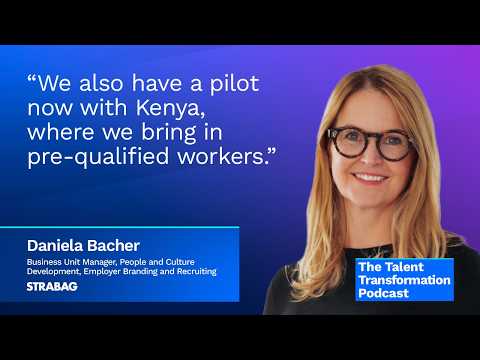
We also have a pilot now with Kenya in Africa, where we bring in qualified, pre-qualified workers. This works quite well. And what we also did is, when all the people coming from Syria and all these countries to Europe a couple of years ago, ten years ago, I think it was in Germany, we gave them a chance and hired them. And many of them are still with us. So the job is less because they get, like, a chance here in Europe.
Dimitri Boylan
It’s a good job.
Daniela Bacher
It’s a good job. And that’s why they really appreciate working for STRABAG. So these people, you know, if you bring them in outside of Europe, if they’re refugees and you give them a chance, we had a good experience with that in terms of we do need these people in terms of demographic development, for us is also an opportunity.
Dimitri Boylan
So the story that you tell, is it a different story in Germany to the German kids that are coming out of secondary school, than the story you tell to the people you’re recruiting in Kenya?
Daniela Bacher
Yeh I think… I mean in Europe and Germany and also Austria, as you said. So the parents were working in construction, and now they think it’s better that the kids are studying construction. So, that’s why I think we have to consider both ways. So on one hand, we also need the guys who are studying here, the kids who are studying. We have really good relationships with universities in Germany as well as in Austria and Germany.
We have, I guess, almost 200 universities we collaborate with. So we don’t have the topic of getting graduates in, we have more of the topic of keeping them. Because, this is also a phenomenon among the young people, they want to make a career quite fast, and they don’t give themselves the time for acquiring knowledge, acquiring skills.
Dimitri Boylan
Patience is a thing of the past.
Daniela Bacher
Patience is a thing of the past. That’s true. That’s why I think what is also good is keeping in touch with them if they leave. Because, as I said, it is a very big, complex company. So everyone who has ever worked for STRABAG and is coming back is highly welcome. Let’s say 90%. Some who never want to come back anyways. So this is something we want to use in the future, also with the CRM to…
Dimitri Boylan
To communicate with the leavers.
Daniela Bacher
Exactly. And, yeah, in Kenya, I think the people are thankful for working for a company that is stable, which makes good quality. The roads we built in Africa, we have been in the African market for 20 years, I think. And, the people I’m talking about are like former STRABAG employees. Some of them. Yeah. And they also go through a qualification screening. And, then because we need to adapt qualifications they have, assign them to…
Dimitri Boylan
The European market, right?
Daniela Bacher–
Yes. And that’s why I think, when we can use this gate for specific countries we are already in and bring people there. So, this could be one of the chances…
Dimitri Boylan
So, do you do a lot of internal mobility? How do you manage moving the workforce around? How flexible is that?
Daniela Bacher
That depends on the segment where you’re working. So, if you’re in the tunneling division, you build a tunnel. It takes you ten years, 20 years. So, I have interviewed once one of our project manager from the Koralmbahn, which is a big, rail tunneling project in Austria, one of the biggest ones. We have two, one is Semarang and the other one is Krain. It’s in Carinthia. It combines Carinthia with northern Austria, with Vienna, and they built 25 years in this tunnel. So this is a tunnel that’s once in a lifetime. And then you have a second project and then you go to retire.
Dimitri Boylan
Yeah. You do 2 or 3 projects.
Daniela Bacher
You have to be mobile because you don’t know. This tunnel can be in Austria; it’s a gift. But the tunnel can be in Canada, like the tunnel we built for the Niagara Falls. So yeah, this could be everywhere. And, the problem we see, especially in road construction, is that mostly people want to stay close to home.
Dimitri Boylan
Yes. Right.
Daniela Bacher
It’s a little bit better, let’s say, in civil engineering, because they are attracted by the project. So, we have them build for Infineon in Austria, a new building. And it was a very tough timeline. So it’s three years and everybody was actually happy to work there because it’s technical, brilliant construction.
Dimitri Boylan
Yeah. And construction is nice because you do end up with something at the end. I mean, everybody that’s in construction steps back at the end of whatever they built and said, “Yeah, I did that.” And it’s there’s a sense of satisfaction there. So do you when you do your recruitment marketing, do you particularly talk about projects? Do you use the sexiness of the project to get the people on board?
Daniela Bacher
Yes, yes, yes!
Dimitri Boylan
You do.
Daniela Bacher
Okay. Because we also figured out, we have launched this year a new EVP, employer value proposition, related to our claim Work On Progress. We launched Work On Progress at the end of 2022 because we had a CEO change in 2023. We had interviews with many of our colleagues to figure out the internal insights. And also, we made personas. So we figured out what is the market, what do the talents want. And it’s progress. It’s innovation, it’s development, it’s responsibility. It’s the same… So building something, being part of something that stands there in 20, 50 years. Yeah. It’s something which is in the construction industry. It’s amazing.
As you said, the big projects we have, you can always bring them at a glance for the talent because that’s what they are interested in, right? And STRABAG is driven really in innovation. So we have 250 innovation projects actually, in terms of AI, building information modeling has been. So we really have a high technology in the group.
So there are a lot of opportunities for young people, but also for experienced people and with Work On Progress, as you know, we want to be climate neutral by 2040.
Dimitri Boylan
Yes. How is that going?
Daniela Bacher
It’s good. It’s. We are in a good way
Dimitri Boylan
That’s an important message for the workforce as well.
Daniela Bacher
Yes, yes the idea…
Dimitri Boylan
Especially the younger workforce.
Daniela Bacher
They’re attracted by that…
Dimitri Boylan
Concerned with that. Yeah.
Daniela Bacher
Because they say, “Okay, well if we are doing something for the climate,” and you can follow what we are doing on our web page, Work On Progress. So it’s visible. It’s really our vision and we’re really going straight forward on that and everything we can contribute we do. For the talent, it’s important because we say progress is nothing that happens. Progress is something that is made by our people. And we have 86,000. And if everyone contributes in his small…
Dimitri Boylan
In their way…
Daniela Bacher
In their way to making a better planet, that’s what STRABAG wants.
Dimitri Boylan
Right. So going forward, are there things that you are thinking about doing? What do you what do you think you need to do? That you’re not doing today, is there something on your agenda that you haven’t gotten to yet, or have you sort of gotten everything that you’re doing is already in play?
Daniela Bacher
No, no, no.
Dimitri Boylan
No fighting.
Daniela Bacher
We definitely have a couple of open topics. So, as you mentioned, workforce planning before. I was thrilled because we implemented a workforce planning tool last year, but it’s only a one-year planning tool because it’s strategic planning in the future, 1 to 3 years.
Dimitri Boylan
And is that is that for planning each project or is it a higher level?
Daniela Bacher
It’s whole workforce.
Dimitri Boylan
Okay.
Daniela Bacher
It’s just should give us an overview of how the workforce should develop within the next years.
Dimitri Boylan
Okay.
Daniela Bacher
So that we can derive from that what will be the recruiting demand. The training demand. Also, the possibility within divisions to shift and think about, “Okay, if I win a project next year, I can get stuff internal mobility from another…
Dimitri Boylan
Another project, borrowing from projects, moving people around? Yes.
Daniela Bacher
To make it more visible. So we are still at the beginning of that. So, this year is the second round. And if you said that Avature has plans in this direction is interesting for us because maybe on some point we can combine data, whatever. Yeah. And can use this as well.
So this is one thing we are still working on. So I’ve read, actually, workforce planning has to be done at least 3 to 4 times that it becomes a good habit, that it can work. Yes. And we adapt this tool. It’s like now it’s workforce planning 2.0. Then we are already talking about 3.0 for next year. So, this is something that we are still working on. The other thing is the internal mobility. Make it visible and also give the employees the opportunity to say, “Okay, I want to…”
Dimitri Boylan
Work on a certain project.
Daniela Bacher
Work on a certain project, work in a certain country. I don’t know, “My personal circumstances will change within the next six months or 12 months. So I am open.” Right now we make a post and say, “Okay, does someone want to go to Australia or something like this?”
These are really big topics and the other thing is the skill-based, competency trainings. We are doing already some at a certain point, but we just need to get more into that.
Dimitri Boylan
Yeah. Nobody’s fully cracked that. Not yet. I mean, because starting to use skills, but having a tie in to the workforce planning and into the forecasting for talent acquisition, and be a critical component of the internal mobility to get all of those things to work is still a big challenge.
Daniela Bacher
It’s very challenging.
Dimitri Boylan
Yeah, and certainly at scale. Right. We’re talking about 80,000+ employees. And how many countries are you operating in right now?
Daniela Bacher
50.
Dimitri Boylan
Oh okay. So, a fair number of countries. How do you feel you’re stacking up in terms of strategic air compared to the rest of the construction industry? Do you feel like you’re ahead of that curve? Hard to tell.
Daniela Bacher
I think ahead, I think we are in a good way. So, I think we have done a lot within the last five years. But I think the challenge is that strategic HR is, you said it today, it’s not easy to say how companies will develop, especially if you’re big. I mean, we do have, I think, 28 billion in the pipeline. We have to do…
Dimitri Boylan
You need to plan for that. You need to we need to execute that work.
Daniela Bacher
And we need to execute this. But you never know. I always say, “Okay, if we don’t finish, then we don’t have written the bill and we don’t have the money in the bank.” I’m not sure. Because you never know. And, I mean, construction projects can be very difficult, and they can turn out differently, especially in tunnelling and mining.
Dimitri Boylan
Yes. Right. Mining.
Daniela Bacher
So, yes. You never know what is behind the next rock. And, that’s why I think a strategic point of view, I think if we are going with the agenda we have in terms of the skill-based competency trainings, really bringing recruiting to a next level, because we face as a company the same problems every company has I figured out yesterday in our session.
We have hiring managers who want to see every applicant, even if there are 50. It’s not necessary. We have recruiters who are on a very excellent level. We have a lot of young ones who are.
Dimitri Boylan
Not that experienced.
Daniela Bacher
Not that experienced. And, yeah, we really need to think about the workforce planning in the future, as I said. So the demographic topic is a topic. And if you know that we need, besides the turnover we have, another 2,000 to 3,000 people in the next year, then we need to think about how we solve these problems. So I think strategically, we know what our topics are, but I wouldn’t say that we are with all our tools far ahead, and we have to involve the whole community, so everything we do from a central department is aligned with the business needs.
Dimitri Boylan
Right?
Daniela Bacher
It’s in accordance with the managers, with our P&C partners. We have 350 P&C partners and recruiters we have to bring into our structure, get them aware of the processes, and bring them to conduct the processes in the best way for the business unit where they are working. So, this is also difficult because it’s when you’re working in Oman, it’s different from when you’re working in Chile, when you’re working in the UK, than when you’re working in Australia. So we acquired a company a couple of months ago in Australia and Georgia with thousands of employees, and yeah, now.
Dimitri Boylan
Different culture.
Daniela Bacher
Totally different culture. We bring them now into our systems, by the way, step by step, they should have the feeling that being part of a big company like STRABAG is an advantage, because together we can reach much more.
Dimitri Boylan
Well, it is.
Daniela Bacher
Is open for that.
Dimitri Boylan
I think in construction, people realize that because jobs come and go and you want a good pipeline of work, all, it sounds like you’re on a very good path. I’d love to hear more from you over time about strategic workforce planning. And, I think construction is a great area to refine that capability because it’s so dynamic. You know, the workforce is dynamic. And, it’d be really interesting to hear how you take on those challenges. I’d love to have you back.
Daniela Bacher
I’m happy to come back.
Dimitri Boylan
Yeah. Fantastic. Thank you so much for being here. Really appreciate it.
Daniela Bacher
Thank you. Dimitri was my pleasure.