Dimitri Boylan
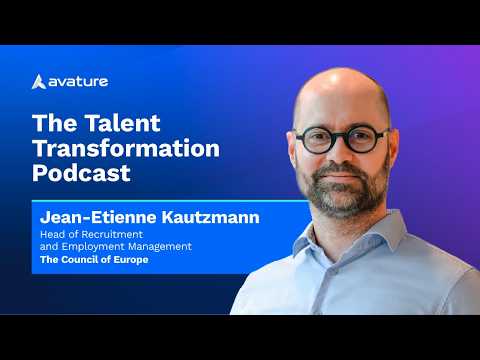
Welcome to another episode of the Talent Transformation Podcast. Today, we have Jean-Etienne Kautzmann, the Head of Recruitment and Employment Management at the Council of Europe. Jean, welcome.
Jean-Etienne Kautzmann
Thank you for having me.
Dimitri Boylan
It’s a pleasure to have you here. I’ve been looking forward to this conversation. Could you start by giving us a little bit of a description of the Council of Europe, the mission and the scope of its services?
Jean-Etienne Kautzmann
Yeah, sure. It’s often the first question we’re asked. We’re an international organization, which means an organization created by states. We have 46 member states, from all whole Europe, from Iceland to the South Caucasus, from Malta to Norway. So, not only the EU member states, but an extra 19.
What we do is… We usually summarize it in human rights democracy and the rule of law. That sounds very general. Very concretely, we do three things. We set up standards. So, just imagine 46 states in a room with experts on a given subject, and we try to reach a consensus to set a standard. And we have 227, I think, since last week, treaties that states can accept.
Dimitri Boylan
And when was it founded?
Jean-Etienne Kautzmann
In 1949. We are approaching the 80th birthday. Then, these standards, we monitor them. It’s a bit like audit procedures. So we have experts again from the member states who actually assess each other. And the third thing we do is that recommendations that flow from these audits, these monitorings, we use them to develop projects to help Member States actually align with these standards. So, that’s the technique behind human rights democracy and the rule of law.
Dimitri Boylan
Right? Okay. And so, when did you join the organization?
Jean-Etienne Kautzmann
I joined in 2004. So already 21 years ago.
Dimitri Boylan
It’s been a good run so far. It sounds fascinating, rather complex. And, I must admit, larger than I thought it was. That’s a lot of member states. How did you end up at the Council of Europe? Because I understand you’re actually a human rights attorney yourself, right?
Jean-Etienne Kautzmann
Yeah. I entered the organization as a junior human rights lawyer.
Dimitri Boylan
And somehow, over time, you transitioned into recruiting and talent acquisition. Did you have an idea about what that role was going to be like? And did it turn out to be what you thought, or did you discover something different?
Jean-Etienne Kautzmann
I knew some part, but there are things I clearly did not expect and it’s a daily discovery and I should even say, because…
Dimitri Boylan
Even today?
Jean-Etienne Kautzmann
Yeah, even today, because it’s, it’s a process that needs to be constantly reinvented. Just the fact that the way candidates apply now, using tools we had no idea would be available to everyone, like AI, changes… has changed over the last two years, the way they actually fulfill their applications and the way we look at them. So that’s constantly changing. And that’s not necessarily something I had expected, but that makes it even more interesting.
Dimitri Boylan
Well, it makes it more challenging to accomplish a mission. Right? Because, as the market changes and as the way people interface with the organization changes, you have to change the way you process that information.
Jean-Etienne Kautzmann
Yeah, quite. And, as you said, the challenges, we all know them, and they’re not very different from what the business can experience. Time to hire it’s an obvious thing, assessing the skills before recruiting, and being good at assessing performance. And I have to say, the multiplicity of tools that we in HR, but also the managers are using, was (still is to a certain extent) a challenge.
Dimitri Boylan
Yeah. So when you came into recruiting, did you have a mandate to do a lot of new things, or did you just come into it with management thinking it was just a different operational role for you?
Jean-Etienne Kautzmann
I came with quite a clear mandate. Moving forward with new tools. We had to because we had to decommission our previous ATS. So, that was clear then, but also clear objectives in terms of recruiting faster. The organization is facing other challenges, like businesses, like quite a significant generational change coming. First wave between 2028 and 2032. That will probably double the amount of recruitment we do on a yearly basis. So we need to prepare for that. So workforce planning is there. All these were really clearly identified challenges.
Dimitri Boylan
How many employees?
Jean-Etienne Kautzmann
2,500 in our headquarters and another 500 in the 20 field offices we have.
Dimitri Boylan
Okay. In the different jobs that you had inside the council. How close did you get to technology in your operational roles before? I mean, were you used to selecting technology and deploying it, or were you more of a user of technology always?
Jean-Etienne Kautzmann
I was mostly a user. For part of my career, I worked with the procurement team. So there you have the selection aspect. And how we were actually procuring. But that’s the only background I have with interactions with the providers and with the technologies to a certain extent.
Dimitri Boylan
So, when you started buying technology for yourself and your team and then implementing it, that was a new experience for you?
Jean-Etienne Kautzmann
Yeah.
Dimitri Boylan
Okay. And how did that go so far?
Jean-Etienne Kautzmann
So far, very good.
Dimitri Boylan
So far, very good. That’s good.
Jean-Etienne Kautzmann
And there are ways to mitigate risk. You meet people in different forums. You look at the solutions, you call other organizations to see whether they’re using. You know, in the case of Avature, we called the European Central Bank, and we had a very interesting conversation. And that’s it. And then we need to go for a public tender.
Dimitri Boylan
Yes. Public tender. Yes. Which is a process in itself that, you know, you learn a lot going through it. Right? It’s a very different process. A lot of our customers don’t have to go through that. Some of our customers obviously do. We have, I think, 7 or 8 governments as customers in various ways, various agencies. It’s definitely a different process. Did you talk to, when you were looking at technology? Did you talk to non-governmental agencies as well? Just pure commercial companies about what they do, or did you stick strictly to government agencies?
Jean-Etienne Kautzmann
We mostly looked at other international organizations, because we know we have constraints. And we tried… There was a tender a few years before my arrival that was unfruitful because, at the end of the day, the provider was not able to comply with our needs. So we learned from that. What’s interesting with public tenders is that you need to figure out what you want before you before you launch the process.
Dimitri Boylan
Yes. It’s not a discovery. During the tender process.
Jean-Etienne Kautzmann
You need to be prepared. You know, you need to know where you’re going. Otherwise, it can actually be a complete failure. So we need to be prepared. Yeah. Right.
Dimitri Boylan
How is your relationship with the technology organization, the technology team inside your organization?
Jean-Etienne Kautzmann
We had to, in a way, rethink a bit the way we were working together before launching the project with Avature. We talked with our IT teams to actually agree on having an IT support team within the talent acquisition team closer to the operation, on top of having the infrastructure colleagues within the CIO team, and that works, from my point of view, very well.
Dimitri Boylan
Yes. There’s a lot of talk about that even at our user conference, which, you know, about that critical component that needs to be in the HR organization and really understanding what the needs are and helping to get those needs met. So was that a challenge to get that or was it sort of obvious? And everybody just said, “We got it.”
Jean-Etienne Kautzmann
I think we quickly agreed that…
Dimitri Boylan
It was the way to go.
Jean-Etienne Kautzmann
Yeah, it was way to go. There was a need to do that, simply to be more efficient and to have IT colleagues, on a daily basis, confronted with what HR does, understanding the complexity of the data model, and also we need to constantly adjust, we need to constantly adjust the process, the workflows.
Dimitri Boylan
Well, you’re interfacing with the external world, right? And you’re shaping the organization, the future of the organization as well. So those are two very complicated things that have to align in some way.
Jean-Etienne Kautzmann
Absolutely.
Dimitri Boylan
Do you feel like you are agile enough for this market, or do you think you have a ways to go?
Jean-Etienne Kautzmann
I think we’re not bad, but… Meaning we are good. But, there is always a margin to improve. So, we can clearly see what needs to be done in the coming two to three years, I would say. And we also know that in the coming two to three years, we will identify things to be done, in the following ones, we will close a chapter of the reshaping of the ATS by the end of the year, which, for us, is a major change, having a central tool, a unicorn, with portals for our different stakeholders to interact with us, that’s a massive change. And then we will look at the evolution of everything around skills management.
Dimitri Boylan
Okay.
Jean-Etienne Kautzmann
From our, what we call competency framework, to the performance management solution, all that needs to be better integrated, so we know that’s the way forward. And we know that at the end of the road, we have a workforce planning that needs to be consolidated.
Dimitri Boylan
Right. Okay. Will you be able to use AI? What is the sentiment right now within your organization? Is it, wait and see? Is it, “Yes. We must do it?” What’s the thinking right now?
Jean-Etienne Kautzmann
I think we have the same challenges as everyone when it comes to trying to figure out what the impact will be on the workforce. That’s obvious. What comes on top of that for us is that, as a big human rights organization working on democracy and the rule of law, AI is not only a disruptor in terms of the way people work, it is one at the level of society, the way people inform themselves and probably eventually on the way people vote.
And that leads us to question how much we can use AI while respecting what we preach for. And therefore, accountability is an absolute key. We preach for accountability in everything we do. We were created for peace in Europe, and we know there is no lasting peace without accountability. That’s a pretty high-level approach. But still, one cannot use AI as another tool without looking at the way it works.
What, for me, becomes more interesting now is that we came from one general AI tool that everybody could use to ask any sort of question on everything to more integrated solutions where we can control what AI learns from, because otherwise AI can be as misinformed as us.
Dimitri Boylan
Absolutely.
Jean-Etienne Kautzmann
So controlling that, but also being able to even control the prompt if it’s integrated in the solution, one could even have the prompt validated by the ethics professionals working with us. So that level of oversight and accountability with a system that guarantees that the decision is made by humans, that’s much more interesting and a way forward.
Dimitri Boylan
That’s probably the avenue. If it’s agentic, you are writing the prompts yourself, you’re getting the prompts reviewed, you understand exactly where it’s being used in the process. You have complete control over that. You understand exactly how it was trained. And you understand what the expected output range is going to be. And you can focus on that and potentially not have that get associated with the bigger issues around artificial intelligence in society. And there are some huge issues there, and I don’t think anybody is debating that.
Jean-Etienne Kautzmann
And on top of that, we adopted a year ago the first international treaty on AI related to human rights, democracy and the rule of law. So we set the standards, and we obviously need to stick to them.
Dimitri Boylan
To stick to those standards. Absolutely, yes. And the type of how different would you say the candidates are that you need today from the candidates that you hired 20 years ago?
Jean-Etienne Kautzmann
That’s a good question. The candidates probably need the same technical skills, the same substantial knowledge. But we clearly experienced, during COVID, a need for adaptability, learning skills to be at the top. That’s something we try to emphasize in the way we assess candidates before recruiting them. Sounds obvious in 2025. Not sure that was obvious in 2005. That’s clearly something we’ve identified: this capacity to learn, to adapt.
But we always need this very high level of technical knowledge with a diversity of themes. This is something that not only has not changed over the last 20 years, but will not change. That’s something we need to keep. From our point of view, our staff is our main asset. Their knowledge… We do knowledge transfer, we create standards. And that requires having a certain amount of knowledge around new standards and the way they have to be implemented. And this technical knowledge is something extremely precious. That cannot be asked of anybody on the market.
Dimitri Boylan
So, obviously, when you work with hiring managers, you have a deep knowledge of the way the company operates. You have direct personal experience doing one of those jobs. When you bring other recruiters onto your team, they more than likely don’t have the same experience. How do you compensate for that? Or how do you get them to have the appreciation for the subtleties that it took you 20 years to hone?
Jean-Etienne Kautzmann
That’s both an immense challenge and probably what I like the most: transferring. So we start by sitting for half a day, and I tell them about the functioning of the organization. I try to refrain from telling them too much from day one. And then and then we need to meet on a daily or weekly, biweekly basis to basically prepare the interactions they have with the managers. And then debrief. And then give them piece by piece, elements of context on what they have done before, the specific knowledge they have, the team they come from, what they need to do, what the challenges they have in the coming year or two, so that they get that context before reaching out.
Dimitri Boylan
Yeah. Is that something that’s very difficult? Does it take recruiters a long time to understand that, or do you think they get it?
Jean-Etienne Kautzmann
It depends. The recent recruitments we’ve done, we’ve done them from other organizations, international organizations. So at least they had that background.
Dimitri Boylan
Oh, steal from your competitors. That works!
Jean-Etienne Kautzmann
Yep. They were not necessarily working with them at the time we recruited them, but they had worked with some of them at some point. So that helps.
Dimitri Boylan
Of course it does.
Jean-Etienne Kautzmann
But otherwise, it takes a year or two to actually catch that.
Dimitri Boylan
In terms of candidates, is it a difficult sell, or is it more of a filtering-out process for you?
Jean-Etienne Kautzmann
We have the two. For many of our technical jobs, we have a lot of candidates sometimes, 100 or 200 per job.
Dimitri Boylan
Okay.
Jean-Etienne Kautzmann
So that’s a filtering exercise. For other like IT jobs or where we are in competition with financial institutions, for example. So, our anti-corruption team, anti-money laundering team or our auditors, for these jobs competition is a bit higher. So you need to work on other aspects. On how pleasant Strasbourg is and how much time you save in your life going to work by bike in ten minutes. And then yeah, then we have the package which is always interesting in international organizations. And for most of the other jobs, the mission is attractive.
Dimitri Boylan
Yes.
Jean-Etienne Kautzmann
From that point of view, we’re quite attractive. One of the challenges we have is that we’re financed by 46 member states, and the contributions are based on the calculation key. And, it’s important from the point of view of them being equal, but also for us drafting standards and being able to say that we actually represent the 46 member states, to have people coming from everywhere. And there are certain countries, I could name Norway, from where it’s difficult to get candidates. So there as well, it’s a challenge, so a bit of sourcing helps.
Dimitri Boylan
Yeah. And that’s very specific to this transnational agency member state concept. You cannot just hire a bunch of people from one member state. So you have to look at that dimension.
How do you, when you look at 100 candidates for a job, that’s a tough selection process. What are you doing? What is your selection methodology? I mean, do you have a defined methodology, or are you still defining that? Are you happy with where you are in that process?
Jean-Etienne Kautzmann
For me, that’s one of the challenges. I would really like us to have both a more standardized process to assess, but also to be able to be focused on very specific skills for very specific jobs on top of these general skills we need for people to be mobile within the organization. On top of that, our process is challenging because we recruit a lot of lawyers.
Dimitri Boylan
Yes.
Jean-Etienne Kautzmann
And we do have a level of litigation that business, private companies, probably don’t have, so we’re challenged on our screening decisions, on our assessment decisions. So, we need to be super strict, and for us, accountability matters; it’s part of our employer branding. But it’s also now integrated into the process. So we know that we need to focus on the skills we need to find the best assessments to do that within the budget we have.
Dimitri Boylan
That’s another dimension that is common to agencies.
Jean-Etienne Kautzmann
Exactly. And we need to be careful what we do without being risk-averse, because the process needs to move forward. And we need to, you know, be sufficiently careful so that the procedure is close to perfect, right?
Dimitri Boylan
Right. Are you enjoying your job?
Jean-Etienne Kautzmann
Very much.
Dimitri Boylan
Very much. Good.
Jean-Etienne Kautzmann
Probably. Certainly the most interesting one I’ve done in 20-plus years.
Dimitri Boylan
Really? That’s interesting. Yeah. It’s a very difficult role in an organization, in my view. I’ve done a few different roles, including that one, and it is a challenging role.
Jean-Etienne Kautzmann
But that’s what makes it interesting.
Dimitri Boylan
Yeah, yeah.
Jean-Etienne Kautzmann
Daily challenges. Pretty high level of pressure. But I probably like it. And, the strategic dimension makes it particularly interesting because we were in the middle of the processes. We align with the program, with the vision. If we don’t do it, from our side, who else will? The connection with the managers is fundamental. It’s also, I have to say, a quicker delivery. You see, the results of what you do much more than when you work on human rights. Sometimes it takes a bit of time to actually have you.
Dimitri Boylan
Well, particularly the life cycle for policies and guidelines and governments working together is maybe larger than governments just themselves working on their own. Right? So, yeah, I could see that being. I could see it being very fast-paced in comparison.
So, it’s a complex mission, an interesting agency. And the challenges that you have are, as a result, some very ordinary, but some with an extraordinary dimension to them.
Jean-Etienne Kautzmann
That’s a good summary.
Dimitri Boylan
But that makes it very interesting. Like you said, it’s an interesting thing.
Jean-Etienne Kautzmann
And fascinating, fascinating times. Very challenging. We’re at the crossroads when we look at our mission: human rights, democracy and the rule of law. Being in support of that is just extremely rewarding. Let’s just try our best and hope we’ll manage.
Dimitri Boylan
Fantastic. Yes. I’d love to talk to you again as you move forward in your journey, particularly as you take on the challenges like workforce planning and how to really strategically align everything that you do with the mission. It’s an important mission. Everybody has a stake in your success. So fantastic. Great to have you here. We really appreciate you giving us some time.
Jean-Etienne Kautzmann
Thank you, Dimitri.