Dimitri Boylan
Welcome to another episode of the Talent Transformation Podcast. Today we have Karen Beaman, Global Vice President of Talent Acquisition at Transcom. Karen, nice to have you here.
Karen Beaman
Thanks for having me. It’s nice to be here.
Dimitri Boylan
Karen, can we start off maybe with just a little bit about Transcom?
Karen Beaman
So Transcom is based in Stockholm, Sweden, where our space is customer experience. So we help businesses transform. We help with their interactions. On any given day, we’re processing two million interactions on behalf of our 300 global clients. We operate in 30 countries, support 33 languages, and have roughly 30,000 employees worldwide.
Dimitri Boylan
Okay. So pretty good-sized company.
Karen Beaman
Yeah. Pretty good-sized company. Yes. Yeah.
Dimitri Boylan
So, Transcom, providing services all over the world. And, you’re running the talent acquisition programs for the entire world. Is that correct?
Karen Beaman
Yes.
Dimitri Boylan
Okay, good. And how long have you been doing that?
Karen Beaman
So I’ve been with Transcom for seven years and moved. I spent my first several years supporting North America for them in a couple of different capacities and roles, and then moved into global talent acquisition. Historically, we’ve been very decentralized, and we saw value proposition in really stitching together the HR organization to be a little bit more centralized, have centralized systems, tools, processes, ways of working, and to help streamline the organization and how we deliver to our employees.
And so, gosh, in 2021/22 I moved into a global role and really started surveying the landscape of how we delivered global talent acquisition at scale and what we needed to do.
Dimitri Boylan
So, there are a lot of challenges when you go from decentralized organizations to centralized organizations. So, maybe we could talk a little bit about that in general. Usually, there’s a political dimension to that. The organization has to buy into being centralized. There’s the organizational and change management aspect of that. And then there’s the technical aspect of consolidating the systems, choosing the right technology. Which of those areas did you find most challenging?
Karen Beaman
So I think all of it had its own unique challenges. You know, first and foremost was getting the buy-in that HR would operate better and provide better service to the company if we were more centralized. We still have a lot of local delivery. And the way we’ve been able to show the business that we could support it, I think was the game changer to get buy-in.
From a operational standpoint, we still are largely decentralized, right? It gives people accountability. We were very entrepreneurial and we didn’t want to break that spirit. But what we wanted to do is ensure our employees, whether they sat in the Philippines or North America or any one of our EMEA countries, that they had the same great service, the same great experience. And so that’s really where we started.
Dimitri Boylan
So you positioned it more from a quality perspective. How do we get the quality to be high? Yeah. Well that’s interesting because if you start with that I think sometimes people feel like they get standardized.
Karen Beaman
Correct.
Dimitri Boylan
You know what I mean? Nobody wants to be standard.
Karen Beaman
No. Especially not at our company. Right. We’re very independent. And when you operate in that many countries, there’s also cultural nuances. And so you have to take that all into consideration. And so it’s not standardization to standardize. It’s, “Let’s harmonize our ways of working while allowing for local nuances. And that’s the tricky part is you have to get both right. So you can have standardized systems, but that allow flexibility for what’s required and necessary in different countries.
Dimitri Boylan
Yeah. So I think that it requires a more sophisticated view of technology. Right? Because some people think that, well, technology will make sure that everybody does everything the same.
Karen Beaman
No.
Dimitri Boylan
And it can do that if you really want it to. Right. And I think all technology out of the box can kind of do that. Right? The question is, can the technology allow you to have a theme? One variation model. Can you do things mostly the same, slightly differently? Was that a… Did you have to go around the world selling that, or were you able to sort of sell that from where you were?
Karen Beaman
So we had some key partnerships. I reported in to our CPO, and she was brought in to help champion through us. So I think there was a very… There was a need and it was an end that was identified. But we needed the right support. One of the key conversations we had was with our CTO to say, “Hey, we need your help.”
Our partnership with technology, we knew, would be paramount to do what we wanted to do. And you can’t do it just from the HRC. You have to have partnerships. So we, you know, had meetings together and just said, “Hey, what could we do together? How could this work if we did this?”And so having that partnership at that level helped.
And then it was selling people on the vision. And so, yeah, there were times when we’d meet with different regional leaders and say, “This is the vision, this is what we’re going to embark upon. Do we have your support? What challenges do you foresee? You want to bring people into what the solution is?” Because you can’t just go top down and say, “This is what we’re doing, right?”
That’s a recipe for disaster, right? And yes, there’s a little bit of a mandate saying this is the vision for the company. We know this will help drive things forward. It’s going to be an investment, but there’s going to be a return on it. And this is what the return is, you know, whether it’s monetary, it’s employee engagement. It’s all of the things had to be there.
Dimitri Boylan
Your business is a people business. It’s right. So, you think of talent acquisition as being pretty connected to the strategic vision and to the financial performance of the company?
Karen Beaman
100%, you’re 100% right in that we have to deliver, and we have to be really nimble. In our space, we don’t always get a forecast with clarity out three, six, or 12 months; we’ll get indications from the business of where they think things are going to go and visibility into the sales pipeline and things of that nature.
But ultimately, our business needs to be really nimble. They need to be able to capitalize on when our client comes to them and says, “Hey, we have this need, or we’re launching a new product. We need your support, or we need x number of new employees to help.” We have to be able to deliver.
If not, we’re leaving revenue on the table. So, for talent acquisition, it’s paramount that we have talent pipelines built, that we know where to find the talent and that we can react very quickly to the needs.
Dimitri Boylan
And so how are you? Have you accomplished your goal? I mean, I know there’s always more to do, but.
Karen Beaman
There’s always more to do. But from a foundational standpoint, we’re very happy with where we are. So, we launched in July of last year. We took a couple months to stabilize the business. It’s a huge, massive change. And because we didn’t just change our system, we changed our entire ways of working. You don’t add automation and technology to a messy process.
So we cleaned up our process, made it what we want it to be, and used the technology to enable that. So it took some time to stabilize. And then we began working on phase two, which was the CRM and the hiring manager portal, and those went in place, earlier this year. So this summer. So, we’ve got our core infrastructure in place, but there’s always more to do, right?
We like to innovate, like we’re innovators by nature. And so we’ve done some really cool things, you know, that we hadn’t even planned to do, to innovate, to make our recruiters’ lives easier.
Dimitri Boylan
Have you changed the way your people are sourcing and pipelining now?
Karen Beaman
So we’re trying. I will say this is an area where we need to do more and get better. So, we just implemented the CRM this summer. Yeah. Okay. And so we’re just dipping our toes into it.
Dimitri Boylan
This is the hard…
Karen Beaman
This is the hard change. Right. So yeah, we’ve done some really kind of cool things that we hire a lot of entry-level people and you think, “Well you don’t need to pipeline them. You don’t need them in your CRM. You need that for your higher-level positions.” But we hired a lot of niche languages, okay. And so we do and we do a lot of relocation even for entry-level.
And so the pipelining process can be very, very critical for that. And so that’s where we’re really dipping our toes into. And then through a lot of the automation that’s possible in Avature through the workflows, when we have a candidate for a job that maybe we filled it but they were a good person, but they were just a little later in the process.
So we have the ability to automatically move them to a talent pool. We get the consent on the application, and they’ll migrate as soon as we disposition them from the job into the talent pool. So our recruiters have a ready pool of people that they can tap into for subsequent jobs. So, that allows us to be super nimble, to meet unexpected hiring needs.
Dimitri Boylan
Yeah. And you’ve already invested in knowing things about those people.
Karen Beaman
Correct.
Dimitri Boylan
If you do make use of that, you’ve essentially saved money.
Karen Beaman
Yeah, but I’m, I’m super excited about where we can take the CRM next. Right? So, it’s a focus area for us in this next year is to really work with our recruiters on how we’re leveraging the power of the CRM to help build pipelines for all sorts of different roles.
Dimitri Boylan
When you talk about introducing the hiring manager interfaces and bringing what you… Were you changing the relationship? How much have you changed the relationship between the recruiter and the hiring manager through this transformation?
Karen Beaman
I think we’ve strengthened it. We’ve made it easier for them to communicate. When you’re hiring people, one of the pain points that our recruiters would tell us is, “We don’t get feedback from the hiring managers. Sometimes, we’re waiting days and days to get feedback. We feel like we’re hounding them, nagging them.” And I’m like, “Do we have an easy process for them to give their feedback?” Right?
I myself would wear the hiring manager hat sometimes, and I’m like, the process wasn’t standard. I was trying to hire someone in the Philippines versus, you know, somewhere in Europe. The processes were different. And as a hiring manager, you don’t know, right? You might be a hiring manager one time of year. So you don’t know. So we have to, and that’s where my thought was, we have to make it easy for hiring managers if we expect them to give us feedback. What are we doing to enable that?
And so with Avature, it’s allowed us to deploy interview feedback forms, right? Yeah. You’re going to interview someone. Here’s the email with a link to the hiring manager portal where you can view their CV. And oh, by the way, here’s a link to the feedback form. And we recommend to our hiring managers. Have it open while you’re interviewing the person.
Right. Most of our interviews, at least the first stages are virtual, so you can fill it out when you’re talking to the person. Three simple questions. You know, very easy to fill. And guess what? Our recruiters are getting timely feedback now. So it allows us to be then provide a better experience for our candidates because we know immediately, are we moving them to the next interview?
Are we maybe putting them, keeping them warm for a couple of days while we interview other people? So it’s had a really significant impact for us.
Dimitri Boylan
And so, you’re fresh off implementations.
Karen Beaman
Yes.
Dimitri Boylan
So it’s too soon to talk about data and results, I guess, yet in some ways.
Karen Beaman
We’ve got some good results.
Dimitri Boylan
Oh, you’ve got some good results.
Karen Beaman
Absolutely. So we set some pretty lofty goals and we set many different bars that we wanted to hit. And I’m super excited. And we measure everything. We exceeded every goal that we put in place. Oh, amazing. So we’ve accelerated our ROI investment, which, you know, of course, finance and light loves. We all like to accelerate that.
So that’s been very, very positive. One of the things we did with our assessment integration, we had banked on a 10% improvement in the completion rate. So when you’re assessing people for frontline roles, that’s a pretty big dropout point in the process. We improved it by 72%.
Dimitri Boylan
Oh.
Karen Beaman
Our goal was 10%, 72%. So hockey stick-like improvement, and it’s been sustained. So we measure it every month. The first time we saw it, I’m like, there’s no way, that’s not real. That’s not going to be sustained. That was a one-time little bump, but it has been sustained. Since we went live for that implementation and that integration, the way that we did it.
And so that helps us tremendously with our recruitment funnel efficiency really.
Dimitri Boylan
So that’s interesting on two fronts, really, not just the data, but the fact that you actually set some of those targets when you were going into doing all of this work. I mean, were you just feeling brave?
Karen Beaman
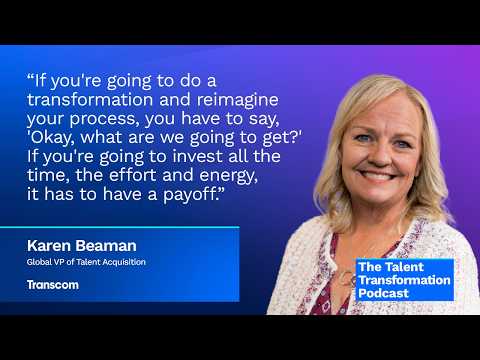
No, I mean, you have to set goals, right? Yeah. If you’re going to do a transformation and reimagine your process, you have to say, “Okay, what are we going to get?” Like, if you’re going to invest all the time, the effort and energy, it has to have a payoff. And so I knew intuitively that if we could reduce the parts of the process where candidates had to stop and wait for recruiter intervention. In recruiting, I mean, it’s a numbers game, right, when you’re doing high-volume recruiting. And so if you can gain even a percent at each one of those drop-off points, you can have the…
Dimitri Boylan
Impact going to be very good.
Karen Beaman
Exactly. And so that was our goal is have better funnel efficiency. And the thought was the assessment is the biggest dropout point. Right. Because you have an engaged candidate then they have to stop and they have to wait for you to trigger an integration, to send them an email with a link to an assessment of your fancy.
You’re also sending them an SMS with it. And that’s where a lot of people dropped out. And so we really worked hard. This is an area where we pushed into our vision is an engaged candidate can have that assessment delivered to them on screen. So they go directly from the application to the prescreening questions to the assessment. If we don’t have to wait, I think big things will happen.
My big bet was 10% and I felt, “Oh, if we get like eight, I’ll be really happy, but let’s go with ten.” And to see the 72% come in was mind blowing. I knew it would be big. I just didn’t know it would be that big.
Dimitri Boylan
Well, there’s no time like the present and keeping the process moving.
Karen Beaman
Absolutely.
Dimitri Boylan
I guess it took a lot of stress out of them, too, because waiting for an assessment is not an exciting thing for people, for sure.
Karen Beaman
And, you know, is that email with the assessment going to end up in spam is a, you know, they’re going on to the next thing that you next company that has an easier application process, you know, more seamless. And so we knew a seamless experience was going to be really powerful in our space. And it was very good.
Karen Beaman
Yeah.
Dimitri Boylan
Okay. How about feeling? How are people? You know, sometimes digital transformation is a stressful period. Everybody feeling good about it? Are you still in the sales process internally with the ideas and the technology?
Karen Beaman
I think overall, we are out of the pit of despair on the change curve. We were deep in it shortly after implementation. It’s real. Right? You tell people like, we thought we did a pretty good job with change management. We brought people together. We tried to get buy-in, have people be part of the solution. But when it actually happens, it’s jarring. And, we had many calls. I spent several weeks traveling around Europe last year to help stabilize, because people needed to express their feelings. They needed to feel really?
Dimitri Boylan
Well, that’s a good point. I mean, I think they need to get it out.
Karen Beaman
They do.
Dimitri Boylan
You know, “You did this to me, and this is how I feel about it.” And if you don’t let them say it.
Karen Beaman
Right, and we let them say, we let them be very candid, there’s nothing off-limits. Let’s get around this conference room table. Tell us the good, the bad, the ugly. And for a while, I’m like, there was nothing good. It was all the bad and the ugly. But as we sat and listened and they felt heard, we could then step in and be like, “Okay, let us help you. Let us show you how to do this. It’s basically reeducation; we trained you on this. But the proof is when you actually get your hands in the system and start doing it.” So, that took some time. But we started to see we were coming out and I think we’re now to the place where people are like, “Okay, yes, this is okay. This is a good solution. This is helping us.”
Dimitri Boylan
So now the dust is settling and you’re getting into the better part of the story. Do you just leave it alone for a while and let them just get to work? Or do you go back and ask them what else they want?
Karen Beaman
So, I don’t know how to leave anything alone and nor does my team. So, we’re just naturally curious. We’re data junkies. Now we have data insights and stuff that tell us, so just little questions can lead to big findings. We’re now able to really proactively go out there and find things that maybe our local recruiting teams don’t even know would help them.
And so we’re able to identify those things and do innovations and just show them through the system how we can make that process better. We’re also listening to them. We have ways for them to suggest projects to our team to say, “This would help my day.”
We always start with, “What problem are we trying to solve? What is your pain point? How can we help you?” And they come up with some tremendous ideas and things that weren’t originally thought of. They weren’t part of the initial requirements document, right? You know, some of these are like one-off situations that just come up every once in a while. But some are, you know, “Hey, we need a solution for this. There’s got to be a better way.”
And I think when you give people permission to say, “Hey, this is a problem for us,” we’ve built, I think, really good collaboration with our leaders across the globe to say, “We’re here to help you, right? From a global to an IT standpoint, we’re here to serve. Our job is to enable you to do your job. So tell us where you have pain. Tell us where those friction points are.” And so it’s led to some really beautiful innovations and it’s policies.
I mean, we’ve done some really cool things like, you know, we set out to implement an ATS and we realized through the process like all sorts of side benefits. We talk a lot about AI, but there’s also a ton of power and automation. Right? Things that people don’t even think about, we were able to do. Like it wasn’t on our horizon to create digital employee files automatically, but it was a result of how we developed and designed our pre-employment process.
And we’re just like, “Oh, now we’re collecting this information and documents in Avature. What’s next? Where do they need to go? Well, they need to go to HR. How are we going to do that? Well, let’s do it with automation.” We don’t want someone pushing a button, downloading every document and then uploading it somewhere else. So we developed a process through automation to automatically create digital employee files and have the documents moved from Avature to long-term employee file storage so that we could follow whatever the data requirements are for each country.
So those are things we didn’t set out to do, but we did. And they’ve provided a tremendous impact to not just talent acquisition, but to HR and other parts of the organization. And so stuff like that. You know, we always are, you know, like I said, we’re very curious, and we’re always asking what’s next? What can we do?
It’s a continuous improvement model. We’re not kicking back, going “Oh, we implemented okay. We’re done.”
And it’s building trust along the way. The more we can deliver for them, the more trust there is. So the more they open up to where they might need more help and where the system or processes or automation or I can help them deliver. Right? I mean, at the end of the day, we all want the best.
We all want the company and the business to have the people that they need to drive the revenue, to support our clients at the end of the day. So we’re all in the boat together, rowing in the same direction.
Dimitri Boylan
Yeah. In terms of strategy. Okay. The idea, of course, with automation is that you get rid of busy tasks and you spend more time being more strategic. Are you having specific discussions with your team about how you up the strategic alignment, or if you know that the end goal of automation, right, is that some things happen without you having to do anything?
Correct? Okay. And we’ll talk about that because AI is really going to give you a lot more opportunity to have things done that recruiters don’t have to do themselves.
Once you get into Workflow Builder and you start building workflow, you realize that you can really automate a lot of things.
Karen Beaman
There is so much.
Dimitri Boylan
And now the agent actions can be added into the workflows. Right? So that’s going to be, you know, another.
Karen Beaman
Another layer.
Dimitri Boylan
On top, another layer on top of the workflow automation that’s already there. So I think it’s it opens up a lot of yeah possibilities. Yeah.
Karen Beaman
Yeah. Tons of possibilities. Yeah.
Dimitri Boylan
So it’s a good time to be opening up possibilities because the market’s pretty tough out there and it is changing really quickly. So it helps to be agile and be able to, you know, control your digital destiny and build your workflows yourself if you need to and be able to interface I into those processes.
And are you now thinking about, well, what happens as we automate more? Are you talking to your teams about how to how do you be more strategic and what would…
Karen Beaman
Absolutely, absolutely. And that was a big impetus for us to make sure we took the manual, busy work that could be automated… Automate it and let people do the stuff that people are really good at, which is building the human relationship, talking to the candidates, making the strategic hiring decisions, being close to the business so that we understand and what their needs are.
So yeah, that’s been woven through this entire journey that we’ve been on, is making sure that we’re people-led, powered by technology, whether that’s automation or AI, whatever the solution is. But it has to be people first. We’re in the people business.
Dimitri Boylan
Yeah. The relationship with IT. Strong in your company? Separate fiefdoms?
Karen Beaman
So we used to be, when I first joined the company, pretty separate, right? That it was powering the business, the operations, the sales side, our clients. And back then, HR was like kind of its island, and that was the same in almost every company I’ve worked with. But we built a really strategic partnership with our IT organization.
We are connected at the hip. You know, I align with people over there. They support us fully. They’re fully engaged in what we’re doing. They were part of the solution. Right? You can’t do the transformation that we did in a silo. And so I called it kind of like a beautiful marriage that we worked really, really well together.
We were very intentional about the relationship. We’re very collaborative. One of the things that we did upfront is we just defined roles and responsibilities, right? I sat down with my partner in IT and I’m like, “How are we going to do this? Right? How do we want to divide and conquer? We’re not we don’t need to be oppositional with each other. Let’s be collaborative. And so yeah, you’re great at these things. And here’s what we can bring to the table.” And so it’s just been an amazing partnership.
Dimitri Boylan
And how much are you talking to them about artificial intelligence now? And, I mean, everybody’s excited about it. I think that’s kind of obvious, but are you starting to pick the places that you want to deploy at first?
Karen Beaman
Yeah. And I mean, we’re a very AI-forward company. It’s part of what we deliver on. And so we already are using it to assist our employees in being more efficient. You know, whether it’s, you know, taking meeting notes for you, scheduling, things of that nature. So we’ve already infused that to a certain extent. Do we need to do more? Absolutely.
Karen Beaman
There’s a lot of things within Avature Copilot I’m super excited about. Being able to have summaries, you know, where Copilot or any number of tools can come along. That helps save time for a recruiter and gets information into the hands of our hiring managers faster.
Yeah, with more reliable insights. So that’s where I see, especially for leadership and support positions, where we can have a lot of impact and make that process even easier. Suggested interview questions. Right?
Dimitri Boylan
Okay. Yes, yes. Interview questions are huge. And I think also, you know, a lot of times, with our customers, yes, there’s a hiring manager doing an interview with they also have three other people doing interviews or six other people doing interviews. And that can sometimes get into the interview Wild West.
Karen Beaman
And I think it’s also really interesting when you’re, you know, on interview two, three or four from a candidate perspective, you have to think of it as well. If I’m getting asked the same questions by each person I talked to, why not just do it as a group interview, right? A panel interview like it feels like it’s a waste of their time?
Yes, some questions should be asked the same because you are looking for the were they consistent in how they answered? But the sweet spot to me is when each subsequent interview kind of complements. Yes, and it’s finding and building and getting depth, right. “Hey, I know you talked to my colleague about, you know, this project that you did. Tell me more. Tell me what was successful. Tell me where you failed or the things of that nature.” It shows that you’re a collaborative, cohesive team. Right? So I think those types of summaries, especially when you’re going into multiple interviews, can be super powerful for each person who’s part of the process.
Dimitri Boylan
Yeah. And I think that’s where AI is going to help on the ground when they’re doing the interviews. But I think it’s also going to help in the broader analysis of what was what happened in all my interviews.
Karen Beaman
Right, absolutely.
Dimitri Boylan
Because for you, it’s not the interviews. We’re one candidate, it’s all the interviews that are going on across the company. And are they progressive in terms of understanding what people do, or are they sort of wandering around and not really getting to the heart of the matter?
Karen Beaman
They’re walking through the desert in the heat.
Dimitri Boylan
Desert migrant, you know? Yeah, yeah. Wandering in the desert with every candidate. It’s a very expensive.
Karen Beaman
Yes.
Dimitri Boylan
Very expensive thing. Yes. Right. And I think that’s where we’re going to see new data. Right, Because you know you go back many years ago and the big metrics were cost to hire, time to fill. That’s only two. That’s not a lot of data. But effective interviewing, not so effective interviewing. Much more subtle, much more difficult to get your hands around that.
Karen Beaman
Yes.
Dimitri Boylan
So are you seeing like, the AI affect the way you organize your teams yet?
Karen Beaman
Actually not quite yet. Okay. I think in recruiting, right, the last couple of years have been getting the right infrastructure in place that will allow us to do what I now call the fun stuff. Right? First you’ve got to build a foundation, the walls, the roof. We’re there now. So now we’re at a place where we can start looking at how do we take it to the next level?
Right. We went from what we considered… We graded ourselves against our peers in the market. We said we were pretty low in digital capability, and now we’re at the high end of digital capability, and we want to stay there. So we have to always be looking to the future of what’s next. You know, what is the next thing?
And a lot of the AI tools are the next thing. And so it’s inserting them in smart ways. You know, I loved, here at the Avature conference, we talked about starting with the least controversial, right? So start with how do we empower our recruiters to work smarter, and equip them with the tools, whether it’s the interview questions or the summaries, things like that. Those are real, applicable uses of AI that can help us find even more efficiency.
Dimitri Boylan
So, it sounds like you’re in an exciting spot. I’m glad you’ve made it through the implementation and the transformation, and that you’re on a journey that’s got a lot of possibilities.
Karen Beaman
Yeah. And we couldn’t be more excited about, you know, the partnership that we have with Avature. I mean, it’s truly been collaborative. You know, there are things that we’ve come to them and said, we want to do this. And like, well, that’s not standard. And we’re like, we know, but we’re not standard and we need to do this.
And so we’ve come up with some really exciting solutions with the partnership. And that’s the kind of collaboration that we as a company look for in companies that we partner with. And so, you know, we’re excited for the future. We’re excited that you guys keep looking to innovate and are always forward looking.
Dimitri Boylan
Yeah. Well, you know, our customers have some big challenges. So there’s no shortage of work to do. I’m glad to hear that things have gone well. And, you know, I appreciate the relationship that we have. And I think it’s, it’s, you know, the possibilities are really good. There’s a lot of them.
Dimitri Boylan
Yeah. So it is exciting. It’s a good time to be in business. It’s challenging because we have a lot of disruptive forces. But I think that, you know, there’s the groups that really embrace agility. Probably the disruption is probably creating an advantage for them. Yeah. Really. It’s an opportunity to really move ahead and leverage the technology, and become, you know, more competitive.
So, appreciate having you here. Be great to have you back. Thank you so much.
Karen Beaman
Well, thanks for having me, I appreciate it.