Dimitri Boylan
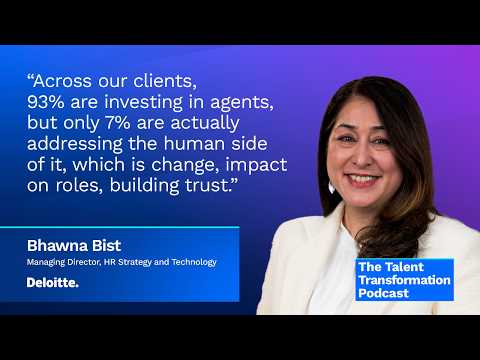
Welcome to another episode of the Talent Transformation podcast. Today, we have Bhawna Bist, Managing Director of HR Strategy and Technology at Deloitte. Welcome.
Bhawna Bist
Thank you, Dimitri. Great to be here today.
Dimitri Boylan
It’s good to have you. So, I wanted to talk to you a little bit about this talent trends report that you just published. And, I think my first question is, did you also co-author the report from the year earlier?
Bhawna Bist
Yes, absolutely.
Dimitri Boylan
Was it more difficult to write this one?
Bhawna Bist
I think it’s more exciting to write this one because a lot is changing and a lot has changed in the last year on the talent acquisition technology front.
Dimitri Boylan
Yeah, it’s been really fast.
Bhawna Bist
It’s been fast. So a lot of innovation and excitement. So it’s been an exciting one. We’ve been publishing this report for the last eight years, and it is specifically to share what’s happening in the TA technology marketplace, but it also provides a very unique perspective we have as consultants who are advising our clients on TA technology strategy, because we bring that perspective of what the TA technology challenges our clients are facing.
What are they prioritizing, and what will make a big impact in terms of the way TA will be delivered through technology? So it’s been eight years and going, and it’s exciting every year. But I must say, there’s been a lot of shift we have seen this year.
Dimitri Boylan
It’s clear that you’re talking about agentics right now. But how much, how relevant do some of the other things remain when you have such a fundamental change happening? What’s your opinion right now about the tech stack of the customer base in general?
Bhawna Bist
I think with a lot of M&A activities, which have happened in the talent acquisition marketplace, there are newer options to put the stack together. I think the TA stack is also something that we see as evolving with our clients. So it’s not static. It’s, I would say, 8 to 10 technologies coming together to deliver the TA experience.
So, there’s always, I would say, some additional, some fine-tuning or some piloting of some technologies that’s always going on with our clients. But, I think the fundamental shift we are seeing is with the M&As, with agentic coming in, which kind of rewires the way you can think about your stack. That’s a big shift. And that’s a lot of our discussions with our clients are around how we should think about TA technology. What stack should we have? What are the possibilities and options to consider, and how can we make those decisions? So absolutely, a top-of-mind conversation and topic for our clients. And I would say both from a functional TA team and also HRIT teams that are focused on TA technology.
Dimitri Boylan
Yeah. Let’s talk about the agentics for a minute because that’s obviously… Maybe this is the year of agentics. Right? So everybody is getting their hands around how to put agents inside of processes… Let’s talk about the change management that you have to do when you start doing that because now you have large organizations, you’re adding a level of automation that is on top of the automation that they’re more used to having. And agents are doing things so that, you know, things are just happening, and nobody’s doing them. The agents are doing them. Right? Are you developing any special stories around change management that deal specifically with this level of automation?
Bhawna Bist
Yes. I would say that is something we’re addressing as a human capital consulting business as well, because outside of talent acquisition, when we think about the workforce and machines working together, what’s the change management required for that? In addition to what we found, and we just published a report and research around this, is that across our clients, 93% are investing in agents, but only 7% are actually addressing the human side of it, which is change, which is impact on roles, building trust with the employee base in terms of adoption for technology.
So I think that’s, I would say, a holistic impact across the organization wherever agents or automation is being infused. But, if I think about talent acquisition, it becomes a key part of the conversation because, many times, the conversation or inquiry starts with what is agentic talent acquisition? What are the use cases? Should we build or buy technology to enable it?
But very quickly, and as a part of our methodology, we would address what is a future state work that is delivered? Which processes? What’s the future state experience that would be delivered? So we are very aligned. Impact on the roles? What is the role of a recruiter or sourcer? What does human and machine working together look like? And therefore, what’s the implication on your operating model that you’re governing digital employees and employees? So it impacts the operating model. But then what’s the change and adoption journey to go with it?
So, it’s much more holistic because the output is that you need to be running to a successful future state. And it’s not just about adding technologies, addressing things that will help you get to the future state.
Dimitri Boylan
It’s not just adding technology, lowering headcount. Somebody does something faster than they used to do it. We’re now talking about a higher level of automation that can move through the organization and do things that couldn’t be done in that time frame before.
And how would you compare what’s going on in talent acquisition with those other areas of the business that you, as a practice, see? I mean, how is TA doing with AI? Let’s put it that way.
Bhawna Bist
So maybe I’ll put the HR lens, scope it out to HR. I see TA as being one of the first areas where our clients go for the adoption of AI or agentic. It just becomes one of the first areas to even proceed. And that’s not only for agentic, but that’s been the case since the time we had AI, RPA, we had Gen AI capabilities being introduced. And now with agentic. I think the nature of work for talent acquisition is that you’re looking and working with a large volume of data. You’re making decisions. The amount of manual work that still goes into talent acquisition is very, very high. The amount of investment in technology from an HR technology standpoint is high, too. And I would say, the amount of innovation, also, that comes in the TA technology marketplace is, I would say, faster than many other areas in HR.
Dimitri Boylan
Yeah. And you’re never satisfied. Because you never have the perfect results. Right. So yes.
Bhawna Bist
And it’s also a very complicated space. I would not think of this as being a simple process. There’s a lot of risk, governance, experience. You’re interacting with hiring managers and candidates, people who are outside the organization. So there’s a huge expectation of experience and your brand. So, it’s a complex space. There’s a lot to be solved. And I think we are doing a lot of studies on agentic within HR, and what are the prime areas that will benefit from agentic? And TA continues to be on top.
Dimitri Boylan
Yes, TA. It makes sense that talent acquisition has been this experimental domain. Okay. There’s a good side to that. There’s a there’s a difficult side to that.
Bhawna Bist
Yes, I think yes. You’re the first one to go and figure it out for the rest of the organization. But I also feel, because TA many times goes first, the amount of, I would say, understanding of the risk around AI, how do you select the right technologies? The TA teams have been on the journey for longer.
Dimitri Boylan
Yeah, we work with companies in the purchasing process and, well, certainly last year and the year before, no guidelines yet published inside the organization about artificial intelligence.
Bhawna Bist
The benefit of being Deloitte is that we have teams that advise on AI governance. So, in case we have a client that does not have policies that are around how do you govern AI, how do you manage AI and the governance council piece of it? So, we do bring in our colleagues in those areas and can provide advisory.
But I think of it both from a client perspective, and as a consulting advisor perspective, it’s a team of folks who have different expertise, like TA technology, risk, governance and AI Council. I think that’s what is needed to kind of arrive at that answer.
Dimitri Boylan
Yeah, exactly. To get the thing off the ground. Let’s talk about that, because getting things off the ground, it’s one thing to read the trends. It’s another thing to experiment a little bit and maybe not go live, or maybe go live in some tiny thing that a large organization doesn’t really notice. But at some point, you’ve got to get these things to work at scale.
I think the key when you’re dealing with these, bringing all these groups together, that I’ve noticed, and maybe you could correct me if I’m wrong, but for us it’s been being very specific on the use cases. Right? To not have it up in the air as a theoretical discussion about AI because that goes south very, very quickly. But to be like, “This is the use case. This is exactly what it’s going to be used for. This is the impact of that. This is the data that goes in. This is the output that comes out.” And if you can walk the rest of the organization through that and you’ve picked high-value-add, low-controversy issues, you pretty much get a green light.
Okay. So you get past that. But now, you’ve got to get these things out to scale inside the organization. What can you tell? What are you seeing there?
Bhawna Bist
I think what really becomes very important is alignment with the leadership in terms of that’s the strategy they want to scale for HR or the rest of the organization. Many times, that’s coming from the HR function. Many times now, with agentic, it’s coming from IT as well. So, I think it’s becoming very interesting in terms of who is sponsoring the broader agentic AI capabilities for the organization.
I think there’s a lot of investment and excitement around it. And as you said, getting initial alignment and proving some pilots and showing some ROI is one part of it. But I think the big question is, how do we scale it? I’ve seen you where, again, it’s a cautious approach where the complexity of some of the agentic use cases, especially if you look at building them, is much higher than what you initially envision. So it’s complicated.
Right now, we have this view that this process will be autonomous. However, there’s so much data and decision-making that goes into it, testing that goes into it to really make it foolproof. There are a lot of scenarios you have to kind of test out. So, I think if you have those built and proven, because I think there is a big question about risk. There’s a big question about are we doing the right thing? What are we accountable for as an organization? Especially if AI is used in decision-making. So I think once you have those, then it becomes a scale-up. And I would say the sponsorship of the leadership becomes very, very important, that it’s the direction you want to go in.
So I would say initial sponsorship, but then also scaling sponsorship; there’s a lot of accountability on the leadership on that.
Dimitri Boylan
Yeah. I see a few areas where companies are struggling. One is the idea that the AI has to be woven in and out of processes, right? It’s not a process in itself. It can’t do the whole process. Humans do some things, agents do some things, humans do some other things, agents do… And it’s a back-and-forth.
Bhawna Bist
Back and forth. Yeah.
Dimitri Boylan
Yeah. And striking that balance is really the architecting of your artificial intelligence strategy right now. You know, when does the machine take over? When does it pass it back to the human? And what is the machine’s capability? And what is the human skill, the capability of that particular person? And right now, we’re sort of putting agents into processes where the human did everything. And you put the agent in, and if you take the human out, but they look at the process, they still know how to do what the agent is doing.
But at some point, you get to a point where, you know, the human knows how to do what the human does, and they don’t know how to do what the agent does. Okay. And that becomes more complicated.
So you could take a recruiter and talent acquisition right now, and they know how to do everything because they’ve had to do everything. But if you’re five years from now, you will have recruiters who actually only know how to do what the human is doing.
How much are you looking into the future with companies? Or maybe you’re not. I mean, it might be reasonable to just look at the present. If enough things are happening at the moment, there’s no reason to get distracted by the future, right?
Bhawna Bist
Now, what you highlighted is a key issue that needs to be resolved down the line. Right? Because think of us, right? When we started using calculators, we forgot about our tables. We don’t have to. And I think the same thing is happening in many ways where we are using AI to assist our, you know, technology to assist in writing, for example.
So, I think if you don’t use a skill enough, that skill does diminish. I don’t think we are there yet when we are talking with our clients about it. I think right now, we are in a scenario where many times you have full-cycle recruiters, and they’re doing everything. But I think what today’s question is, where can we safely bring in technology to assist or augment or automate work? Where does it make sense?
How can we then define governance? Or, I would say a decision-making, which is still human, to overlay, so that we have we can kind of, given the output, what the agents are producing. And then have the human and machine work together. But the point you bring out is a very good one, because I think as that process gets very refined, then we may lose some of the skill sets of actually doing the work. And that may become areas where we’ll have to think about mitigation, or how do we still maintain that legacy knowledge, so that’s part of audit or governance.
But I think that may be challenges we have to solve as an organization across wherever we deploy agents.
Dimitri Boylan
Our customers like your customers. Really big companies. Right? Lots of different systems going on. And, you know, sometimes even in one vertical technical space, they might have like five different systems doing the same thing. Right? Because it was legacy. To what extent are you talking about how agents will work with agents in the future? Is that just too much right now for the customer?
There is a standard protocol by which agents can interact with each other. So we’ve enabled that.
Bhawna Bist
Yeah, I think it is certainly a construct that is discussed, especially if a client is looking at agents across the enterprise, across HR, and they may have already made investments in building agents in certain areas. So I think that architecture discussion is certainly current in terms of how we would connect to agents.
And also, I think the complexity is, a lot of technologies already come with agents. Right? So you may be building some agents, but you may also be turning on agents with the existing technologies and making sure how that would work. I think at an HR-IT level, certainly, that’s a discussion, certainly a discussion at the enterprise level.
So, I don’t think that’s the future. I think that discussion is happening right now. I think where talent acquisition sometimes becomes very different is the depth of AI and agentic in TA, which has already been built into products, is very, very deep.
Dimitri Boylan
I think it’s deeper than in a lot of other types of systems. But I didn’t really research that. Yes to that, because…
Bhawna Bist
I think some of the examples where we’ve taken clients through agentic use cases, journeys, and really try to understand what they want to have the agents do, and then look at a clean slate of build versus buy, a lot of decisions, at least today, have been that what you have in TA is very, very robust and deep and the technologies have managed this data and enabled decision-making for a long time. So, there is a lot of merit in what those agents are bringing. I think as things evolve and as the build side of agents beyond talent acquisition in HR and the broader enterprise architecture for agents evolves, I think we’ll have to see how that has an implication.
Dimitri Boylan
Yeah, it’s to be seen. How much do… Well, I guess if you’re saying that the AI is pretty advanced in the space. What other… If you are a talent acquisition manager and you’re breaking some ground in agents and AI in general in your organization, you’ve got your pilots going, you’ve got a couple of things going at scale around the organization, so you’re feeling pretty good.
Where else do you look inside the organization to see people who are doing things that are similar or interesting to you at this point in time? You know, if you want to look over the shoulder of your comrades, who are they?
Bhawna Bist
I think the two areas that come top of mind for me are learning, which is also being radically, I would say, enabled through agents and agents.
Dimitri Boylan
Learning is.
Bhawna Bist
Learning. So, absolutely, you know, just kind of socializing their learning experiences and how they’re thinking about the use cases and strategy for agents. I think that’s certainly an area where we hear a lot of interest and a lot of willingness to adopt agents. And the other one would also be shared services, where, as an HR shared services function, the agent enablement, and think of…
Dimitri Boylan
Huge impact.
Bhawna Bist
So I think those two areas would be interesting to share lessons learned and see also how those functions are bringing agentic strategies to life.
Dimitri Boylan
We found that gen AI is fantastic in HR case management. It really allows you to not have to open a case for everything that people come to the website for. And it’s really given a new level of… I mean, you always could go to like, “We don’t want to create a case because you could go to this FAQ section and you could read some FAQs,” and everybody’s like, “No, I don’t want to go there, so I’m just going to create my case.” And now you can really have a dialog and smoke out an issue and just give them the answer, which is buried somewhere in the FAQs, which actually might have been might not have been, because you had to create that FAQ system. And it was hard to anticipate what the person who was going to go there was really thinking.
So you had this sort of hard-coded set of responses, and now you have this completely personalized, customized, fully automated response based on information that you have put into the system, but not had to turn into answers to anything. So that’s a game changer. We see that as a complete game changer. And you know, in case management, which it really maps to then being able to provide higher touch because you don’t have to do…
Bhawna Bist
The volume work.
Dimitri Boylan
The grunt work. Where do you see the manual work falling out the fastest in other areas right now? I guess scheduling, right? Talking a lot with our customers about scheduling. We all know that it’s probably better done fully automated, right?
Bhawna Bist
Yes. Though it’s a complex. I would say, you know, you have to manage the experience and scheduling. But yes, if I look at talent acquisition, the key areas where we are seeing a lot of interest, and I would say automation, I think AI’s been there, but automation would be sourcing, a big way. Just the amount of data and access you have to information and how much can that process be enabled through agents. I think that’s, that’s a big area. Sourcing and scheduling, I would say, are two big ones.
We also have a lot of interest from clients who are looking at, you know, autonomous interviewing, especially with the first initial screening interviews. In fact, one of our clients did a pilot, and they did a pilot in Asia, not in the US, for risk and regulatory reasons. But the results they got were phenomenal. And they want to scale it globally now. And interestingly, they found that most of the interviews happened after 10pm.
So it was an eye-opening stat for them on when the candidates actually took the interview. And, it’s actually helped them a lot in terms of refining their slate and finding the candidates. Again, a lot of, I would say, interest in that space, I think, from the TA side. And I’m also actually seeing that from the business side, where the business is demanding that we have better ways to interview and not speak to every candidate. So, I think there’s a lot of appetite, and also just the way we adopt technologies in our daily life, that the question is, can we do this better and faster and be more efficient?
Dimitri Boylan
Yeah, that’s really interesting. And that’s an interesting fact about 10 pm, because that’s new data that you would not have had if you had controlled the process. When you let it get controlled by just the candidate, you discover something new.
In Europe, they’re working their way around the works councils, and what AI means for employment and to the worker, I think the US is kind of in between Europe and Asia in that spectrum. So, that’s something I think managers have to take into account, but they also have to take advantage of that if they can. Because if you can deploy something, get experience, learn something new in a market, well, the learning is great.
Bhawna Bist
It’s great. And I think the advocacy when we’ve seen the output. And we believe this is the right direction. I think it’s helpful. Also, the volume sometimes in the Asian market of candidates is high, so it kind of lends itself well in terms of solving a challenge through technology, but then monitoring the results, seeing the data output. And then I think the buy-in from the rest of the organization is different.
Dimitri Boylan
Yeah, absolutely. Yeah. But I want to stay on that now and pivot just a little bit because you talked about automated interviewing and companies can do that, but candidates can do a little bit of that too. So, let’s just talk about the fraud dimension of artificial intelligence. Artificial intelligence is available to the company, but it’s also available to the consumer. How much time are you spending now talking to customers? We’ve actually started a whole, like, category of conversation with our customers around this because it just came up so many times when we were talking about AI.
Bhawna Bist
We are spending a lot of time on fraud in hiring. I think it’s just surfacing in a big way across our clients. And in fact, across industries as well, as you said, I think fake resumes or very doctored resumes are very common. I think what it’s leading to is a lot of stress on the TA teams and technology because the data that is coming in is not reliable; it’s fabricated. And a lot of technology in TA today looks at that data to match candidates, make decisions, provide some recommendations. So, I think that becomes a big, big challenge in terms of how would you enable technology to support processes to be more efficient when the incoming data is unreliable?
Dimitri Boylan
Right.
Bhawna Bist
So I think the big challenge and the way we are talking about it with our customers and clients is, you know, if they will be more demanded of TA just to process the candidate load you’ll get. But then what are the, I would say, points in the journey that fraud needs to be detected?
And we have client conversations where they are even thinking of radical approaches. And that will keep getting more and more prevalent in the future. But I think it goes beyond that. It goes beyond just resumé data. It’s also the assistance candidates can get through the interview process, be it through technology.
We’ve had some cases come up recently around deepfakes where deepfake candidates were actually offered, and they went through the entire process when that person was not real. Right? So, there is a different level of, I would say, scrutiny required, which was not required earlier. So you did have background checks. You were doing some checks and balances, but identity checks as a part of the recruiting process are becoming more and more important. And I think a lot of technologies are also bringing in those features in terms of eye detection, if you’re looking at a different screen and talking. How can we bring in identity checks early in the process? So, I think that is a part of how you think about the TA process now.
Dimitri Boylan
Yeah, I think it’s a fluid battlefield. And so, there’s no doubt in my mind that, over time, part of talent acquisition’s job will just be authenticity, you know what I mean? And the processes may be automated, but then there’ll be some level of analysis and oversight that is done to find the outliers that are the problem issues and then how to deal with those issues. So right there, you have sort of like, a slightly shifting, you know, job description in TA.
So yeah, but I do think that there’s a big difference as a software designer as us and as you, as an advisor talking about something like how to automate scheduling is very different than talking about how to be on the vanguard of fraud detection because your candidates have artificial intelligence and you have artificial intelligence, and you’re people that are doing the fraud may not be just, you know, Joe Blow with AI. So, it could go all the way from very simple things to extremely sophisticated stuff.
Bhawna Bist
In fact, there have been cases where some government agencies had stage actors being hired. So it’s a big risk in terms of, once you have a high-end employee, the access to data and information they have. So I absolutely agree with you in terms of what functions, you know, and realities today versus what’s demanded of that function will dramatically change.
In fact, we have an analysis in terms of how we see the pyramid shifting in terms of the nature of work that is done in TA. And so right now, about 10 to 20% might be strategic decision-making. As a function or at the req level. But then, a lot of time for TA is actually spent on the operational work of interview scheduling, making offers. Right? That’s where 70% of the work is done.
But with the automation and technology that is available, that pyramid is really flipping, where 70% of the time would be in strategic areas and 30%, the rest of the work would be automated, which you are looking at and managing the outputs.
But what does that shift mean? It does mean things like governance, making sure you have the right quality of hire. Because you’ve because a lot of automation is happening, but at the end of the day, if you’re not getting the right hire, it doesn’t make any sense. Right? It’s about managing, I would say, as you said, fraud in hiring, making sure you are detecting the right places, which will help you protect if you have the right hire.
It is also going a bit beyond what your traditional boundaries of TA have been. So, traditionally, things like workforce planning, things like other areas of talent development, which may be outside of, to like you’re not buying talent, but you have to build a long-term pipeline working with schools and colleges to hire that talent in the long run, TA did not have the capacity to do those things.
But from a business perspective, the business is really looking at TA as a primary engine to bring talent in. Right? So I think those areas of expansion, be it better connectivity with forecasting and planning, workforce planning, long-term pipeline building, which may be leading to a future buy strategy, more connectivity with the rest of the functions, like onboarding and learning. So, there is a lot of strategic value in those expansions. But traditionally, TA has been very siloed because there’s so much to do.
Dimitri Boylan
To be siloed and trapped in things. Yes, now going to get away from which is really going to open up the door for TA.
Bhawna Bist
Absolutely. And I think it adds the value that the business really demands from the function. Right. And so far, it’s been like, we have so much to do. And now there is a big enablement, and it changes the roles of recruiters of TA leaders in the organization in terms of what’s expected of them, which to me is a very different level of, I would say, ownership in terms of how you’re bringing in the talent and you’re managing the risk for the organization. So, it’s exciting. I think it’s a big opportunity. But it requires a shift in the way you think about talent acquisition.
Dimitri Boylan
It does. Yes. For you, the person managing it and for the organization that you are in and how they’re looking at you. And I think that the responsibility, to a certain extent, on TA leadership is to make sure that they’re making the case, making this clear to the people around them, because I think you can wait for other people to really define how your role is changed. That’s a very risky thing.
I think you need to be in there and say, “Look, we’re going to be getting rid of these things and we’re going to be focusing on these other things, and this is why this is going to be good for you and good for you and good for you. And we’re going to take on some of these security/ authenticity issues, because we have the bandwidth to put human to human to figure out if it’s a human that we didn’t have before.” And I think that case has to be made strongly and the time is now.
Bhawna Bist
It also means that you’re working with different parts of your organization. You may need to start working with your cyber and risk team and looking at what are the identity/governance authentication mechanisms they’re using and how you can bring them into talent acquisition. So, it does require you to spread a bit outside your traditional.
Dimitri Boylan
Your little box.
Bhawna Bist
Your box.
Dimitri Boylan
It needs to get bigger.
Bhawna Bist
I think it is very risky to stay in that box. It’s very important for you to kind of look at the holistic shift. And then look at where those teams’ capabilities exist where you need to partner in order to, kind of, really meet the needs of the business.
Dimitri Boylan
Yeah, I think so. I really enjoyed the conversation. I think we really covered some interesting topics. I would love to have you come back. I’d love to hear how these movements from pilot to production are happening around the world. I think that people are really interested in seeing what’s happening there. We’re sort of on the dawn of the deployment.
Like I said, we’re out of this hype phase. We’re into the phase where people are really doing things. So, you know, I think you have a great perspective on that. Love to have you back to talk about that again. Thank you so much.
Bhawna Bist
Would be happy to and thank you for having me here today.
Dimitri Boylan
It was a pleasure.
Bhawna Bist
Thank you.