


Summary
At Jack Henry, internal mobility became a priority in response to two interconnected challenges.
Firstly, associates were clear about what they wanted. Survey data showed that mobility and growth opportunities mattered to them. However, limited visibility into relevant roles, combined with restrictive mobility policies, meant opportunity felt both hidden and out of reach, pushing some individuals to start looking elsewhere.
Secondly, the external market wasn’t getting any easier. A tight talent landscape made internal mobility as much a practical challenge as an organizational one for Jack Henry: if they could make movement easier, they could fill more roles with qualified, culturally aligned associates already in the business, often faster and more cost-effective than starting an external search.
But the barrier wasn’t intent, it was structure: A two-year in-role requirement, recruiting workflows that didn’t reliably surface internal candidates and mobility that, when it happened, often stayed within the same product line.
Jack Henry responded with a deliberate sequence: remove the structural barrier, reduce day-to-day friction, then scale what would make the experience feel real and personal at launch. The result: the rate of internal mobility nearly doubled over three years, and—excluding entry-level roles—about 40 percent of positions are now filled internally.
When Mobility Matters, Friction Gets Loud
The signal came through clearly: associates wanted growth, and they wanted to find it inside Jack Henry.
But the experience didn’t meet expectations. A two-year in-role requirement made “later” feel like “never” for many employees. Even highly capable people could do the right work, deliver results and still be ineligible to explore their next step.
At the same time, the mechanics of recruiting worked against internal movement. Recruiters couldn’t consistently see internal talent in the flow of work. Internal candidates blended into the same lists, the same queues, the same screens, easy to miss when you’re moving fast.
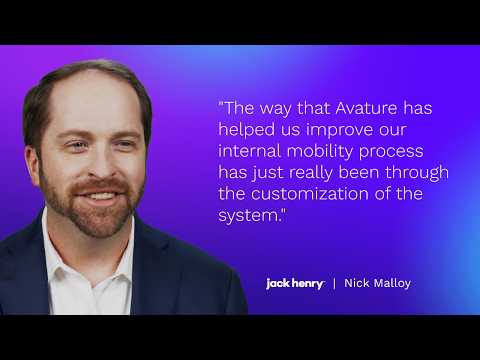
As Nick Malloy, Senior Manager of Talent Acquisition at Jack Henry, puts it:
“We were using a system prior to Avature that really put some limitations on how we could find internal applicants. There wasn’t a way to call them out when you were looking at a list view, (…) so oftentimes we missed candidates.”
This created a dual risk:
- Underutilizing a strong internal talent pool in a market where finding the right external candidate is hard.
- Losing engaged, culturally aligned people when opportunity feels out of reach.
Jack Henry didn’t need more reminders that mobility was important. They required a path that actually worked, and one that associates could trust and recruiters could execute.
Building an Internal Mobility Engine
Jack Henry transformed internal mobility through a two-pronged approach that addressed policy and process head-on, sequenced deliberately so the portal could deliver value as soon as it went live.
First, the team removed the structural barrier, reducing the internal waiting period from two years to six months, aligning policy with the career experience associates were asking for and making internal opportunities more accessible.
Once associates could move, the organization focused on making that movement easier to execute. Jack Henry needed internal candidates to show up clearly and early, so they didn’t get lost.
We’ve been able to put checks and balances in place that show our recruiters where internals are. They’re called out specifically at different steps. We have reports that show where they are and how long they’ve been there, and that’s allowed us to move those candidates through the system faster. And we’re trying to make sure that our internal candidates are seen first.”
Nick Malloy
Senior Manager of Talent Acquisition, Jack Henry
The work became measurable and manageable, not dependent on someone noticing the right name at the right time.
Scale Skills Capture To Power Matching and Recommendations
With the foundation in place, the team moved to the part that makes mobility feel real: helping associates see opportunities they might not have found on their own.
Historically, movement tended to stay within a product line, partly because those paths were familiar and partly because they were the easiest to spot. Jack Henry deliberately chose to widen that lens, wanting the portal to surface roles across product lines and teams based on what an associate could do, not just the job title they happened to hold.
That required a skills-based approach. If the portal could understand an associate’s skills, it could recommend openings beyond the “next logical” move, showing adjacent paths and cross-business options that weren’t visible through traditional career structures.
But that only works if the skills data is there from the start. So Jack Henry treated skills capture as a go-live requirement, running a three-wave opt-in campaign that invited associates to add their skills in Avature. Participation exceeded 70 percent before launch.
To reach the remaining 30 percent—and keep profiles current—they began parsing the resumes of associates who applied after go-live, adding new skills as they emerged. The team used a combination of their own and Avature’s skills ontology, along with AI parsing, to standardize those skills so they could reliably power matching and recommendations.
Results That Changed Both Outcomes and Experience
The impact showed in the numbers. Over three years, the rate of internal mobility nearly doubled, rising from 16 percent to around 30 percent. Excluding entry-level roles, about 40 percent of positions are now filled internally.
It also showed up in the shape of opportunities. Skills-based matching helped associates see roles in other product lines that fit their abilities. As Malloy explained, “Associates who might once have only moved up within one product line can now see jobs in different product lines, expanding what growth can look like.”
On the recruiting side, automation helped remove the quiet delays that stretch internal hiring. With process checks running in the background, internal candidates spent less time waiting between steps. The team estimates it cut up to two weeks off interview timelines, without adding any extra work for associates.
Most importantly, it answered the original signal in the survey. Mobility mattered to associates, and Jack Henry built an experience that made it easier to find a path and easier for the organization to move people through it consistently.
Looking Ahead
Jack Henry is continuing to build on what they started: a transparent internal mobility portal that gives associates a clearer view of how to shape their careers.
The next evolution is to go beyond jobs, adding gigs and stretch assignments, so growth isn’t limited to applying for a new role but also to gaining new skills through short-term opportunities. The result will be a true one-stop shop where associates can shape their own careers without having to look outside the organization.