Dimitri Boylan
Welcome to another episode of the Talent Transformation Podcast. Today, we have Ateesh Roye, the VP of Talent Acquisition at Mantech. Thank you so much for joining me.
Ateesh Roye
Thank you. My pleasure.
Dimitri Boylan
So Ateesh, place Mantech on the map for me. What it does. I know it’s a government contractor, but you’re not building airplanes.
Ateesh Roye
We’re not. I think the easiest way to describe it would be a US federal government contractor that’s involved in the national security and government services space.
Dimitri Boylan
Right. And dealing a fair amount with a cleared type of workforce.
Ateesh Roye
The vast majority of what we do does require clearances.
Dimitri Boylan
Okay.
Ateesh Roye
And experience in the national security space or some very specific…
Dimitri Boylan
And is this the industry you’ve been in for your whole career, or was Mantech the first introduction to this type of it?
Ateesh Roye
It’s not my first introduction to the federal government contracting world. Living in Washington, DC, you have an organic ability to work across multiple industries, right? I’ve been here nearly 30 years, so I’ve spent about half my time in federal contracting and the other half entertaining myself with a whole host of commercial work from startups all the way to Fortune 100-scale companies.
Dimitri Boylan
Oh, okay. So you’ve covered the gamut then.
Ateesh Roye
I have, yeah. And then, for even further entertainment, I spent a good number of years in the RPO space.
Dimitri Boylan
Oh, okay. So that’s a tough space. Let’s talk about Mantech. It’s been more of a fast-growing, I don’t want to say it’s a newer entrant, but it’s been a rising brand in the government contracting space. How does it affect the way you recruit?
Ateesh Roye
That’s an interesting perspective. The company’s been around for 50 years, but you’re 100% right in the sense that as a brand, it’s emerging, right? Particularly in the employment brand aspect of things. Our customers know who we are, have known who we are. Right? The world at large. Maybe not. But here’s an interesting snippet: the vast majority, and I’m saying vast, I mean, like the huge majority of people who land up at our website go straight to our career pages.
If that gives you some sense of what the consumer brand of a company like Mantech is, it isn’t just Mantech; it’s most companies in our space. It really is focused on the employment brand. Right? So it behooves us to understand that the employment brand is powerful and to really activate and amplify it.
And so, in terms of the journey over the last three years, for us, even within recruiting, it really was about focusing on the very top layer of the talent supply chain, which is the candidate attraction, the candidate engagement, before you get to the applicant identification and the rest of the downstream things to do with recruiting.
If we don’t have mindshare with the people that we want to engage with and hire, that’s half the battle lost because, if the first time anybody is really engaging with us is at the point where a job shows up, that becomes a very transactional process.
And that does no company any favors. So for us, the conundrum was, well, how do we move upstream? How do we move mindshare upstream? How do we how do we identify and curate the talent communities that we want to engage with? How do we get them to pay attention to Mantech? How do we share what we are doing with them? How do we differentiate ourselves in the sea of sameness, which is what the industry is, right?
And so, put it this way. Talent acquisition transformation is a pretty major theme. A lot of companies know they want to do it. They don’t necessarily understand what it is.
Dimitri Boylan
Right. It’s classic marketing, actually. Yeah, it is.
Ateesh Roye
It actually absolutely is. The partnership between talent acquisition and marketing and workforce planning and resource management has to be seamless because not only are you marketing to the talent you want to attract. What happens once they show up?
Dimitri Boylan
Do you do you worry since you have a defined population and you can’t do it, fail and then go engage a new population? You have a community that can do this kind of work, and they have a choice of working in 15 different companies, and that’s it. Right? So, do you think about that? Do you think about where our brand is potentially sliding down or where the competition’s brand is trying to respond to our brand and counter that position?
Ateesh Roye
We do. The quality of the engagement is paramount, right? So, you can’t have too many missteps in our industry. Look, if you’ve got a million applicants coming in and you’re hiring 70 to 80,000 of them a year, that’s fine, right? You can afford… You actually need to be broader because you need to appeal to different mindsets and different response patterns amongst your candidate population, with your prospect population.
With us, it’s far more specific. So we do test, we do A-B tests on every single thing that we put out there. Fortunately, we’ve got 10,000 people who can help us do that who are part of that community, right? There are employees of our company today. So my personal choices and level of sophistication on what we put out are different from what we sometimes find the testing tells us we need to put out.
Dimitri Boylan
Yeah. I thoroughly agree with that. Let’s talk about content a little bit, because you have to engage this community and build your brand. And one area where a lot of companies struggle is with the content that they use to engage the community. What do you do? What are you doing in that domain?
Ateesh Roye
You invest the resources it takes to build content. And you, whatever you think you need to build, you build 2 or 3x, right? Look, we are in an age where people consume information in quantities and at a pace that may not organically seem comfortable for those of us who’ve been around for a while longer.
Dimitri Boylan
That’s a very nice way of saying that.
Ateesh Roye
And, so, that requires resources, that requires people. It requires engaging our own teams. It requires infrastructure in terms of having people you can deploy rapidly across the whole company to all our sites and do very quick dynamic video shoots. People who can write really good content and write at scale. And people who can edit and people who can review, whose job it is to do that better than I could.
And then another team that gets to deploy and activate it, which is why we’re here, right? With Avature. Because Avature is a core part of that strategy on how do you activate that brand that you build and that content that you build? And how do you build the curated talent communities to which you want to deploy this content? And, look, there’s no secret to it. You just have to do it.
Dimitri Boylan
You do. But I think that sometimes organizations that are not used to using a marketing approach to CRM are afraid to invest the time and money in the content, and then they struggle because they don’t have the material to communicate, enough material.
It is hard to find the people who do it well.
Ateesh Roye
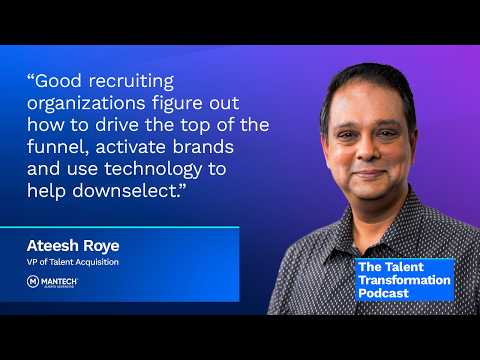
Yes, you’re 100% right. And then the truth is, I’ve worked for years to upskill and to really broaden the perspectives of recruiting teams to understand that, “I want to recruit, I’m a really good recruiter, and I have a great network,” does not scale, right? So there’s a difference between a good recruiter and good recruiting organizations. They’re not mutually exclusive. You do need both. But good recruiting organizations figure out how to drive the top of the funnel. And good recruiting organizations figure out how to activate brands and use technology to help downselect and then have good recruiters to take that gold and turn it into hires. And reacquire the candidates that are good for downstream hiring.
So, all of these things and on and on and on. Right? So there are so many different things that we have to do. Well, but you can’t just work in isolation with just the parts of that process flow that you are most comfortable with. Right? You have to move upstream and downstream. And when I say downstream, you’ve got okay. So you hired somebody. What happens next? How do you engage that new hire to activate those networks to then further feed your end for talent acquisition? Right?
A lot… It’s just going down that rabbit hole. People will sometimes go, “Well, you know, we pay you so much to get your referrals. Send us the best people.” That’s a whole lot different than than having an individual go to that person once they’ve been in the job for a while and hopefully are still in their honeymoon phase, and go, “Who’s the best person at doing X, Y, or Z that you’ve ever worked with?”
Dimitri Boylan
Right? That’s a very different question.
Ateesh Roye
Yes, absolutely. It’s not rocket science. But it’s that level of engagement, so it’s investing in the right things individually and organizationally as recruiters and recruiting that drive success.
And remember the employment brand. Yes, we use it for candidate and prospect attraction, but we also use it to reinforce the choices that our new employees have already made in coming to join us.
Dimitri Boylan
That’s an interesting perspective. Yes.
Well, it certainly helps feed the referral process. But I think that it also helps… Well, you can’t go wrong reinforcing your brand with your employees either. So it’s it’s it’s good to do. But I think it’s also interesting because of what you mentioned earlier, which is that you’re actually using your employees to determine whether or not your messages work on this type of person, which you’re trying to get more of, of course. And I thought that was very interesting.
So, I see how you’ve sort of brought the whole thing full circle there, right? I mean, if you are reinforcing your brand with your own employees and it’s not working, then that brand message is not working. It’s not going to work in the external community either.
Ateesh Roye
It’s exactly right. Yeah.
Dimitri Boylan
So, I think that’s an interesting way of looking at how you manage that brand. Technology obviously is an important part of this because the execution of these things can be complicated, right?
Now, how do you think about the technology and how has your technology vision evolved over the years across all of these different companies? You know, going from the corporates to the RPO to the government contracting?
Ateesh Roye
What is true across every industry is that you have to take control of your earned, owned and paid media orchestration. Look, it isn’t enough to build a brand and build a website and deploy it. That’s the easy button, right?
You brought up the act of creating content. We talked about the importance of a certain quantum of content, which is much larger than we initially think. Then what do you do with deploying it? Right? Do you want to deploy it at large? Yes. But also, there has to be curation, and there has to be variation between what you are communicating with different segments of your population.
So, if you are a huge global 100 company, right? You have people at headquarters who do some very sophisticated things with finance and technology, and you might have individuals who work in warehouses, right? You might have people pulling cables in data centers. Does the same employment brand resonate with all of those populations? Does the same employment brand resonate with somebody who’s involved in full-spectrum cyber operations versus somebody who is deploying, more kinetic things in forward bases? The answer is no. So the thing that you learn is that you have to use technology that enables you to segment, curate…
It’s not one large talent community, right? For most companies, unless you are involved in a very narrow space of work, you have multiple talent communities within your organization that you need to hire for and that you need to nurture. So, for us, it’s always been about how do you curate that overarching talent community into segments and how do you deploy different content and different engagement methods with those talent communities?
So, for certain, it’s not just A/B testing about how people resonate with the content. It’s also about A, B, C, D testing against what platforms work right? But the first thing that you have to do is you have to build the technology platforms and customize them and configure them to the point where you can do what you need to activate your business goals.
The second thing that you have to do is use your technology platform. And we don’t talk about this too often, but underlying all of this is building a robust and sophisticated data and analytics infrastructure as you could possibly need.
And you were leading in your question into things that might fall traditionally into the job distribution spectrum of things, which most companies have figured out how to do SEM, search engine marketing, things like that. All right. Well, not all of that’s created equal either. So, if you’re looking for a robust way to handle your budgets for how you use SEO and SEM, would you just deploy the dollars based on what the platforms tell you your average CPA and CPH should be?
Dimitri Boylan
Yeah. That’s meaningless, maybe.
Ateesh Roye
Right? So instead. Here’s a construct. Figure out who you hire, in what geographies you hire them, and what skill sets you hire for. Create those buckets and then analyze which ones of those combinations receive organic traffic to your own owned and earned properties directly. And then figure out where you have difficulty securing your own organic channels of applicant flow. That’s what you take to SEO and SEM.
And then the next layer of sophistication is to analyze how many people you need against your acquisition in order to get to your target goals, which is typically, “I need X candidates to hire in Y days in this geography-skill intersection.” So your SEO and SEM operations should be targeted at driving that top number of applicants against that requisition as quickly as you possibly can to get to that outcome.
And then as soon as you get to that top level, you probably should be shutting off the flow against that requisition and moving on to the next requisition. So this layer upon layer upon layer of sophistication around how….
Dimitri Boylan
How you operate.
Ateesh Roye
How you have to use your data and your analytics to drive your decisions on something as seemingly not granular as SEM budgets. Right? So it underpins everything. It’s exactly the way data underpins how you build and deploy your employment brand.
Dimitri Boylan
And really how you develop your own treasure trove of data that means something important to you? Clearly, that is something you want to grow over time so that your decisions get better and better. Some companies are just starting to collect that kind of data. What’s the advice you’d give to companies that are just…
I mean, you’ve been doing this for a while. You’ve obviously honed a lot of this marketing dimension, top-of-funnel stuff. For a group that is just starting to think of top of the funnel in a proactive way, where do they start? What do you think the starting point is? Not the nth level of sophistication where… We kind of got into the deep stuff. Let’s go way out for a minute and say, “You’re going to start doing this.” What do you do first?
Ateesh Roye
Just start. That’s the hardest step to take, right? So, and it sounds really cliched, but it isn’t because what I found, having worked with all the organizations I have, is that it seems overwhelming. And there are a dozen reasons why you don’t have the resources to build that level of people analytics, or you don’t have the ability to invest in content. So let’s just buy a system and say we have a CRM, and then default to you know what everybody does: distribute hot jobs every week. You know, so the question isn’t necessarily what you do. It’s what you stop doing.
Dimitri Boylan
Well yeah. Absolutely. You have to stop doing some other things to do it.
Ateesh Roye
Right. And what that means is you’ve got to stop thinking of recruiting in the traditional sense that I need recruiters to transact my requisitions into hires. You’ve got to start thinking about the organization’s responsibility as far upstream as taking control and owning and building and improving and deploying a brand that’s attractive to your prospects and your candidates. And the minute you start, and you have that argument and in my role as a leader, right? It’s to go out and advocate for that vision and to get the company to put resources behind it, right? That’s how you start.
Dimitri Boylan
What’s next for you? You’ve got a well-run top-of-funnel operation. How are you tying the things that you do at the top of the funnel with the results that are happening on the offer and acceptance side of the process? How much does what happens there affect how you adjust the top of the funnel?
Ateesh Roye
I think you’ve figured out that we build and consume metrics at pretty aggressive rates within my organization. So, we measure everything. We measure time to everything, not just time to fill, time to hire. We will measure how long it takes between a requisition opening and the first viable candidate being submitted.
We measure how long it takes to get to an SLA slate of X candidates for a certain type of job, and then we measure how quickly we act through each step stage of the recruiting process. So, when you start talking about outcomes, the top of the funnel isn’t necessarily divorced from what happens in the recruiting process, but if you start measuring it that way, and if you kind of flip the script on how you look at outcomes. So, a lot of organizations look at average time to X as a core metric, right? Averages and notoriously difficult to justify statistically because what you actually have is a bell curve. Right? And you can have a left-skewed bell curve where you have high availability, low skill recruiting needs. So you can have a massively right-skewed one where it takes a lot longer, but the average doesn’t tell the story.
Dimitri Boylan
It’s hard to take action against the average.
Ateesh Roye
Right? So, for example, you have to use a different construct. The RPO business does this well, by the way, where they kind of look at this and go, “Okay, how long does it take for me to get to 80% of my hires? What’s my time to fill for 80%? Eighty percent in how many days?” Fill, hire, submit, whatever those metrics are.
All of a sudden, when you do it that way, you start addressing the big drivers of how much noise there is in your system, right? Because if you’re filling 80% of your positions faster this year than you did last year, you’re demonstrably improving your outcomes in ways that are meaningful to your organization.
And if you’re smart, you can drive that metric into a productivity gain for your company. Right? Because it is really at the end of the day, you, as recruiting, are in the revenue line nd if you can demonstrate how much of a positive impact you’re making to your company on the basis of those outcomes that you drive, all of a sudden, the investment that you need to have in order to drive the top of the funnel becomes a lot easier to go talk to a CFO about.
Dimitri Boylan
Yes. And in your business, which is a people business, that connection to revenue is a little easier to draw than with some of our customers.
Ateesh Roye
So, really, the thought process there is to figure out what’s important to the business and draw the line between that and what we in recruiting do to support that business and try to articulate what the link is.
Dimitri Boylan
I think the important thing to talk about there is that it’s very important that the manager of the recruiting organization does that. I don’t think that’s something that is done for them.
Ateesh Roye
Yes. Personally speaking, you’re exactly right.
Dimitri Boylan
Yeah. So I think they had to be prepared to do that. And it’s a project. It takes work to put that whole construct together.
Ateesh Roye
You got to get the math thing straight.
Dimitri Boylan
Yes. And it takes support from various parts of the organization to do that. So, that’s interesting. We were talking about the top of the funnel, but this is sort of like another dimension completely. Right? But if you don’t get that done, you don’t get that content and you don’t get those marketing people into your recruiting organization, you know?
Ateesh Roye
And this is what outcomes matter as a recruiting leader: the outcome that matters is how much you can invest in this stuff to do all this really cool, interesting work that we should be doing in a modernized, transformed recruiting environment, progressive recruiting environment. So, those are the outcomes that matter. Ultimately, what you can invest in to support the company and what the company does is what really matters.
Dimitri Boylan
Right. What’s what’s next for you? What are you working on now?
Ateesh Roye
So I started in talent acquisition. I work across the entire talent spectrum right now. Right. So, understanding organically that it doesn’t end when you have a new hire on board, but then it’s working with that individual and re-recruiting them while they’re in the company for their next job and the next job and the next job, all the way up to executive leadership if you do it right, it’s to retain the talent that you’ve hired. Right?
Dimitri Boylan
Well, particularly true for you. Your business is growing quite a bit, actually, Mantech’s been growing quite a bit, and you have a limited supply. I guess you want to hold onto just about everybody that’s.
Ateesh Roye
You want to control your supply chain before they show up at your door. And once they…
Dimitri Boylan
Once they’re in.
Ateesh Roye
Once they’re in the house as well. Absolutely. So, you’re exactly right. So, what we’ve taken, what I personally am really enjoying and having a lot of fun with, is looking at talent as an entire continuum that involves workforce planning, management and career progression for every single person within the organization. Understanding what our current skills topology is, what our future demand topology is, comparing those two, understanding what the skills gap is, and then figuring out how do you organically grow talent within the company through learning and development channels versus what do you need to acquire six, 12, 18 months down the road, right, in order to sustain that growth that you were speaking of. And then with talent acquisition being one pillar…
Dimitri Boylan
Of the.
Ateesh Roye
To fulfill your demand. So, understanding your demand spectrum and understanding the supply side, not just in terms of external acquisition. But melding it all together in an intelligent and sustainable way has been, is where my what you.
Dimitri Boylan
And that’s what you’re thinking now?
Ateesh Roye
That’s where my focus has been.
Dimitri Boylan
Yeah. We call that the total talent framework. And I think that is the most difficult area for talent acquisition leaders because, very often, it’s not in their domain. Right? So they’re one of the pillars. But if the workforce planning, I see the workforce planning kind of at the top, you know, you’re bringing maybe you need people from the outside, maybe it’s an internal mobility answer to part of the equation. Maybe it’s a learning/learn first, then internal mobility. Or it’s an independent contractor for six months until there’s co-learning, co-experience and then transitioning to… And that whole mix is sort of…
Often, TA leadership just gets handed the, “Go get me the people.” And sometimes that’s not even doable completely. Right? There actually aren’t enough people that do… That will be available. So you’ve kind of moved into the whole talent picture. And so that is exciting. There are a lot of things to be done there. And, I look at what you’re doing there and I see it being the same thing: segmenting, communicating, understanding the skill sets of people, understanding where the gaps are between people. Are you early in that journey, or have you been on that for a while inside Mantech?
Ateesh Roye
Mantech’s been on that journey in some way, shape or form forever. Now we organize differently, obviously, as times change. And yeah, the need to evolve is constant. For example, we take every single person within the organization, and we organize them into talent hubs. Sounds a lot like segmented talent communities for your prospects, doesn’t it?
And then we communicate with them, we give them opportunities to engage with each other, we create opportunities for people to learn from what they’re doing in different parts of our business.
Dimitri Boylan
I like that talent hub idea.
Ateesh Roye
To flow through innovations in one part of the business to other parts of the business, to do that organically, not just top down at right. You know, you are the solution architect, so you need to do this. No, we open that up to every single person in the company. Right? Talent hubs of thousands of people, and we give them the platforms to go do this. So, you see how that fits right within that, so there’s a consistency to how you think about talent and how you activate that talent, right, both in the acquisition and the nurturing side of the house. So that’s…
Dimitri Boylan
I really like that idea of talent hubs. And I like the idea of activating talent at the right time, the talent activated for the right tasks. Really, that drives performance.
Ateesh Roye
What it also does is it builds organic connections between people who normally, being in disparate parts of the business, wouldn’t necessarily interact with each other so much, and that creates an organic internal mobility.
Dimitri Boylan
Right. Which, of course, we know when people have those kinds of experiences, retention goes way up because that organic feeling of interacting with other people, understanding what they do, understanding what I do, understanding how I can succeed in a company when it’s organic, it feels like it’s owned by them.
Ateesh Roye
Right? And it democratizes everybody’s ability to manage their own career pathways within the company. And that’s powerful.
Dimitri Boylan
Yeah, it is. Very interesting. So, you are doing some fascinating things. I would like to have you back to talk specifically about those things next time. We spend a lot of time on talent acquisition; it’s very interesting, but I think I want to talk to you about the whole talent picture. Again, in the future, if you’d be so willing to join me.
Ateesh Roye
I’d be happy to. And it’s been a pleasure.
Dimitri Boylan
Fantastic. Ateesh, great speaking with you.