


Summary
IBM has set a clear goal: to become the most productive company in the world. Achieving it meant embedding AI and automation end-to-end across the business—not as isolated tools, but as a new way of working. These efforts have already delivered $3.5B in productivity savings across the organization.
For HR and talent acquisition, this vision demanded more than modern technology. It called for a fundamental rethink of processes, operating models and how humans and machines work together at a global scale.
By partnering with Avature, IBM rebuilt its talent acquisition ecosystem from the ground up. The focus was on removing unnecessary complexity, simplifying global processes and creating a foundation that allows AI to be applied responsibly, transparently and at scale. What began as a technology transformation has evolved into a continuous journey, one that positions HR as both an innovation engine and a proving ground for IBM’s broader AI strategy.
The Challenge: Preparing Talent Acquisition for Scale, Speed and AI
IBM’s HR organization reflected the scale and history of the enterprise itself. Recruiting processes were fragmented across 85 countries, supported by multiple disconnected systems. Manual steps slowed hiring, increased risk and made it difficult to deliver a consistent candidate experience.
As IBM’s AI ambitions accelerated, it became clear that talent acquisition was not ready to support the next phase of transformation.
We chose Avature because, from a strategy perspective, we wanted to do different things with making a jump in Gen AI. And to do that, we needed to understand if we had the right platforms in place within our HR ecosystem. And in the case of talent acquisition, the answer was no.”
David Swanz
HR Talent Transformation Practice Leader, IBM
Just as importantly, IBM recognized that automation alone would not solve the problem. Automating inefficient processes would only hardwire complexity.
Instead, the organization adopted a clear transformation philosophy: eliminate what is unnecessary, simplify what remains and only then automate.
Talent acquisition quickly became a priority area. To support IBM’s broader AI strategy, the function needed a platform that could provide open access to data, evolve with new use cases and support responsible AI innovation without locking the business into rigid workflows.
The Solution: A Co-Created Platform for Ethical, Scalable Innovation
When IBM went to market, the goal wasn’t simply to replace technology. The organization was seeking a partner that could support its growth and evolve alongside its strategy, enable experimentation and meet rigorous standards around data, governance and AI ethics.
Avature stood out not only for the flexibility of its platform but also for its philosophy and willingness to co-create, making it possible to rethink what talent acquisition could become.
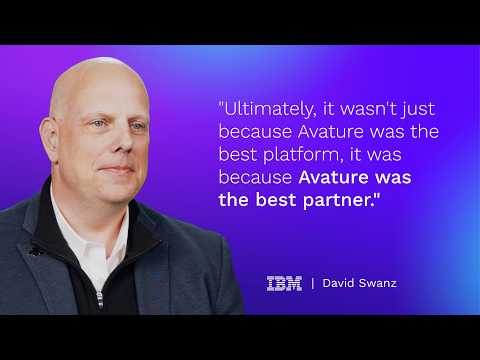
When we selected Avature, we didn’t necessarily focus everything on ‘are you just the best platform’? And you were… But we’re not looking for a supplier. We want a genuine partner who will work with us to help us achieve our outcomes, but also will listen to our feedback.”
Jon Lester
Vice President of HR Technology, Data and Artificial Intelligence, IBM
This mindset shaped the entire transformation. Crucially, this work was never treated as a one-time optimization.
We look at the deployment of Avature as the start of the journey, not the end. We iterate every quarter as our strategy evolves.”
David Swanz
IBM
Simplifying Before Automating: The Offer Letter Turning Point
One of the most defining moments in IBM’s transformation came early on, with something deceptively simple: offer letters.
At the start of the journey, IBM had more than 850 localized offer letter templates in use globally. Replicating that complexity in a new system would have stalled progress before it began. Instead, the teams paused and went back to fundamentals.
Together, IBM and Avature challenged the process itself. The first proposal came back with one offer letter per country, totaling 85, a major improvement, and already a reduction of more than 90 percent. But the conversation didn’t stop there, and the partnership continued to question, “Why not one global offer letter?
There were good reasons why it couldn’t be done—or so it seemed at first. Legal requirements, local practices and historical exceptions all surfaced. But rather than accepting those constraints at face value, the teams worked through them, iterated and evolved the model.
The result was a final set of just 14 global templates.
That massively accelerated our deployment of a system we wanted as quickly as we possibly could because we were building 14, not 850. And that’s a real kind of shift in the way that we operate.”
Jon Lester
Vice President of HR Technology, Data and Artificial Intelligence, IBM
That shift did more than simplify a process. It marked a change in mindset. Technology was no longer the answer by default. Elimination and simplification came first, and automation followed only where it made sense. This moment became a blueprint for how IBM approaches transformation at scale: challenge assumptions, simplify boldly and build for what comes next.
Co-Creating & Adopting Ethical AI
As AI became more deeply embedded in talent acquisition workflows, ethical governance remained non-negotiable. From the outset, IBM was clear that innovation could only move forward if it met the company’s AI Ethics Principles.
Governance is built into the design process itself. New use cases are reviewed, tested and validated before they ever reach production, ensuring transparency, explainability and fairness. This also ensures that AI augments human judgment rather than obscuring it.
AI has to meet our ethics standards. If it doesn’t, we don’t deploy it. Avature works with us to understand those requirements and build responsibly.”
David Swanz
HR Talent Transformation Practice Leader, IBM
This shared commitment has not slowed progress. Instead, it has enabled IBM to move forward with confidence, creating a foundation where experimentation can happen responsibly and at scale.
The Results: Measurable Impact at Global Scale
The impact of IBM’s transformation is visible not only in metrics but also in how talent acquisition operates day-to-day.
By eliminating unnecessary complexity and consolidating technology, IBM has created a recruiting function that is both more efficient and more human. Recruiters spend less time navigating systems and manual steps and more time building relationships and making informed hiring decisions.
Key outcomes include:
- A dramatic reduction in operational complexity, enabling faster, more consistent hiring across markets
- $3.5B in productivity savings delivered across IBM (2023–2024), supported in part by HR-led simplification and automation enabled through Avature
- Eight legacy systems retired, improving data quality and reducing technical debt
- Higher recruiter efficiency, supported by automated scheduling, compliance and workflow orchestration
- 94% HR satisfaction, reflecting a strong focus on experience and usability
Importantly, IBM views these results as a milestone, not an endpoint. With quarterly iterations and continuous learning built into the model, its talent acquisition strategy continues to evolve alongside IBM’s broader productivity ambitions.
Looking Ahead: Building an Agentic, Human-AI Operating Model
With Avature as its foundation, IBM is now focused on the next phase of evolution: redefining how people work alongside AI.
This includes developing new AI ways of working, helping individuals learn how to collaborate effectively with large language models, and rethinking roles and skills as AI agents take on more transactional work.
Rather than following a fixed roadmap, IBM is investing in the capabilities required to experiment, learn and adapt—ensuring that humans remain at the center of an increasingly hybrid operating model, something Lester refers to as the human/AI mix.