Dimitri Boylan
Welcome to another episode of the Talent Transformation Podcast. I’m Dimitri Boylan, your host. And today we’re here with Alberto Rossi. He is the Hachigian Family Professor of Finance at the McDonough School of Business at Georgetown University, and he’s the director of the AI, Analytics and Future of Work Initiative. Alberto, thank you so much for joining us.
Alberto Rossi
My pleasure to be here.
Dimitri Boylan
There are a lot of things I want to talk to you about. But maybe first, you could tell us about the AI Analytics and Future of Work initiative. What is it? And what are you doing there?
Alberto Rossi
Okay. So, very, I mean, there was a couple of years ago, maybe 4 or 5 years ago, the university and the business school realized that there’s this massive trend that was happening, even before ChatGPT came out, that analytics was going to transform the way work is done. So what we did is come up with an initiative that effectively does a few things.
So number one, we have a ton of people at Georgetown, within the business school, outside of business school, that are working on all aspects of trying to understand how AI or technology is affecting the future of work. So we wanted to have an umbrella under which we can have all the research done within the university.
The second aspect is convening rights, which enable us to be an academic institution at the forefront of what is happening, both in academia and in business and society. We wanted to have a way to bring in leaders from the industry and government who would come in and tell us what is happening within the organization.
And then third, the initiative is one way for the university and the business school to change the way we teach.
One of the hard things that is happening within the university system is that universities are very slow at adapting to a new system. And then we need ways to stay very current, or you have changing curricula for students is very challenging for us. The initiative is one way to experiment with new classes, experiment with new methods of instruction.
And so this, a lot of, what we do at the initiative is also trying to see how we should change the way we teach. And, how should we think about the university of the future?
Dimitri Boylan
Okay. So it’s much more than just producing publications. Yeah, it’s actually reshaping the university’s education strategy.
Alberto Rossi
Exactly.
Dimitri Boylan
What do you think? You know, you talked a little bit about the replacement. You know, we’ve moved out of this hype stage of AI. I think you agreed. Yeah. The hype is kind of getting out of the way. Now we’re sort of into this next stage, and, you know, you were talking in your talk to our customer base about this boundary between augmentation and replacement. And maybe we could go into that a little bit because I think that’s interesting.
Alberto Rossi
There are two aspects that I think are very important. Number one, you have that sometimes people are slightly misguided. They think that if the technology comes in and the technology allows a certain employee to be twice as productive, then that will mean that you will need only half of the workforce to complete or to serve a certain market. And then people are going to lose their job.
And that is misguided in the sense that in many cases, and we have seen it a lot of times, is that technology will lower the cost of certain services. And some people before did not, could not afford these services. So you have that by the introduction of technology, you have that automatically; your market has expanded.
I like to always have this sports metaphor. So you had that, take Formula One. I don’t know how many people in the US watch Formula One.
Dimitri Boylan Boylan
It’s growing.
Alberto Rossi
But Formula One, at some point, was becoming boring. Why? Because you had that the rules were not changing. So you had that a certain team had complete dominance for decades or over 6 or 7 years. And then they said, “Okay, what are we going to do? We’re going to change the rules every year.” And then we’re going to level the playing field constantly.
And so I think that, unfortunately, this is what is happening a little bit in business. You have that new technologies are coming up. You have that the level playing field that the field is changing constantly. And this means that you’ve got to stay on your toes, and the Schumpeterian creative destruction that we just talked about has become faster and faster. But this is good. I mean, competition means that we’re going to get better and better and faster and faster at doing things. So I think it’s good. But of course, it’s very painful.
Okay, then there is this other aspect that I think is very interesting in terms of the replacement or non-replacement of the human.
So if I think about 20 years ago, you were going to a new city, you would go to the concierge of your hotel and you ask them, “what restaurant should I go to?” Nowadays, you open, you have OpenTable or whatever app, and you’re going to do it, of course. Will you still have some people that want to get a table at a three Michelin star restaurant? They’re going to go to a concierge, of course. That’s always going to be there. But the number of concierges is going down. Why? Because we are now at the stage where the decision of where you go to dinner is not that consequential. Or you may have a bad meal, but that’s fine. Now, go to the very other end of the spectrum; you have medical services.
Now, how many people would be comfortable having a pure AI bot that prescribes drugs for them and does the physical? Not many. Not many. Some people are, some people are not. And in the middle, you have, for example, financial services. Financial services you have when it comes to financial advice, many people in particular, the ones that are younger, they’re very comfortable with having full-on robo advisor.
Now the moment these people start becoming a little bit wealthier and they’re they are going to want to have a little bit of the human touch, because the considerations they’re going to have are going to be more complicated. So in this case, you have we are still at the phase that some of the known or simple and non-consequential decisions are being automated away.
And we have that instead, the more difficult ones are still… You have the person that delivers the service, now is augmented by AI, but you still have the person in the loop. Now, I think that going forward is going to… We’re going to push the boundary more and more I think. So. I think that eventually we’re going to get to the stage that a lot of the jobs are going to be automated. But once again, human ingenuity is such that new jobs are going to come. I don’t know what they are.
Dimitri Boylan
It’s hard to know.
You ended your presentation with a good quote. And I really like that. Maybe you could just say it again.
Alberto Rossi
Yeah. Basically, that the, the, it’s sometimes the going forward… I mean, the hard part is not adopting the new ideas, which is letting go of the old ones. So this is…
Dimitri Boylan
Yeah, the old ones.. The escape velocity you need from the patterns that you thought were going to give you all the success that you wanted. Well, they’re not anymore. So what are you finding out? I mean, you have business leaders coming in. You have a lot of academic expertise at Georgetown. You’re probably collaborating with a lot of academics in other places.
I mean, are you at such an early stage of understanding the impact, the feedback that you’re getting from the people that you’re bringing in? Is it very useful yet? Or have they just not done enough for you to get the data that you want?
Alberto Rossi
So I think it’s very interesting that you mentioned, because one thing is to implement new tools. One thing is to understand how effective they are at changing the way corporations operate. And so in universities or anytime you do a sort of academic study, you’re always going to be a little bit behind it just because it’s you need to, you need to, you need time, and you need data.
But definitely. So what is happening is that we were going through this hype period where everyone was… I’m old enough that I’ve seen it. When I was at the beginning of the late 90s, every company was an internet company. And then you had that in early 2000s, every company was a big data company.
And then we had that everybody was a blockchain company. And now everyone is an AI company. Truth is, that there are certain applications where, and I think unfortunately, you have that a lot of the applications where AI is effective, are not very sexy. I mean, those are the ones that, you know, the menial tasks, the repetitive tasks, you know, processing a compliance task.
Some of these can actually be very valuable and can be integrated seamlessly into the way you operate it.
Dimitri Boylan
And so the question is, how does that change how people then succeed in doing the things that they do, right? Because you now have this incredibly powerful toolkit available to you. And the way you do business is going to be different.
Alberto Rossi
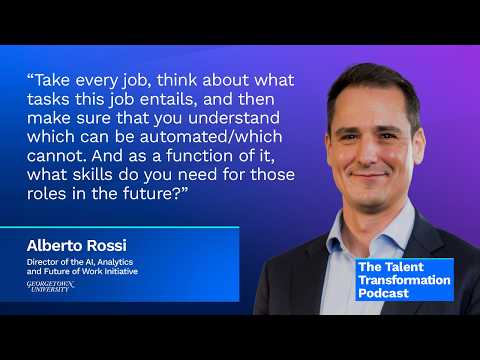
Exactly. I think… So, I think every person within your organization, every organization, the way they should approach it is very simple. I mean, take every job, think about what tasks this job entails, and then make sure that you understand what kind of tasks can be automated, what kind of tasks cannot be automated, and as a function of it, what skills do you need for those roles in the future?
Now, it’s easier said than done, of course, because the problem is that you have this fundamental difficulty whereby you have that sometimes you have that the technological innovation is there, but the technologists don’t understand exactly what is the workflow of the employees. And the employees don’t fully understand what are the capabilities of the technology.
And so it’s very difficult. And the funny part is that every time I see the implementation of a new tech tool or AI tooling in corporations, you can see that if it’s not done well, all it creates is a ton of frustration on the employee side because the employees are like, “I used to have them. My workflow had this and this and this items and it was easy. And now you have removed one piece. And why do you remove?” Just because the technologists didn’t understand that piece was fundamentally important in the workflow.
So, getting together, getting the conversation part, it’s hard. And you know, we try to do it. I think that one of the areas where technology is going to be fundamental… I think that understanding AI tools is fundamentally important for business leaders and for business students because, if you can understand that your corporation is a set of processes and you can understand what processes you… Systematically and sit down and think about what processes can be automated, what can be you can streamline the whole workforce. And yeah, you can also become an entrepreneur much quicker, right?
Dimitri Boylan
So you can. Yeah, absolutely. And so you’re in the business school. Yes actually. So let’s talk about that a little bit. Because the business, the way of doing business… So at Avature, we’ve always had this idea that the next generation business leader was going to be much more technically adept, right? And so they didn’t want to have the technology removed from their fingertips.
They wanted to control it. And this has been a problem in the corporate world for a long time, that the business person kind of knows what they want to do. But then there’s a chain of people that they have to meet and talk to, and then eventually somebody builds something and then it comes back the other direction. Eventually, you get something, and it’s kind of a telephone, right? So, I asked for a banana, but I got an apple.
Alberto Rossi
Yes.
Dimitri Boylan
And so, there’s been a very high frustration there. And it has limited business people’s ability to be effective as more and more business has to be done digitally. But now the digital divide between what the business person wants and what the business person can have is shrinking to almost, well very small. We’ll see how small it can get. So the business person certainly can be more creative. But a lot of business people went to business school and then walked into these very structured environments. And the business school kind of prepared them for that very structured world.
Do you think that business schools are adjusting enough to prepare people for what this new environment is going to be like?
Alberto Rossi
So I think we’re trying. So I think that the one thing that I think the AI revolution is doing is that we’re really worried about is the entry-level employees, you know, because what was happening is this, I think, and you probably know better than me, but you had that we were preparing the students to get into the entry-level roles.
The entry-level roles involved some skills, but some grunt work. And that was the years when people learned to manage people and learned how to take someone else’s product and edit and revise it. And now you’re getting into the stage where you’re thrown out there and you have, effectively, to act like a little manager. Maybe you’re managing some agents that are doing some of the work for you, that are preparing the documents for you, and some people are unprepared. And so the question of, you basically don’t have that part, those periods where you actually were able to learn those skills.
What we’re trying to do is make the learning experience much more entrepreneurial. So what we are trying to do is to encourage having entrepreneurial activities among our students, having them start as entrepreneurs while within universities, have an incubator type of thing.
But I think we need to amplify this because the more we have people that are willing to go out on a limb and try and create something new, the more they are going to have… They are going to gain experience, they are going to have the scar tissue to understand what works and what doesn’t work.
Dimitri Boylan
Yeah. And I think our customer base is primarily very large companies. And I think their license to innovate has gotten clearer over the last decade, at least from a corporate strategy level. They’re being asked to be more entrepreneurial. Whether or not in the machinery of the structure they’re in, it’s so easy to do, that is another story.
One of the things that slowed companies down a lot was the high cost they paid for the technology that they had. You know, they paid an awful lot for it. Okay. And it was very rigid stuff that couldn’t move, and to adjust it was very, very expensive. So they got into this mentality of don’t touch, don’t touch the digital stuff, but let it sit there because we paid $30 million for that thing and to change it and you know, the cost of changing technology today is just it’s in good technology, it’s built into the technology, the ability to change. Right?
Alberto Rossi
Absolutely. Right. Yeah. That’s exactly I think I completely agree. And I think in today’s world in particular, I mean, we see it every day. Right? So you have… You think that we’re going in one direction, but you have to be very willing to pivot. I’ve come to the realization nowadays is that being maybe sounds a little bit cliche, but the ability to pivot, the ability to be agile, the and the ability to be curious is what is going to separate those that are going to be successful.
For that, there are not. I mean, unfortunately, you have that. Some people are fundamentally intrigued by novelties and by new technologies and by new ways of operating their lives. And those people are going to thrive.
Dimitri Boylan
Yeah, well, that’s why new things favor younger people. Quite frankly, because their curiosity engine is usually running at a slightly higher gear. And I think that for a lot of people running organizations, you look at AI and you say, “Oh, I kind of had everything under control. You know, I knew the playing field. I knew where things were going. I had all the experience lined up based on the prior architecture. And now I have to go back. I said to people, “I’m backl to doing homework. You have to go back and do homework now and you need a little bit of curiosity to want to do that.”
Alberto Rossi
One thing that is certainly true is that a lot of the automation is creating, unfortunately, a big bifurcation. Right? So, and this is something that unfortunately we’ve seen before, if you give the internet to people, you’re going to have two reactions.
Some people are going to go on Wikipedia and become extremely knowledgeable. Some people are going to be watching cat videos on YouTube and Instagram, and that’s what it’s going to be. And I think, unfortunately, with AI is happening the same. You have those people that are extremely curious, they’re going to be going down the rabbit hole of figuring out new things, and they’re going to be exploring, and they’re going to be building new, and some other instead are going to be mindlessly wandering around and getting some dopamine hits by cat videos.
And, you know, already have the a lot of those platform like going back to the user experience, I think about Instagram and TikTok. They are designed to give you exactly the right.
Dimitri Boylan
They are designed to give you that. Yeah.
Alberto Rossi
And so from that perspective, I fear that what will happen is that, unfortunately, it’s going to be very difficult for people to for some part, if those people that don’t take the right trajectory and don’t upskill themselves, they going to be a little bit left behind just because they’re going to go into the phase where it’s going to be hard for them to acquire new knowledge, because the brain is not going to be able to do it.
Dimitri Boylan
It’s not gonna be able to do it. Right. And so, in the corporate world, you know, for example, with experience, the corporate world has the employees interacting with the machines and the automation and interacting with the people, the customers, and the other employees. Okay. It also has the employee interacting with the TikToks and the social medias with the rabbit holes that bring you down into a non-reality dopamine hit experience one after the other.
And so corporate customers are trying to get the user experience that is as frictionless as what you have on the consumer side, but they have a really different objective than the consumer commercial systems. Right? One is…Consumer commercial is obsessed with viewing, easy to see advertising. And the other one is to develop your curiosity, develop your skills, advance in the organization, leverage that new technology to then do something of extremely higher value. And that’s a very tough battle to fight.
Alberto Rossi
It’s, I mean, of course, it is extremely difficult because you are basically trying to sell broccoli and chicken to people…
Dimitri Boylan
Who have French fries.
Alberto Rossi
But at the same time, I mean, there is definitely… One thing that I have to say is that there is a lot of learning that can be done from some of the companies that have end consumers. One thing that I think is very important is that the same with video games. A lot of platforms, also even a lot of universities, they are not as good at upskilling their employees because they don’t have personalized journeys. So the way, and video games got it right from the very beginning. So video games were designed in such a way that the first level is extremely easy, and then you level up. So if you meet the person, because…
Dimitri Boylan
At their level.
Alberto Rossi
Exactly. If you have some, if something is challenging enough, but is, if it’s calibrated exactly to your skill level, people are going to find it rewarding. The problem is that it is not that simple to do. It is easier said than done. But I think this is where companies should work with, like they should have a personalized journey for their clients.
Dimitri Boylan
That’s a very good thing for companies to focus on. I want to say, how does the AI and the automation help me to have a personal, direct experience with the employee?
I think the good thing is in the business community is that while that’s a very difficult thing to accomplish, as you have new business leaders come in with their own independent, innovative power, there may be more people trying to solve the problem. And so it’s more likely that the problem gets solved, right? We’re moving into an area now where your digital ideas can be implemented. There’s no excuse. If they fail, they fail because the idea didn’t work, not because you couldn’t get the resources or the execution capability to actually do it. So I think we’re coming into an interesting period like that where, you know, this generation of leadership will be able to find things that were unavailable before.
Alberto Rossi
And I think that deep down, I mean, once again, I have a lot of hope that this technological revolution is going to be what is going to be able to empower employees to be more self-actualized on their job? Yeah, they’re going to find their own journey. And there is. So I want to be a little bit so in a world where we have the productivity increases and in the age of abundance, we are potentially headed towards a world where everyone is going to have access to the goods they like and the heels they need, and they’re going to have a self-actualizing life.
I mean, there’s going to be some changes, structural changes in society that may occur just because you have that. Of course, in a world where you have that, like who shares the benefits of AI, it’s going to be.
Dimitri Boylan
Well, that’s a social issue that hasn’t been addressed yet. And some leaders in the AI world have brought it up as well. Exactly that there is going to have to be a reckoning there. Exactly.
Alberto Rossi
Yeah. So that is a very difficult question that at some point is going to be a social…
Dimitri Boylan
Issue, a social issue. We have some big social issues to take on. But I think from the commercial perspective, the automation is all gears forward and we just move into it and free ourselves of things that took a long time to do. Hopefully, that turns into more high-value interactions among people.
I still think people like people more than machines. Yeah, I always say that we build software. The idea is for the software to sort of become invisible.
Alberto Rossi
It’s funny that you mention it because this is actually one thing that I completely agree with, and I think that this is potentially what is going I mean, it’s already happening, but ambient AI, you know, anything that becomes seamless, everything then becomes extremely natural, the same way ChatGPT was adopted because it’s natural for people to interact with it.
You have that if you have the AI tool is embedded into everything you do, it picks up everything you see properly and so on and so forth. Then it becomes second nature, right? Then it becomes a personal assistant that helps you with everything you do. And of course, we’re not there yet, but we are way ahead of what I thought we would be by now. I mean, you can interact with any sort of conversational AI tool compared to what Alexa used to be three years ago.
Dimitri Boylan
Yes, yes. It’s right. Yeah. So it’s pretty exciting. But, I’d love to have you back as you accumulate more data, because I know that the academic community doesn’t like to say something until they have the data to back it up. A pleasure having you here. I hope to see you again.
Alberto Rossi
Okay. Thank you so much Dimitri.
Dimitri Boylan
Thank you.