Dimitri Boylan
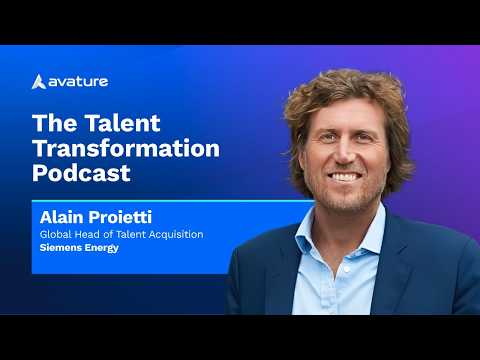
So welcome to another episode of The Talent Transformation Podcast. Today, we have Alaine Proietti, Global Head of Talent Acquisition at Siemens Energy. Alain, thank you so much for joining us.
Alain Proietti
Thank you.
Dimitri Boylan
Pleasure to have you here. Siemens Energy, been around for a long time, but a new company. Maybe you could first cue the audience into the history of Siemens Energy.
Alain Proietti
Yeah. So, it’s been around a long time because it was part of the Siemens group. Now it’s a standalone company, Siemens Energy. It’s a company that was formed a few years ago, and with 97,000 people at the time. So, you start off a company, basically new company, obviously with a strong legacy to Siemens but purely focused on the energy sector. And it’s been a very, very interesting journey in these last few years, especially from a growth perspective, started off with the energy sector starting to really pick up and it’s been a very fun ride so far. And we see that the next few years will also be years of growth.
Dimitri Boylan
That’s a company in it’s first week of operation with 97,000 employees. Right? So obviously, there was a transition year. That’s not a lot of time to get all your ducks in a row operationally. I mean, how hectic was that?
Alain Proietti
I joined three years ago while still a lot of the systems were linked together. We needed to unbundle the systems. And it was a year when you actually create new teams. So it was a TA team, which was newly formed for the energy business. Probably not fit for purpose because the company was growing and we had the recruiters managing req loads of 50 reqs per recruiter, which was way too high. And we weren’t built for growth. So, we have the sector that’s growing, the perception of TA in the business wasn’t the highest because they were inundated by…
Dimitri Boylan
50 reqs per recruiter. You actually never get customer satisfaction.
Alain Proietti
Never get… You’re in escalation mode every single day with inefficient processes because we’d just moved from one company to another. End-to-end processes were relatively broken. I would say it was a burning platform. So, I joined when it was a little bit, the beginning of the journey and we’ve seen a continuous growth year on year.
Dimitri Boylan
And I think you came from pharma, is that right?
Alain Proietti
Yes. I came from another company that went through a massive growth. So I was heading TA at Novo Nordisk, which had that beautiful product that launched and basically sold what we felt or thought was going to sell in a year, we thought we were going to sell this amount in a year, and we sold it in three weeks. So that created a huge backlog. We couldn’t produce as much as the market needed. We didn’t expect it to go viral because it went viral with large stars talking about it. And so we saw huge growth in the whole business, including TA.
Dimitri Boylan
We’re talking about Ozempic.
Alain Proietti
Ozempic. And so that really changed the ways we had to do things in TA. And then I joined Siemens Energy, and it’s going through a similar journey.
Dimitri Boylan
So do you feel, having gone through two of those… And just to be clear that the energy explosion is really being driven now by artificial intelligence, right? And the data centers that are running these GPUs, is that the main reason?
Alain Proietti
It’s a huge driver. We’re using so much more electricity. To run a search on AI takes ten times the electricity of running a search on Google. And so, you know, today you showed some statistics that more and more people are using AI. Imagine the data centers that need to be built.
So, obviously we’re looking at the market growing and we look at the predictions and it’s much bigger. We also realize that, probably, there are not enough people in the sector to meet the demands of the sector. So, you know, again, hiring for skills is super important because we’ll have to go into adjacent industries to hire for talent, so that’s part of the excitement.
Talking about AI, which is super interesting, we as a TA team can’t continuously grow. We need to be more efficient and effective. And we see that obviously technology is going to change a lot the way we do recruitment or how we do it, and then be more efficient and consistent over time.
Dimitri Boylan
So it’s interesting because sometimes people look at AI and say, “Well, that’s great because, you know, I can reduce my workforce maybe by 30% by being more effective,” but you actually need it to just meet the demand.
Alain Proietti
Absolutely, I mean, you can’t continue going to say, “I need another ten recruiters. I need another four recruiters.” It’s not sustainable. Also, because you know that at one point, all companies go through cycles and you don’t want to have a huge team when there isn’t the need.
Dimitri Boylan
Do you feel like having been in Novo Nordisk and then coming into this kind of ground-floor, high-growth, high-pressure scenario a second time, that you are just dealing with it differently? Or do you just feel more comfortable now in that type of thing, or are you a different person having gone through two of these?
Alain Proietti
More comfortable in terms of you’re much quicker at seeing things. So, for example, straight away, workforce planning was super important for us because that is something that makes a difference when, at one point, we were hiring a thousand, opening a thousand positions, 1,200 positions in Denmark every month from 400, a significant… And we weren’t ready for it. We actually hired pretty much all the recruiters in Denmark to work for Novo Nordisk… I’m exaggerating, but more or less, we weren’t ready for it. And the business wasn’t. So it did catch us by surprise. But those were some of the things that you look at, you go into, okay, this is growth.
Let’s have the conversation with the business. “How are we growing? Let’s not have it once a year this conversation. Let’s course correct all the time.” You understand that you have to have a process with no waste. You’re starting to do 20,000 hires a year, it needs to be streamlined as much as possible.
The one thing that you realize is you can’t just copy and paste what you did, because cultures are different. It made me definitely more prepared for the challenges to have lived them. And I knew more quicker where to sort of put my fingers.
Dimitri Boylan
And that quickness is key because the pace is just so high.
Alain Proietti
The pace is very, very high. And the pressure is very high. In the energy sector, you’ve got a lot of projects that you need to deliver on. And every time there’s a delay, there’s a penalty. So you need to hire people. So, the business is demanding and rightly so. And you need to be able to deliver on the demands.
Dimitri Boylan
So, you mentioned before adjacent sectors. Bringing people into the energy sector. What’s the storyline there? Have you developed a really good storyline for that? And where are you finding that kind of talent that you want to get?
Alain Proietti
So obviously, we are big in Germany as an organization. Siemens Energy is very big. The automotive sector in Germany isn’t doing as well at the moment, so this is definitely an adjacency that we’re looking at very keenly, because obviously the market is tight, but you see that there are some sectors that are going through different cycles.
Even in production, blue-collar hiring becomes super important to us. Our manufacturing plants… For example, there’s some wiring that you do in grid technologies that you have to have skills with your hands for the wires and we’re looking at where can we get these skills? And we are trying even in hairdressers because they do plaits because we can’t find…
Dimitri Boylan
Isn’t that interesting?
Alain Proietti
I mean, you try different things. We’re looking at hiring more for skills and getting more applications in. I saw it in some of the speeches today. Everyone’s sort of looking at hiring for skills and thinking about adjacencies and looking to see talent differently. And nobody has the silver bullet, yet. But I think it will be a burning problem for us because the sector’s growing and there aren’t enough people in the sector, so we will have to do something.
Dimitri Boylan
So skills is almost your way of moving into adjacent sectors. It’s the guide. That’s interesting because a lot of people have talked about being a skills-based hiring organization, but I haven’t had too many people who pinpointed something like that and said, “Well, yeah, it’s not just to select better candidates, but to identify markets that we could tap into.” Because, I guess one thing that’s true of all our high-growth customers is they’re usually in a place where they are certainly going to be resource-constrained. I mean, it’s just known at the CEO level, the board level. And you’ve got to be creative.
Alain Proietti
And then internally, we also need to develop people. You move people from different sectors. You need to also prepare to onboard them. And when I mean onboarding, it’s not just your laptop. How do I get them productive as quickly as possible. How do I train them into a different sector? And the organizations need to be ready for that. They need to be able to then integrate different skills in and make them successful.
Dimitri Boylan
Yeah. I think what people are beginning to realize is that the onboarding process for new employees into a role is not very different from the onboarding of an internal mobility person into a role. Right? You have a certain amount of time, you have a certain amount of knowledge, you have gaps to fill and you have a success rate at getting that to happen. And a mechanism to tell you if it’s happened in the time that you need it to happen or not.
And I guess that takes you back to the workforce planning, right? Because, if the answer to everything is, “Find somebody from outside,” it puts a huge burden on talent acquisition.
Alain Proietti
Absolutely.
Dimitri Boylan
So you want to be able to shift some of that to the internal mobility, shift some of that to the training areas. And it’s nice to have a plan for that. Right? So I always say workforce planning, it’s it makes you recruiting more intelligent and ties it together.
So in energy right now, how diverse are the skill sets? I mean, you mentioned people wiring because I guess you’re putting together the wires on the grid.
Alain Proietti
Super diverse at the moment. So, you need to start thinking creatively about different skill sets that you need, you need to attract, retain people. Or not to retain in terms of you say, “Okay, we know that they will stay three years because the market is so buoyant,” but how much…
Dimitri Boylan
Much can you get…
Alain Proietti
In those three years. How do we get the best out of those three years together? Before they’re out in the market. And I think these are the conversations that are a little bit more strategic. What are the skills that we need for the future? Because there’ll be new skills and nobody’s… You know, am I writing job descriptions for jobs that will be obsolete in two years, three years’ time?
Am I hiring for future skills that we need? And these are conversations that I think need to happen a little bit more frequently. And that’s the conversations that you do when you do workforce planning. Also, where is my workforce based? We obviously look for the best low-cost locations. You don’t want everyone in high-cost locations. Do we have the skills in the low-cost locations to do some of the…
Dimitri Boylan
So this is a lot of strategic talent acquisition. How do you take a recruiting organization that’s been, and I’m not saying yours was, but how do you take a recruiting organization that’s been very reactive? You certainly had high… If you have 50 reqs, you don’t discuss any of those things. You don’t think about any of it.
So, you take recruiters that are doing 30, 40, 50 reqs, super reactionary, and you try and transition them into a strategic talent acquisition organization that is saying to the business, “Don’t go to this market because we’ll never find the talent in this market.” So you come up with a new one, or “Let us test three different markets for you and see whether there’s enough talent there to support your business objective.”
So, besides the plan itself, how do you get recruiters upskilled so that they can have those kinds of conversations with hiring managers and with the business?
Alain Proietti
So the first thing we did was we needed to get the right average of reqs per recruiter. And we looked at what skills we were hiring for and what was the good average, and we came up with roughly an average of 25 reqs at any given time per recruiter. And so, we did shift from 50 to 25. And we check that all the time. Obviously, there will be recruiters with blue-collar hiring that can do 100. But on average, we know what they’re touching.
The second thing we did was we segmented the model. Our recruiter was the old 360-recruiter doing from job posting to calling the candidates to speak with the candidates to working. Everything. So we thought, “Okay. Let’s bucket those activities.” So, we split the recruiter role in three. So you have admin. Everything that’s admin is one bucket. Everything that’s sourcing and pipelining is another bucket, and speaking to the candidate and giving good candidate experience, the strategic advisor, the recruiter. And so a couple of things. So we split the role in three. So you have now TA admin. You’ve got sourcers and you’ve got.
Dimitri Boylan
Strategic advisors working with each hiring manager. Figure out exactly what.
Alain Proietti
The hiring manager doesn’t know what’s at the back end. He doesn’t need to know that there’s three people working on the req, but they are highly specialized in what they do. And so, you know, that’s where you also get best practices, how to write job descriptions and so forth. They learn it, they build it in that area.
Our productivity went up with without increasing headcount. We did have to shift the roles and we did need to train everyone in the given specialties. But headcount neutral. Now, recruiters managing 100 reqs a year instead of 65. Productivity: they do 100 because you’re just giving each person an area.
And with the strategic part, we’re telling the recruiters, “Okay, this is what… you go to the meeting with data.” The sourcing team prepares potential candidates for the job descriptions before the intake meeting. So, these are the type of roles. We look at how available those skills are in the area. So the conversation that we have with the hiring manager is already a different conversation right at the beginning.
So, obviously, it takes time. You also have to have the right team size to be able to do that. And obviously, we see this more and more, the evolution of taking everything that’s transactional out of the process and make it automated, predictable and reliable, and investing more in the conversation with the business.
Dimitri Boylan
Let’s pivot off that predictable word. You know, the biggest thing the hiring manager wants is, “Am I going to get what I want when I want it?” And, where are you in the spectrum in terms of being able to forecast filling positions? I mean, is it an objective of yours to be a certain level of good at that?
When do you get to the point where you can say to the managers, “We’re pretty sure this role, this market, this skill, we’re going to deliver it in this certain time?” Do you feel like you’re getting there? I mean, that’s obviously the perfect place to be. It’s hard to be there in evolving markets.
Alain Proietti
So, yes and no. I mean, we have actually created the sourcing team that pipelines all the time. So we know what the skills are. And so, for example, what we try and tend to do is not hire by business area but by job family. All the business areas need engineers, so we have sourcing teams that are pipelining against those roles all the time. And they use silver medalists across the board.
Dimitri Boylan
Oh, good.
Alain Proietti
So it’s like this, “Okay…”
Dimitri Boylan
“You didn’t get that job. But we got another job.”
Alain Proietti
Is there someone else who could use them? So this we try and do and then we have a lot of conversations with the businesses. What are your hiring needs? Are you filling them? At the beginning of the year, we get the workforce plans from them. How much are you going to hire? Where are you going to hire? What are the skills that you need? And then every month we go back and say, “Okay, you’re hiring too fast or you’re hiring too slow. Are you doing this on purpose? Are you front-loading your reqs or was it unexpected? The more you have these conversations, the better planned you get.
When I joined, we were like 50-60% off, some business areas 120% off, by the way. And now it’s pretty much, very close, at least on the quantity of hires they’re going to make. Because we keep going back, “This is your forecast. These are your growth numbers. We know how much attrition you need. We know how many internal moves you’re doing on average. Are you meeting the growth needs?” These are conversations we have pretty much monthly with them, and it’s a painful conversation until it becomes an easy conversation at the beginning, it’s really Excel files with data all over to try and get it all into…
Dimitri Boylan
Something that’s digestible and an actionable plan.
Alain Proietti
And now, it’s proper conversation. And then you bring in the talent attraction team in terms of, “Okay, you’re going to hire in this location. We’re not known as an employer. What are the sort of social…
Dimitri Boylan
You know, different headwinds over here.
Alain Proietti
We need to hire… Three months before to do a campaign on social media because we’re going to hire this amount in three months’ time. So you prepared the market, and this is having… I think that’s where the business is, “Okay. There’s a value here, right? It’s not just transactional.” You do need to be strong in delivering. So your transactions need to be good. Unless you have that, I mean…
Dimitri Boylan
That’s the credibility.
Alain Proietti
That’s the credibility. You don’t have that, then there’s nobody who wants to have the strategic conversation.
Dimitri Boylan
But the conversation is also part of the credibility because managers recognize your methodologies. And when you go in and you start talking about market availability, you start talking about evolving skill sets, usually they tune in and understand those kinds of things, and that conversation with them builds the respect that you need.
Because if they don’t participate in the process, then it gets hard to deliver the service right? And, obviously, you mentioned that you have to get the data together. I think one of the challenges for our customers is how to have the right data available.
The hiring manager says they have a need. How do you find out about that on Monday, and by Wednesday, you’re walking into a meeting with them and you have all the historical data on something similar? “We did these types of jobs for these other managers. This is how long it took to fill them. We did these skill sets. We had to go adjacent to meet these to grow these pipelines. We have these pipelines that have been working for us that are pretty full. Looks like you can draw from some of those.” That all requires data at your fingertips.
Alain Proietti
And preparation and changing the conversation. An example that we had. The energy sector has struggled with diversity among female candidates. Engineering, it’s very you know… It’s typically one of the lower sectors. And we’re trying also to increase females in leadership roles.
And so, you then have to have different conversations, “How do we create a pipeline?” and so forth. But for example, we were looking for a position in the Middle East. And the idea is “Okay, let’s look at diverse candidates,” and we were prepared. We went we looked at all our competitors. We mapped the market and we said, “Okay, in these types of levels in all our competitors, probably two females are available. The ones that level down, these are where they are.” And so it became a different conversation. They were prepared. Is it realistic or is it not realistic? And if it is realistic, then we will have to look at a sort of training or one level down.
Dimitri Boylan
What compromise do we make?
Alain Proietti
So you have to have but that conversation with them or by preparation, by going with data, by giving them real data.
Dimitri Boylan
Let’s talk about the sourcing group because you’ve got the three groups, obviously. And, the one group interfacing with the hiring manager needs to data needs to forecast, needs to build that special relationship. You have the sourcing pipeline building, are you bringing over ideas that you put into play at Novo Nordisk? Are you coming up with new ideas or where do you what’s your maturity level with that, group in that role?
Alain Proietti
So it was something new here and Siemens Energy wasn’t.
Dimitri Boylan
It wasn’t here before.
Alain Proietti
It wasn’t there before. So it’s a new thing. I think it’s it was really… I think it makes a big difference to be prepared rather than post and pray. It’s really about being aware of what you need and then going proactively to find it. And what we felt we needed to do is really map the experiences from a candidate perspective. Again, what are the moments that matter for a candidate and having that team expert in speaking to candidates, knowing what the job positions are, how can I move them to different roles?
Dimitri Boylan
One place to the other.
Alain Proietti
That was really, really important to have them organized where you feel, “Okay. It’s a consistent experience.” You map out the experiences, each touchpoint that a candidate has, it’s sitting in the team that has that expertise. It’s more work behind the scenes because the recruiter needs to have a strong relationship with the…
Dimitri Boylan
Sourcing manager with…
Alain Proietti
So, behind the scenes, it’s not as straightforward. It’s more of sort of… You need to get it humming, and at the beginning there is a lot of…
Dimitri Boylan
You need different processes. You need where processes overlap. You need sort of quasi-service level agreements between the recruiter working with the hiring manager and the sourcer. You need different metrics. You need metrics to show how each group is working with the other. It opens up a lot.
Alain Proietti
It opens a lot. It can open a lot of cans of worms if it’s broken. And ultimately, you don’t want the hiring manager to feel any of this. You want the hiring manager to have the recruiter as their point of contact and not necessarily… They need to know who will manage the req to the end. But it has a huge value. We saw our time to fill go down incredibly because you go to meetings already with candidates that can be used, or they’ve already been interviewed. You know, they were the second best. They hired someone else. This candidate they would have hired if they had another role. Would you be interested?
Dimitri Boylan
You invested in knowing about.
Alain Proietti
And so we’re not wasting this and making sure that the candidates have a good experience and the hiring managers get that value from the beginning, I think it’s definitely valuable to have a dedicated sourcing team.
Dimitri Boylan
The third group is the administration group. So, let’s talk about artificial intelligence. There’s a lot of low-hanging fruit on the administrative side right now that’s becoming available with the agentic workflow, AI-driven scheduling. Where are you on that journey now? And what’s your thinking with the administration?
Alain Proietti
I’m super excited. I mean, I have invited your team to our leadership team meeting to map how do we accelerate the AI journey internally? I’ve seen great things, and I need to translate them into a real, actionable roadmap for Siemens Energy.
Dimitri Boylan
It’s pretty exciting. It’s more exciting than we thought it was going to be. The output is better than we thought it was going to be. And the speed of enabling it is better than we thought because, adding that AI level on top of already well-designed processes, it’s just like gasoline. It’s just an accelerator. It’s amazing. And it’s almost a flick of a switch. It looks to us like there’s a good year to two years of just accelerating the administrative processes. We’ve never looked at anything… We never had anything like that.
Alain Proietti
I agree. I have been many years in recruitment and there hasn’t been such a disruptive change. I mean, if you look at the… The ways of working have been relatively similar for a long time.
Dimitri Boylan
Our whole careers basically.
Alain Proietti
You know, this is an accelerator and, definitely, we’re keen on jumping on it as quickly as possible, especially when you’re in a growth you can’t afford not to. I mean, you really can’t afford not to be implementing all these changes, and I realize that we’ll implement some changes and there will be bigger, bigger changes going forward. But let’s start the journey wherever I can simplify and automate and make the experience more consistent.
Dimitri Boylan
That’s a good point because it really impacts the stuff that we’re doing. We look at it, it really does affect consistency, it’s not just speed. You know, when we did generate questions for the candidates, the AI generates an incredibly robust set of questions based on each type of candidate. And I look at that and I think, “Well, I’ve been asking people questions for 35 years and, on my best day, I could come up with a list like that,” but it would take a fair amount of work. So, I’m kind of surprised at just how good it is. Of course, it’s obviously super fast.
Alain Proietti
And you invest so much time in hiring manager training, interview guides.
Dimitri Boylan
And there you have it. They hit a button, and these are the questions they should ask, and they’re great questions. And the hiring manager gets through the interview, and then you go back and you start doing a data analysis, and you have a consistent sort of way of, a very comprehensive, meaningful and cogent sort of template, almost, that developed organically.
And, if you can just modify and refine that a tiny bit to adjust to your business over like a year or two, so that it just gets 10 percent better and specific to you, you get into a special place.
Alain Proietti
Absolutely. If you think we receive, on average, 125,000 applications a month, how many man-hours do we spend? How many people in time do we spend on writing job descriptions when you have 50 reqs? You get nobody spending time quality checking them, and then you see them online and say, “Who would apply for this role? It’s got internal acronyms, it’s got stuff that nobody externally would understand.” And so I need to create that level of experience, which is much better for a candidate to read the proper job description, consistent. So, if you read one in the US and in Italy, it’s the same touch and feel. Ultimately, you’re taking 20-30 percent time off.
Instead of next time that we are growing, you don’t ask the business for another ten recruiters. You ask for three because you’ve become more sustainable.
Dimitri Boylan
Yeah, it’s exciting. It’s a very interesting time. I know you’ve been in the frying pan for many years. It sounds like you’re still in it, but hopefully with the AI and with the methodologies you’ve developed, you can really get ahead of the pack because that’s what it is, right?
It’s how to get into that winner’s circle when there’s this high level of technology-driven disruption. I’d love to hear from you in the future as you deploy more and more solutions and get deeper and deeper into the development on all three of those categories that you’ve sort of set out.
I really like the way you’ve designed talent acquisition. I think that’s really state-of-the-art. So glad you shared that with us here. Love to have you come back, Alain. It’s been fantastic. Thank you so much.
Alain Proietti
Thank you very much. Thank you, Dimitri.