Dimitri Boylan
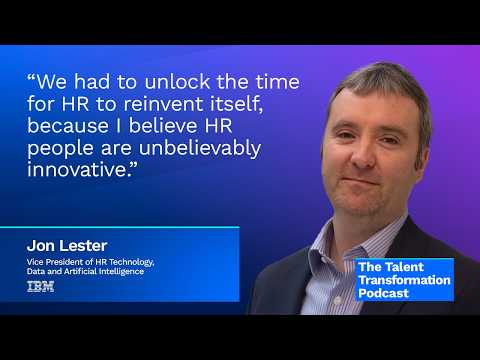
Welcome to another episode of the Talent Transformation Podcast. Today, we have Jon Lester, Vice President of HR Technology, Data and Artificial Intelligence at IBM. Jon, great to have you with us. Looking forward to chatting.
Jon Lester
Yeah, thank you very much for the invite.
Dimitri Boylan
So, Jon, you are doing some pretty interesting things and things at a pretty big scale at IBM, so maybe you could give us a little bit of an idea. I guess two things. First of all, a little bit about what IBM is going through and then a little more on how you’re involved in that and how you’re orchestrating that.
Jon Lester
Yeah. Obviously, IBM is a big technology company. We employ 275,000 people in about 83 countries, but we operate in 170+ countries. And our vision is to be the best hybrid cloud and AI company in the world.
So we’ve got two platforms. One is a hybrid cloud platform through Red Hat. The other is Watson X, which is our AI platform. But more importantly for us, we want to be the catalyst that makes the world work better. We don’t sell products or consult with individual consumers. We’re a B2B organization, so we want to help companies and employees who work for those companies be the most productive people that they can ever be.
Now, a shift we’ve done over the last few years is to say, “What does work better mean? It means being more productive.” And we want to say to other companies, “We’re going to show you how we’ve done this or how we could do this. We’re going to try it.” At the end of 2022, we set ourselves a target to deliver $2 billion worth of productivity in two years. It’s a huge challenge. We’ve never done that.
Dimitri Boylan
Big number.
Jon Lester
Yeah, very much so. I like to say that we failed at that because we actually delivered $3.5 billion in productivity in two years. And this year, with 2025 being the third year, there’s another billion there that we’re putting in. And a big part of what we do, though, is say we almost become client zero for our own story. So we can tell you how we’ve transformed as an organization. We can tell you how, for example, in HR, we’ve transformed. And I’d spend a lot of my time talking to other companies: A: kind of sharing our story, but B: very much learning from them, saying, “how are you becoming more productive? What can we learn from the way you’ve transformed yourselves?” And therefore we can apply it back to ourselves. And that Client Zero story is really kind of starting to resonate now within that, as an HR function.
I sit in HR. I own the HR technology, the data, the AI and the people analytics capability. And I would say what HR wants to do within IBM is be relevant to making IBM the most productive company in the world, to start with ourselves. And I think that’s the work we’ve done. And it’s fundamentally still about solving problems in different ways because technology is evolving every single day, it feels like at the moment. And therefore, to get to those outcomes that we’ve signed up to, like the $2 billion turning into $3.5 billion, focus on the problem, focus on the outcome, and use tech in ways we’ve never done before.
Dimitri Boylan
Nice formula.
Jon Lester
It is. And it also includes things like fail, allow us to fail, allow us to learn. I recently had a big debate with someone who asked, “Is it fail fast and fail cheap or learn fast and learn cheap?” And I kind of actually quite like the learning ones. I like the positive concept.
Dimitri Boylan
It’s positive to the same sequence of events, but with a more positive view of it.
Jon Lester
Yeah.
Dimitri Boylan
Right, because you never completely fail.
Jon Lester
Of course.
Dimitri Boylan
You learn. You learn things that allow you to succeed the next time.
Jon Lester
Yeah. And I think that’s a big part of our culture now. First of all, we had to unlock the time for HR to reinvent itself, because I believe HR people are unbelievably innovative, but you’ve got to give them time to do that. And if you’re too busy being busy, you don’t have time to do that.
Dimitri Boylan
Busy work kills everything.
Jon Lester
Yes. Then invest in your skills because you can’t stand still in today’s world, especially in HR. It’s moving so quickly. And then figure out what it is you want to achieve and go for it. And if you don’t, and sometimes go through PLCs, go through experimentation, learn, and then back to your point at the very beginning, then scale the hell out of it. Yeah, because that’s what we want to do.
Dimitri Boylan
Draw a circle around the scaling. Give me an idea of the scope of the transitions you’re doing.
Jon Lester
There are a couple of easy places to start. One, if we go back to 2016, when we kind of started what we now refer to as our digitization phase for HR, we were a very federated model. We paid the people in 83 countries, but individually, each country had its own HR leader, HR policies, HR processes and HR ways of working. And it was a very federated model. So if our CHRO said, “Let’s do this,” it was almost like, “Yeah, shall we do it? Shall we not do it?”
Dimitri Boylan
Let’s see how it percolates.
Jon Lester
“That doesn’t work for us. We’re too specific,” all that kind of stuff. So we used cloud technology at the time, kind of initial early SaaS movers, as almost the lever to change from federated to global. Get everybody on singular platforms to do different things. So you’ve got good quality data in open API systems, standardize your processes as much as you can, recognizing that payroll time and absence benefits are local by nature. And then take that, try it in one or two countries and then roll it out across everybody.
So we suddenly went from a slow-moving federated model to a very quick-moving top-down model that operated globally but was sometimes experienced locally by our employees. And that was kind of one example where we turned ourselves into a truly global operating model that had speed. And speed is one of the biggest cultural things, DNA, whatever you want to call it, that companies today have to have. Because if you move too slowly and you think about everything and you worry about everything and you try never to fail, all these technologies are moving everything else forward, and you get left behind.
Secondly, another idea of scale was back in 2016. The front door to HR is your HR support model. And you could phone up the help desk, you could email them, you could fill out an HR form online, you could ask your business partner, your manager, your friend, “Where is stuff? Where’s my payslip?” Or, “What’s the sickness benefit? I can’t do this task on our underlying system; I get an error. How do I then get someone to teach me how to do it better or do it for me?” And that front door was 1.6 million tickets for HR support in 2016. That’s a lot of work coming into HR that then percolates through all the different tier models and makes HR really busy, kind of being busy. And we said, “How do we stop that?” Because I genuinely believe HR people are phenomenally innovative if you just give them time to think.
And therefore, what we did was put a very simple AI natural language-based chat capability as the new front door. It was tier zero, and we did two and a half thousand FAQs over time. We initially accessed about 19,000 policy pages and then realized that over half the policy pages hadn’t been updated or visited by anyone in a few years. So we got rid of them. So we simplified the content. We got into 7,000 policy pages. We could link the Ask HR capability, which we call our digital assistant, to the underlying systems through the APIs, and that meant that you can now transact through chat.
Typically, it was three to four times quicker to do a transaction through chat than in any underlying system. And it completely revolutionized the experience. But it got us down, last year, to 407,000 tickets, so a 75% reduction. Our customer satisfaction has gone up as an HR function because people are like, “You guys are helping us be more productive,” back to the earlier kind of point of the conversation.
But what we also did as a huge shift was we put things like feedback capability into that chat, and annually, we would typically have about 40,000 pieces of feedback from IBMers, mostly positive, which is really good. Some had nothing to do with HR, and about 10% were just, “You know what, it didn’t quite give me the right answer.” Or, “Wouldn’t it be good if it could do this as well?” And that feedback was phenomenal because we could start to listen, and IBMers liked the fact that we were listening and fixing their problems. But also, if they allowed us to see who they were, they shared their email address, we’d go and say, “That’s a brilliant idea. Can you work with us to give us more context? Can you help us maybe co-develop it with us?” And IBMers then say, “HR is listening to us.” That’s a really cool thing to do.
And now, as we, I’m sure we’ll talk about as we move to the Gen AI model, it’s a whole different ball game. We launched that in March this year, and Ask HR is now moving to agents rather than assistants. It can still answer those questions, it just does it in a very different way; it generates the answer rather than curated responses. But we now received 140,000 pieces of feedback so far in 2025 because we said to our IBMers, “We’ve never done this before. We don’t quite know what we’re doing. There’s no formula to do this yet. We need your feedback.” And they have just responded brilliantly, partly because they like a challenge. They love the fact that we’re using our own technology on top of other platforms, but also because they know we’ll listen, and that’s a massive shift.
Dimitri Boylan
All of this requires a very good relationship between HR and tech. Let’s speak to that just a little bit. What is your experience there? And is that the key to the success in what you’re talking about?
Jon Lester
It is. So, HR has challenges, has opportunities, has things it could do. Although we believe that tech is not the answer to everything, you start to solve a problem through: build a great experience, simplify work, eliminate work, just make life easier.
An example I always quote is, as we were actually deploying Avature last year, in our legacy recruiting system, we had 850 offer letter templates. And I think your team, who were in the boat rowing with us in all the right directions, were like, “You’ll never get live if you replicate that.” And we’re like, “Okay, let’s go back to talent acquisition and say, we’re not building you that.” And they went, “Okay, don’t worry, leave it with us.” Then went to the individual countries and created one offer letter per country, 83, a 90%+ reduction. Brilliant. And we said to them, “What about one? Why not have one offer letter template?” And they went, “We can’t because we need this, this, this, this and this.” And they kind of listed all the good reasons why you couldn’t have one. So they eventually evolved and designed 14 offer letter templates. And that massively accelerated our deployment of a system we wanted as quickly as we possibly could do because we were building 14, not 850. And that’s a real kind of shift in the way that we operate.
But what we did is we had this concept of my team sits in HR, we are HR-IT sitting in the HR function and capability. We own all the technology spend on HR.
And we then say, “Okay: eliminate, simplify, automate work, use the technology, then upskill and reskill the people in HR doing the work because the work has changed. And then change the culture, change the operating model.” Because we’re now seeing digital assistants, digital twins, and digital agents start to come into the HR workforce. You pull all four levers, and you have transformation.
And when we selected you guys, we didn’t necessarily focus everything on are you just the best platform? And you were, by the way.
Dimitri Boylan
Okay, good, I’ll take it.
Jon Lester
Do you have a vision for AI? Do you have the open APIs, because our biggest issue with our previous providers, we couldn’t get at the data in real time.
Dimitri Boylan
Ah, okay.
Jon Lester
Good-quality data in open platforms means good-quality AI. It’s that simple. It’s non-negotiable. But what we also look for is, within IT, we’ve got a great partnership. But it’s HR that owns the business process. My team is on the product, CIO is on the applications and the platforms. And the fourth partner in this model is the supplier. But we’re not looking for a supplier. We want a genuine partner who will work with us to help us achieve our outcomes, but also will listen to our feedback.
Dimitri Boylan
Do you think it’s a little easier because you’re a tech company?
Jon Lester
Yes and no. So we are a tech company. So I do think that when it comes to things like user adoption, maybe, we perhaps have a benefit in that the vast majority of our workers are what you traditionally call office workers, white-collar workers, right?
Dimitri Boylan
Yes, true.
Jon Lester
They have a laptop, they’re used to doing their work there. I have utmost admiration for some of these huge global distribution companies or retail companies where they’ve got a lot of shop workers or people who don’t work in.
Dimitri Boylan
Yeah, some of our customers are 80% blue-collar.
Jon Lester
Engaging that way. It’s harder. You’ve got to think more.
Dimitri Boylan
Yeah.
Jon Lester
What I would say is HR is still HR. You could probably swap over HR capabilities for any other HR department in the world.
Dimitri Boylan
I think a state-of-the-art HR organization could pop into any environment and deliver success. But there are very few state-of-the-art HR organizations today.
Jon Lester
I would still say that our HR department still does what every HR department does. It’s probably open to risk; it’s open to change. So, yes, I think we are a tech company. We probably get users who might be more tech savvy, more willing to talk to a chatbot than a robot. But HR is still HR, and as you say, that forward-looking, futuristic model of HR, that’s what differentiates.
Dimitri Boylan
Right? The muscular HR when it comes to the future success of the company. The strategic maneuvers that you need to win as the market shifts around. And when HR is able to participate in that and really facilitate that, it’s a completely different organization.
Jon Lester
It is, and it increases our… We’re really interested in our relevance. Is HR relevant to the business? To be the client 0 example for others to follow. There’s a huge shift coming now. We’ve gone through cloud, we’ve gone through traditional AI, we’ve gone through RPA, we’ve gone through AI that has a memory, we call it digital twins. And we’ve evolved better experiences, better engagement, more productive, more efficient, more effective as an organization, more innovative as a company. All these great things we’ve achieved. But gen AI and agents are a whole different world.
Dimitri Boylan
Different. It’s a game.
Jon Lester
It’s like stop, right? Reinvent yourself. Because this is a jump. This is not an evolution anymore. And we’ve been very fortunate in some ways that everything we’ve learned in the last 10 years has gotten us into a great place to be ready for this.
Dimitri Boylan
Well, also, in this dimension, it does help to be a tech company because I’ve been working with a lot of customers to explain AI to other parts of the organization, which is understandable. And you do have a slight advantage there because you have huge AI products. You know, you beat the best chess player in the world back in the day. And so, a long history with AI and a fundamental corporate-level, R&D-level understanding of artificial intelligence. So that is certainly a huge advantage at this point in the game because, I think, for everybody else, for a lot of people, it feels like AI has just hit in the last three years. But for a lot of companies out there and for the people you know in them and in the HR organizations, they’ve yet to do it. They’ve yet to do any of it.
Jon Lester
And some of that’s fear. And I think what we learned, and again, it took us a while, is if you look at the Ask HR chatbot, it was natural language. It would listen to the question, it would say, “Oh, I think you’re asking this question, book a day off, take leave, whatever it may be, and here is a scripted answer, or here’s the policy that will do the response.” HR was in control. We own the policy pages, we own the responses. And we knew that if we got you to the right question, you were guaranteed the right answer. The language that we wrote, we controlled. Gen AI doesn’t do that.
Dimitri Boylan
It’s not like that.
Jon Lester
It’s very scary. It hallucinates. It makes stuff up. You can’t go to Ask HR and say, “What’s maternity leave in the UK or…” It knows I’m in the UK because of single sign-on. And have it respond, “It’s 16 years full pay.” Because that’s clearly not true. But that’s a legal representative of HR telling you you can do this. And if I’m an IBMer in that situation, I take a screenshot, I go to my manager and say, “HR just told me you pay me 16 years full pay. Thank you very much. I’ll see you in a while.” You can’t do that. So, Gen AI, large language models are losing control. You can almost guarantee it. Now we’ve learned how to recognize it.
Dimitri Boylan
Put it in the right place and…
Jon Lester
Put in the right place and not give an answer that we can measure to be a hallucination.
Dimitri Boylan
Exactly.
Jon Lester
We’ve learned how to think about large language models. If you say, “This has happened to me,” they will apologize. But that’s a legal representation of HR. If we’re apologizing to an end user, you can say, “Oh, HR’s just accepted what I said is right.” No investigation, no discussion. It’s now a grievance. And you can’t have a large language model doing that. And you also think about the very early stages of large language models. It used to respond to maybe the wrong questions, hate and profanity questions. So we’ve now adapted a filter that says if you want to do something that is fundamentally wrong, it won’t give you an answer, full stop. We’ll recognize it and say, “Look, perhaps this isn’t a question that I should answer, but maybe you’d like to talk to someone to get help in understanding what the problem really is.”
Dimitri Boylan
I think this is where people are still struggling because you have the consumer Internet experience of the LLM. Okay. And then you have the challenge of getting that level of technology, and I would almost say level of technical power, into the enterprise, working inside the enterprise framework. And you can even see now with the large language models where they’re beginning to focus on some things that probably won’t be priorities for the enterprise, like a big emphasis on the warmth of the answer.
At a consumer level, that’s maybe the big battle in 2026. But that’s not the challenge for the enterprise. So in the enterprise, you look over at the consumer LLM model, and you say, “Okay, they’re sort of diverging from my needs.” And inside the organization you’re thinking, “How do I take that large language model and some combination of other models to create the algorithms that define the experience that I want inside the various business processes that I’m doing and very specific to each business process with very specific context for that particular business process and with the sufficient guardrails so that it stays in the process with the right set of answers?” And this is something that, in the enterprise, people are struggling with.
Jon Lester
I think you talked about the context. It has to have the context. It has to have single sign-on. It has to know that when I go and ask that question, it knows…
Dimitri Boylan
It’s talking to you.
Jon Lester
It’s me, who you are. I live in Liverpool, I’m employed by the UK, I work in HR, I’m a manager, I’m a Vice President. It has to build that picture of me, so when it either sometimes doesn’t allow me to do stuff because I don’t have a particular ability to access that content, or it then can change the process based on who I am and the context of why I’m asking that question or why I do that task. That’s really hard because you’ve got to align individual data.
And again, single sign-on is almost a must nowadays. It has to build that picture of you. You ask the question because things like payroll, time, compensation and benefits are local. If I ask a question in Germany, I’m going to get a different answer for the maternity question than if I do that in the UK or the US or wherever it may be. I can’t give you the wrong answer. And therefore, that contextualization of the business cases, the business processes, enabled through a large language model, is a whole new ball game.
And that’s almost like the prize at the end of the competition, a way to say when we get there and we’re there now, then we can do some really fascinating stuff. Then we can go from what we call digital assistants, which follow a process, to a digital agent, which is task-based, which just gives me an outcome.
Dimitri Boylan
Right. And ideally, what we talk about is you being able to configure the agents in your platform just like you’re configuring your workflow or your data model or your visualization schema for whoever you’re talking to, whenever you’re talking to them. And I think that that’s something that is a good example of the new skills that are needed. People talk about the new skills that you need, and somebody who’s going to be developing a workflow that has AI in it is a higher skill than developing the workflows that don’t have AI.
We have in our user conference a session on prompt management because if you have agentics inside your workflow, you’re going to write these pre-written prompts and, at some point, you have to get good at that. Not everybody’s going to be good at that because you have to have an understanding of how LLMs work, know what models you’ll be pulling.
So, there are a lot of new dimensions that are opening up. I think it sounds like you’re in a very good spot relative to other companies in that sense. It’s pretty impressive where you’ve been. And again, I go back to the scale that you’ve been doing it at. It’s pretty large. What’s the big thing on your list for 2026?
Jon Lester
So I think it’s probably three things. The first one, your summary then was perfect for where we’re going next in a way. So, we are developing what we call an ‘AI ways of working roadmap’ for every single IBMer, starting with HR. That said, here is how you learn how to interact with an LLM, with an agent, how to understand, how to improve the way you individually work, that you are, as an individual, AI-first in the way you think and the way you operate. It’s a very personal thing, and we’ve got a whole kind of 10-step process. We’re building prompt libraries, and we are building training plans that will scale through HR and beyond. So that takes care of the individual.
Then we’ve got this AI-first methodology and mentality around the functions. So we’re going to talent acquisition as a great example. Our talent acquisition team is phenomenal, and we’re going to them and saying, “What if we weren’t a 114-year-old company, what if we were a startup that started up yesterday? How would you design for the future everything to do with TA, as if you were a blank sheet of paper? You had no legacy thinking, no baggage to bring with you.” However, as individuals across your function and your leadership now understand what AI can do, you can build an AI-first model of the future. So, that’s the individual and the functions.
And I think for us it’s then saying, “Okay, how do we now try this stuff? How do we get used to the fact that there is no roadmap for this?” Again, we don’t know what we’re doing, but we’ve got some pretty good ideas of how to try it. We’ll try it, we’ll fail, we’ll experiment, we’ll figure out what works again with you guys as well. Because you’ve got AI, Gen AI, in the box already.
Dimitri Boylan
Yes. And the AI will be talking to the AI. We’ve got the protocol now to leverage.
Jon Lester
I think that is going to be a whole scary, fascinating, exciting new world that we can’t wait to get our hands into. But you have to have the methodologies. You have to have the skills. And the third bit is skills: we’ve been working with AI and skills since 2018. We built a skills inference model, we built a skills scarcity model, we built skills adjacency models for the whole enterprise using traditional AI. So we’ve always recognized the value in a way that AI can bring to skills, possibly more than any other part of the organization.
What we’re now exploring is the idea that this is, as we said, a jump. This is not an evolution of skills. We have a skills ontology, but in the not-too-distant future, we’re going to build agents that won’t eliminate or simplify work; they will remove work from humans. It will do jobs for you as a manager, it will do stuff for you as a candidate, it will do stuff for you as a recruiter, that you actually don’t need the skill in that space because the agent’s doing it. And it’s doing it relatively autonomously. It’s not making decisions about people because of the ethical guardrails, etc., but it’s still doing stuff. And not just simple stuff, but complex stuff.
So, if you look at your whole skills ontology and you say, “Well, maybe there’s a third of it,” and I don’t know the exact number, “but a third of it that humans will never do in the future.” So, A) first create me that skills ontology. These are skills for agents. These are the skills for humans. The humans are going to move from doing a lot of the work through skills to governing an agent doing the work. It’s a different skill set. And they’ll also be the ones who will reinvent their jobs, their work through, “Here’s the skill an agent will do. Here’s a skill I will evolve,” in this concept of a hybrid operating model.
So, as well as a hybrid operating model, we have to somehow create a hybrid skills ontology because we’re investing a lot of money in skills and that’s exactly what we should do. But we therefore have to say, “Let’s invest technology development money into the agent skills and let’s invest the rest into training humans into the skills of the future, not the skills in the past.”
So that hybrid operating model and that hybrid skills ontology are fascinating, and I don’t think anyone’s quite done that yet. And we have to figure out the right partners, etc., to go on this journey with us. And we’ll figure it out between us as usual.
Dimitri Boylan
Jon, you have a lot to do.
Jon Lester
It is. It’s fun. And for me, when you used the word you, I know you meant us.
Dimitri Boylan
Oh, yes.
Jon Lester
Because we have so much we can do together. Us, CIO, HR, and you guys —it doesn’t work without the four of us. And therefore, it’s all the things you want in life is excitement, interest, not quite sure it’s going to work. Friends you can call on when it doesn’t to kind of help you through…
Dimitri Boylan
And progress that you can look back on, “We did it.”
Jon Lester
Yes, we did.
Dimitri Boylan
That sense of satisfaction.
Jon Lester
Yes.
Dimitri Boylan
It would be great to hear from you again in a year to see how some of that 2026 stuff has gone, share that with our audience. I’ll probably know a lot of it as we go along, but I think sharing it is really valuable. Thanks so much for coming here and sharing what you’re doing at IBM with our audience.
Jon Lester
Thank you, appreciate it. Thank you for the invite, and again, thank you for the partnership. Fantastic.
Dimitri Boylan
Thank you.