Dimitri Boylan
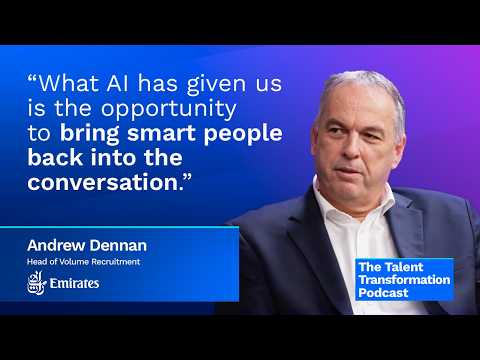
Welcome to another episode of the Talent Transformation Podcast. Today my guest is Andrew Dennan, Head of Volume Recruitment at Emirates. Andrew, how are you?
Andrew Dennan
Very well. I’m living the dream.
Dimitri Boylan
Good. Great to see you. You work for a company with a very strong brand. It certainly helps when large airplanes are flying around with your name on them. Tell me a bit about yourself. How did you end up at Emirates, and what were you doing before that?
Andrew Dennan
I actually had two tracks early on. I started out in the financial markets: trading, derivatives, options. I was a technical analyst. I studied the greats: Elliott Wave, Gann, Fibonacci, and applied those to my trading models. I was one of the early adopters in the early 90s. I began developing software programs for trading in the markets.
Dimitri Boylan
Okay.
Andrew Dennan
I did that for a while, all over the world. Then something happened, and I decided this business was no longer for me. I was looking for a new adventure and ended up in talent acquisition. I love it. I’ve never looked back over the last 20 years. I’ve worked all over the world, from contingent and search to RPO and in-house, but mostly it was about building systems and models to deploy people effectively.
Dimitri Boylan
I find that interesting because, in many conversations, I’ve noticed that people in HR today come from very different backgrounds than they did 20 years ago.
Andrew Dennan
I wouldn’t have been selected back then. They wouldn’t have hired me.
Dimitri Boylan
No, they would have been cautious.
Andrew Dennan
Yes. They were, for a while.
Dimitri Boylan
Yes.
Andrew Dennan
The perspective was different. The human element has always been there, and it’s important to me. But I came in with a very analytical mindset. Everything was categories, and everyone had their own category. We had to see it that way and place people accordingly.
Dimitri Boylan
Interesting.
Andrew Dennan
That scared people.
Dimitri Boylan
Yes, it did. But I think what we’re seeing now in many organizations is the benefit of having HR professionals with diverse experiences and skills who bring new ideas. That’s good for us from a technology perspective, because we don’t define ourselves through performance management, but through agility. And it helps to have people who think differently, who are agile, who try new things. More people are coming into HR from other parts of the business. I think over the last ten years, the idea of talent has evolved. There’s a much stronger link between talent and business success.
Andrew Dennan
Absolutely.
Dimitri Boylan
Compared to 20 or 25 years ago.
Andrew Dennan
I don’t think it was ever really a topic back then.
Dimitri Boylan
Yes.
Andrew Dennan
Projects used to be built around assets and infrastructure. Today, especially in the last ten years, people deliver the outcomes.
Dimitri Boylan
Yes, it’s about people and knowledge.
Andrew Dennan
Exactly. So that concept had to change and be anchored right at the top so HR would be involved. Otherwise, success wouldn’t happen.
Dimitri Boylan
When you decided to go into talent acquisition, what did you tell people? When you arrived and they asked, “Why are you here? Why do you want this job?”
Andrew Dennan
I had spent almost 20 years making money for people I didn’t know. Then something happened that really changed me. I lost someone very young, someone who was just at the beginning of their life. I wanted to do something good.
Dimitri Boylan
It was a life-changing moment.
Andrew Dennan
Yes, it was. I was standing on the tarmac in Kuwait. I was freezing. It was the middle of winter, and the wind was coming from the Euphrates in Iraq. I just thought, “This is no longer the place for me. I need to do something that’s good for my life.” I wanted to work with people. I took what I knew and went into recruiting for financial markets and banks. That’s what I understood.
Dimitri Boylan
Obviously.
Andrew Dennan
Yes. I made the connection between what was needed for growth and build-out, and the people who were there or could potentially be there. That made sense to me.
Dimitri Boylan
Talent acquisition is inherently tied to the business because you’re supporting it in a very strategic way. It helps if you’re a technical recruiter and you’ve worked in a software company before. You understand what managers are going through. You started that journey in talent acquisition. Did you go straight to Emirates, or were you elsewhere first?
Andrew Dennan
I was everywhere. I started in contingent recruiting. Nobody really knew what to do with me. I went to the Middle East into executive search and into the DIFC, just before 2008.
Dimitri Boylan
Right.
Andrew Dennan
So I was working in banking recruitment at a very difficult time.
Dimitri Boylan
Yes.
Andrew Dennan
Then I moved to Abu Dhabi. The government brought me in, within the public sector. I worked across different agencies. If there was a problem, I’d go in, fix it, and hire the people needed. I spent some time in Hong Kong, running a large RPO business across Asia-Pacific.
Dimitri Boylan
Okay.
Andrew Dennan
Then I went back to Abu Dhabi and became a father.
Dimitri Boylan
A lot of Middle East.
Andrew Dennan
I love the Middle East. It’s a great environment. If you’re an entrepreneurial innovator who wants to push boundaries, the Middle East is a place where you can find your space.
Dimitri Boylan
Yes.
Andrew Dennan
During COVID I went back to New Zealand for a while, and then Emirates offered me the opportunity of a lifetime. I couldn’t say no.
Dimitri Boylan
Right.
Andrew Dennan
As you said: an incredible brand, amazing people, and the vision is…
Dimitri Boylan
There’s always something new happening in the Middle East.
Andrew Dennan
And having visionary leaders in talent acquisition right now, people who guide and encourage you like I have, that’s everything. Because that’s what will make the difference over the next ten years.
Dimitri Boylan
Talent acquisition is critical because these aren’t high-population-density regions. You’re effectively pulling people from all over the world. You’re at the intersection of Europe and Asia, and Asia alone is an economic engine. You’re bringing people from everywhere into the Middle East, into Emirates. Your role has evolved, and now you focus specifically on high volume. Tell me about that. What does high volume mean at Emirates? Obviously, you’re not running a retail app.
Andrew Dennan
No. There’s a certain standard we operate at. Customer service and context are part of it. There’s an enormous amount happening, as always when we’re growing. There are operators, ground staff, logistics, and we’re increasing the number of aircraft. We need people, and we need quality. In our daily operations, mistakes are not an option.
Dimitri Boylan
Right.
Andrew Dennan
So quality has to be there. There’s the classic two-out-of-three rule: time, quality, and volume. You can only ever have two. My job is to bring the third closer to the other two. That’s why we work heavily with AI. We’ve been doing that for a while, to improve time to delivery, which also impacts quality.
Dimitri Boylan
Right.
Andrew Dennan
The great thing about Emirates is that the brand attracts people.
Dimitri Boylan
Yes.
Andrew Dennan
We get people. We receive over three million applications a year.
Dimitri Boylan
How many?
Andrew Dennan
Three million.
Dimitri Boylan
Three million applications per year. That’s a lot.
Andrew Dennan
We have to get through them.
Dimitri Boylan
Yes.
Andrew Dennan
Handling that volume is difficult anywhere. You have to be smarter, faster, and you have to understand your business.
Dimitri Boylan
I think high volume is the biggest challenge. You mentioned AI. I believe AI delivers the greatest value in high-volume talent acquisition. That’s where the real opportunity is. We’ve talked about disruption creating opportunities and risks, winners and losers. How do you think about that?
Andrew Dennan
It’s about making the right decisions at the right time. That’s critical. For me, it comes back to data fundamentals. With that volume of applications, what we really have is data. How we analyze it and how we use AI to identify what we need now and in the future gives us a competitive advantage. It’s self-reinforcing. We have to stay at the top. You have to be looking at the next step.
Dimitri Boylan
Yes.
Andrew Dennan
If you’re not already there, you risk never catching up. That’s one of the things that keeps me awake at night. We have to be out in front. We need to use our talent pool correctly and continuously, and make sure data quality is right so we give AI the chance to make the right decisions.
Dimitri Boylan
Better data leads to better predictions.
Andrew Dennan
Absolutely.