Dimitri Boylan
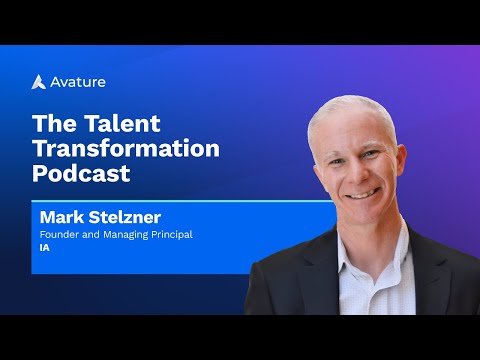
Welcome to another episode of the Talent Transformation podcast. Today, we have Mark Steltzner. He is the founder and managing principal of IA, an HR transformation consultancy and a recognized thought leader in HR technology and transformation. Mark, thanks for joining us.
Mark Stelzner
A pleasure to be here. Thank you.
Dimitri Boylan
Yeah, it’s good to have you. Mark, can you just, tell me a little bit about IA?
Mark Stelzner
Yeah. We really do three things. One is that we help the C-suite of primarily large global 1000 organizations. The average client has 75,000 employees in 70-plus countries. The C-suite struggles with prioritization and resourcing their operating model. Basically, what do we do and in what order of dependencies? And how do we secure the capital, the operating expense, and the opportunity cost to pursue it?
So one distinction in that category is every business case we have ever written has been approved.
Dimitri Boylan
Oh, really good stuff. Okay. That’s a good track record.
Mark Stelzner
The second thing is, once you have your eyes on the prize, how do you deconstruct this amazing provider landscape, yourselves included, to find the best-fit provider? Who’s going to be an accelerant to achieving those objectives? So we run a lot of RFP, but we hate the RFP. We think the RFP is this transactional instrument for a transformational moment.
Dimitri Boylan
Okay, I can buy that. I’m with you on that.
Mark Stelzner
So I hate to cut and paste 3,000 questions. And the answer is no one’s going to read it. I’m all high-value use cases, clients and provider engagement. We do workshops in the middle of the RFP process. We think this walled, procurement-led process is not what’s going to lead to long-term sustainable relationships with an RFP. Yeah. And then in the last probably 8 or 9 years, we really leaned into process optimization, where people own a lot of great tools and technologies.
They have really, really smart resources, but there’s disharmony in their ways of working. So we do very forensic deconstruction of current state processing, reconstruction of future state processes, and then priorities related to projects, programs, initiatives, remediation. How do we improve with intent in the areas where we think we want to win? So that’s all we do. We’re a fiercely independent firm, and we’ve been around for about 19 years.
Dimitri Boylan
Well, that sounds like a lot. I don’t know where to start on that. Let’s, let’s let’s think about that for a minute. So, you know, you’re going into companies that are pretty anxious to do digital transformation. Certainly. Okay. It’s probably true that they’ve already launched some kind of digital transformation when you meet them. Right. Because I don’t think we have a customer, for example, that wouldn’t say that. They are a few years into a digital transformation.
But I think that there still seem to be sort of caught with a lot of systems of questionable value. And they’re also still struggling to sort of understand how that transform mission, what that transformation is supposed to look like. Do you find that you go in and they tell you not only are they in the middle of a transformation, but that they can’t actually describe what their end state is?
Mark Stelzner
I think they have a strong hypothesis, and I think that hypothesis is often shaped by management consulting firms. Lived experience and socialization among their peer group.
Dimitri Boylan
Right.
Mark Stelzner
So there is a sense that HR needs to be leaner, more technically competent, and provide digital assets. I want to come back to this notion of digital transformation. I question whether organizations are truly purpose-built for full digital transformation, but I love to come back to that. So they have a point of view, but I think of it truly as a hypothesis.
We think we have a destination in mind, but it presumes that who we are today is who we’re actually going to be in that projected future. And if we know anything, it’s that organizations are fluid and dynamic, and we can’t really predict what the future state may be. So part of the trick here is to try to project ourselves into some scenarios that represent our future state. And then, based on those scenarios, we can determine whether we’re really professional scenario planners.
Dimitri Boylan
Work backwards.
Mark Stelzner
What’s the best and highest use of teams and resources in order to achieve that? And the reality is, there are endless permutations that cause paralysis. So really it’s about what are the areas in which differentiation is going to cause you to win. Right. Elevate your function to differentiate yourself from your competitors. That’s the hardest work, to be honest with you right up front is getting that level of alignment that sometimes may be disassociated with the original hypothesis.
Dimitri Boylan
Right, right. And that is something that I talk about a lot when I say, you know, you have to find that sustainable competitive advantage and, you know, the challenge for some of my customers is that the landscape in which that they have to affect change is so vast. And they have a lot of technical debt. We call it technical data in technology, software that has to keep running, but it’s not fit for purpose anymore, okay? And then a lot of built-in workarounds. And at the same time, the customers are struggling with what is really available on the market.
Mark Stelzner
That’s right.
Dimitri Boylan
Okay. So, you know, it’s very hard to cut through the hype that comes out of the software industry. Okay. And at the same time, they also have some entrenched power centers inside the organization. That may change rather difficult. So are you mostly. Yeah. And the only time you get free of that is when you’re really up at, you know, the CEO level of the organization, right? Because they can kind of look past all of those things. But everybody below that kind of gets stuck in a lot of that. Do you mostly work with the CEO or do you mostly work with the CHRO?
Mark Stelzner
Our primary entry point is through the CFO, CPO or CTO. Certainly, the CEO is part of the work we do because they have to be. It’s inextricably linked to the destination of the organization. But I’d say sometimes that elevation does a disservice to the reality that the organization itself is facing, meaning you can set an artificial destination that by Q3 of 2025, we would like to achieve the following, but without understanding the projects, programs and initiatives that are subsuming your teams, the actual skills and capabilities of those same teams – so capability versus capacity – the understanding of the means by which one can achieve that future state and the nascent and maybe even hidden capabilities within the investments you’ve already made.
We’re talking about 3D chess in some respects, where you’re trying, and all these pieces are moving around the board at exactly the same time, but sometimes it’s really unclear who’s winning.
Dimitri Boylan
Do you ever just talk about finding the entrepreneurial energy inside the organization?
Mark Stelzner
Yeah, it’s an interesting point. Several years ago and I won’t name the firm we were working with a very, very large, brand. They had spent about $95 million on a transformation of people transformation. They had worked with a formidable and certainly renowned management consultancy, and they were stuck. And the head of transformation asked me to come in and meet with the leadership team and the board. The new CEO sat down at the table. Very large table. CFO’s on her phone. Board members are checking their email.
Dimitri Boylan
The usual.
Mark Stelzner
Yeah, no one’s very present. You’ve probably been in a few of those meetings, but what really got the team’s attention was when I asked the new CEO to define his true north. What is your true north? What is the one thing that when you get lost navigating through the complexities of your job, the imperfect information that you’re working with, etc. that you believe is the true north for you? And then what is that for the organization and how do those match or not match? Is there dissonance potentially between them?
It stopped the room in a really interesting way. Devices down, heads up. And this was his chance, really, as a new CEO. Maybe six weeks in the seat to define something that he inherited. But what was clear is that he had yet to declare his true north and the organization’s true north. And when he did, we now knew what we were moving toward, and we now knew how to cascade that down the organization we now knew whether it was aspirational, inspirational, or factual.
We could then measure progress and restructure the entire program, which is what we did. Within six months, we fired ourselves. What’s really strange about it, and what I’ll tell you about us, is that we want to get out of the way. Our job is to get you started, to teach you methods, and to give you a reflective surface – and I’m serious about this – that you cannot look away from. This is your truth, or this is the version of your truth that you’re currently projecting, is that, in fact, the identity you want? And if it’s not, then it’s beholden upon all of us to change that destination. And I think sometimes what we find is that that elevation in the organization, there is very little truth-telling.
Dimitri Boylan
Yeah. In fact, I would say that. Well, when I think about the entrepreneurial spirit, you know, I find that you know, quite a few of our customers are exhibiting that trait, but they’re inside an organization that’s not responding to it. And, you know, I think about a large organization always from the context of my own environment, okay. And I’ve been an entrepreneur. My whole life. And companies I have created, you know, are smaller companies, obviously. But I been around other, you know, startups and, and entrepreneurial companies, and you can’t, you can’t mandate that behavior. And you can’t…
The best thing about, let’s say a startup is, you know, there’s gonna be a lot of change. Right. Okay. And the people that are driving the change are sworn to change. They’re free to change. Right. Okay. And they’re, they’re, they’re enthusiastic about that freedom. And they have a lot of energy. Okay. And one of the problems I see in the digital transformation is, you know, the CEO doesn’t do it. Right. He’s not doing the transformation. He’s going to he’s going to pass down to all the people what he wants them to do. Okay. But if you have people in the organization that are really eager to change, I see the process is sort of like, how do I get out of the way and let those people do it?
I’m just throwing out a non-top-down approach. Right, okay. Do you think that’s possible?
Mark Stelzner
Certainly. And I find that, particularly in the people function, the sad reality is there are huge swaths of what HR does for a living that aren’t entrepreneurial. They are absolutely table-stakes requirements. And when you put an entrepreneurial-minded individual into an operational function, I’m not saying all HR is like this, but a lot of HR loses that spirit, that sense of experimentation.
They lose that desire to potentially do sprints and fail fast and bring new ideas forward because you’re you’re frankly just you’re burdened. It’s heavy. So how do you rise from that when you’re wearing five or six hats and you know, more hats are coming because the HR is getting smaller and smaller and smaller, and that’s what’s, and I mean this truly, what’s heartbreaking about the people function is HR can’t catch a break and it’s not getting well
Dimitri Boylan
I’ll agree with that. They can’t catch a break. I feel like there’s quite a fair amount of entrepreneurial energy inside of HR.
Mark Stelzner
Certainly.
Dimitri Boylan
Okay. I think that they have a challenge with the C-suite in terms of being able to actually take the actions that they want to execute. That’s my feeling. I’ve talked to lots of people who are running large HR organizations. And I notice it in one area, which is technology because I actually know a lot about technology and kind of know a lot about technology. And I see them struggling with the IT organization. Do you ever you said you came in, to the companies through the CFO, through the, the CTO. Do you come in through the CHRO?
Mark Stelzner
Yeah.
Dimitri Boylan
Okay. So you’re helping them. How do you help them relate to the CEO, the CFO, and the CTO to get what they want done?
Mark Stelzner
Yeah, we have this philosophy. It says our job is to stand next to you. In a perfect world, I’ll stand behind you, but I should never stand in front of you. Everything is storytelling.
Dimitri Boylan
Yeah.
Mark Stelzner
I mean, you’ve navigated a lot of boardrooms and C-suite meetings. It’s storytelling backed up by facts and data, but also with energy and purpose and a sense of something, right? We’re all here to accomplish something. And I find that if unlocked and unleashed, the storytelling capability of the HR and people function is unparalleled.
We have nothing but stories, and we have stories by the way, that every human can relate to. I don’t care where you are in the stack of the organization. We have all been recruited, we have all been onboarded, and we’ve all tried to leverage our benefits programs. We all want to get paid. We all want opportunities to lead and to grow and to develop like we’ve all been there. It’s intrinsically human part.
Part of the challenge, I think, and the rub that I think you’re getting at is there’s a sense that when it comes to technology or digitization, suddenly CPOs or CHROs need to wake up and be technological experts in many are, by the way, just to name it. You don’t need to be. Actually, what you need to understand is the outcomes, the technology can enable for your people. You need to think about use cases. And this is where tech for tech’s sake, you know, leads frankly to the tech you were talking about earlier.
Dimitri Boylan
Yes.
Mark Stelzner
The only reason I take a little bit of a pause with digital transformation is that, let’s face it, huge percentages of the populations of these large, amazing, storied global organizations have no access to technology other than for the purpose of their jobs. If you work in a distribution center, a clean room at a pharmaceutical company, or a manufacturing facility, you have the technology, but that technology is fit for purpose for your role.
But you are often precluded from bringing your own device wage and our concerns, security concerns, frankly, licensing costs where we can’t even provision email addresses or digital environments despite technological capability to do so, there’s a perception that we’re not going to digitally enable a huge percentage of our front line.
And what’s a bit counterintuitive is leveraging the good graces of solutions like yours that are all about digital engagement. And I’m sure you have endless sources of data and research and actual behavioral heuristics that say the world is more digitally enabled than sometimes we give ourselves credit for it.
Dimitri Boylan
Yeah. I mean, I think, you know, what we try to do with our solution is empower the HR organization to be a bigger digital player inside the organization. What I’m going back to with you and I keep doubling back to this is you’re advising the C-suite. Okay. You know, what is it you’re telling the C-suite about HR and what they need to do? Because, hold on a minute. Because, my observation – and I will admit that the HR organization needs to be more confident about its digital capabilities, okay – but I also feel like they have been under-supported by the IT organization. Okay. Which is partly sometimes staring at their own navel. Okay. And dealing with their debt. Which they have a huge amount of.
Okay. The CFO is a little transactional. Okay. HR, remember, is trying to get out of transactional and get into the spiritual, cultural, and softer things that really do drive productivity. Okay. So how do you help a row with a message that is not about we’re going to make a tweak to the benefits system?
Mark Stelzner
I was talking to a CTO just two weeks ago, and we were talking about this exact topic, right? And I said, is this even interesting to you in your organization? Well, that’s.
Dimitri Boylan
A good question for a CTO.
Mark Stelzner
Is this even because you have you’ve got e-commerce and omni channel, like you’ve got a million really cool, super interesting things to work on. And his honest answer is no. It’s no, no, not really. Right. And I said, okay if you could let it go, if you trusted that the people function, could care for themselves.
Dimitri Boylan
Now we’re getting to the big issue.
Mark Stelzner
Right. And you felt it as if certainly when it comes to security, privacy integrations are consumption data, right? There’s some level of oversight and standards. Exactly. Right. How would you feel about that? And his answer is, you know, can we start can we start tomorrow so that.
Dimitri Boylan
That’s an uncommon answer.
Mark Stelzner
But not from a customer, but not from a CTO.
Dimitri Boylan
So sometimes I would argue that’s an uncommon answer. I would argue that of the hundreds of high-level HR people that I talk to, they would be very surprised if they got that answer out of there, because…
Mark Stelzner
Tech wants tech ones completely.
Dimitri Boylan
Let’s, let’s, let’s call it what it is. Right? Right.
Mark Stelzner
But what I’m finding is again, back to this capacity capability debate on that spectrum, that it does not want to put discretionary capacity into areas that are not forward-looking to the organization, that are not certainly revenue-generating, and those that support the enterprise functions, which are critical. Right. This is critical infrastructure that’s necessary. They aren’t looked to necessarily as the next generation of technical thought leadership.
And so if we can cede more capacity to allow just like I’m talking about an HR, there’s really smart, you know.
Dimitri Boylan
People in HR
Mark Stelzner
Highly-minded people in tech and HR who would love to elevate out of the whac-a-mole hole if they could, but we’ve gotten ourselves into the self-fulfilling prophecy where this, this endless discussion of sort of tech versus HR. And I share all of that. Just to say that triad of the CFO, the CTO, the CPO slash CHRO, I am finding closer and closer linkages. And I’m not a generationalist. You know, I’m a I’m a I’m a Gen Xer, but as I’m watching those that frankly Covid ruined their career, they don’t have the energy. It took a personal toll on them. As they move out of the people function, the next generation that’s moving in, I think, senses that the only way for us to achieve balance is for the three parties to govern collectively.
And when I talk about collective governance, I mean it. It’s not about this is mine, this is yours, this is yours. Well, yeah, absolutely. It’s the intersection between and I would challenge anyone that says, no, I own, I own, I own. You’re not going to thrive in the current environment. So these are the real sit-down conversations that we like to build, which are bridges between these functions.
You can’t go it alone. I don’t expect I don’t expect HR to be the best technical function. That’s what a technology organization is for. But I expect you to have a point of view about capability that you’d like to unlock relative to the future.
Dimitri Boylan
I think that the organizations that we work with are having the most success have made a special partnership between HR and technology, and they’ve usually relabeled and redefined it. Okay. because the things that HR needs to do in dealing with people and the technology that you need to deploy to deal with people is a little harder to get your hands around than installing a new finance system. Okay. It’s a little harder than, you know, some other things. And it’s also something that can have trouble competing with a revenue-generating… Because companies do have to think short-term a lot of the time. And if you go into a general IT organization with your idea about how to develop a better culture and how to use technology to do it, you have to compete against them, the project that it’s taking on to, you know, to send, more marketing messages to potential buyers.
Right. Well, it’s pretty clear, right? Okay. That if you’re in that battle, okay, you have a good chance of losing out if you’re on the HR side.
I think, though, that a lot of people in HR are actually drowning in a sea of technology that they didn’t choose.
Mark Stelzner
Sure. That could be true as well.
Dimitri Boylan
And that’s making it harder for them to navigate to a transformation that actually gets them to strategically have the type of HR organization that they want to have. I’m not saying some of our clients aren’t achieving that because some are okay, but we don’t really have to talk about them because they are achieving it. Sure. Okay. So let’s look at the.
Mark Stelzner
Ones that are not.
Dimitri Boylan
Okay. And if you’re not achieving it and you don’t have the insight, vision and energy inside the HR organization to do that, okay, you probably have to try to generate that from the top down. Okay. But what I’m saying is there are companies that have that kind of energy inside the HR organization, and it’s trapped.
Mark Stelzner
Absolutely. And what I think is going to be fascinating, this is sort of what we can watch, right? What you and I and others can watch for the future is certainly without question, HR has been hamstrung relative to investments and resources, and I want to come back to product light as an example in just a moment, if I may.
But as soon as we get back to HR’s comfort zone, if I can position it as such, where we’re back to focusing on the employee, on the family, on the candidates, on the alumni, on the people leader, on the organization.
Dimitri Boylan
Which is what HR likes to focus on.
Mark Stelzner
And I would argue, kind of what we should be focused on because if we’re not here for our customers, what are we here for? Right? So we need to get out of our own sort of ecosystem and get back into the business of caring deeply. And I’m not suggesting HR doesn’t, but we’re distracted, caring deeply about our customers. And what will be interesting and why? Design thinking and journey mapping and those things I think are really interesting developmental skills, not to mention prompt engineering and other things I’d love to see HR develop the technological aspects in some respects getting subsumed or commoditized within those stories.
It’s not to say the technology isn’t important, it’s the engine. It’s to say that HR could actually potentially return to its position of strength for those that are struggling with that position, by virtue of re-emphasizing in some cases, why we got an HR in the first place.
Dimitri Boylan
Right, absolutely.
Mark Stelzner
And I think that’ll be an interesting thing to watch because we’ve been wrestling with this notion of how HR partners with tech and how we can make HR more technically conversant. We’re seeing digital teams.
Dimitri Boylan
Now we have the HR organization understanding. Certainly, the customers we work with, understand that it’s not about buying different technology to do various tasks. It’s about being a designer of a product that allows you to deliver an experience. Right, okay. And to meet a business objective through the delivery of the experience. And this type of design thinking has not been, I admit, an area of expertise historically for the HR organization. But I also want to point out that that’s also true of the IT organization.
So when HR says I need to think product design, they need to create a new kind of partnership with IT. Okay, that is not we are the IT department. We will do your technology for you. You will be a user, we will help you buy six products for your business off the shelf. And you will use them. We will find the right people in our organization and the right people in your organization who will come together and think in this entrepreneurial product design perspective about how to create something that delivers an HR experience that reflects the true value that the HR organization can deliver to the organization, which is a very, very high value.
Mark Stelzner
Can I ask you, when you say product, are you thinking…
Dimitri
I don’t mean a single product.
Mark Stelzner
You mean a capability.
Dimitri
A technology capability technology stack that looks like a product, right? Because HR works with people and people don’t like being in different systems. They like experiencing something. And if the technology stack is really good, it actually becomes invisible to the users one.
And I recognize when somebody is able to create product and when they’re not. And I admit that many of our customers are not very experienced in that. But I’d also argue that the organizations have no choice but to let them do it. No choice, because their digital transformations aren’t going to work if they don’t end up with product, and if the people designing the product are not the people that understand what the end state is, you will not get a product that’s useful.
You can only create the right product if the people are part of the architecture team for that product. So you have to upskill them. Okay. And provide them with the technology that allows them to start thinking that way and remember that they evolve and change because they’re not a static organization. You know, one of the things that I’ve noticed, especially in some of these podcasts, is that the people that are coming into HR today are not the people that ran HR 25 years ago.
Mark Stelzner
But let me ask you a question. Are you bullish on HR or are you a little cynical on HR?
Dimitri Boylan
Bullish on HR.
Mark Stelzner
You are.
Dimitri Boylan
Okay. Yeah, I’m very bullish on our technology, which I think is going to be game-changing for HR. But I’m also bullish because I see the composition of people who have come into HR over the last 15 years, and many of them are technically savvy. Many of them have experiences outside of HR that are really, they’ve been either in it were an entrepreneur where they ran a business for the organization. And I think that’s partly also because the C-suite does recognize the value of HR, and they’re beginning to move people into HR from other areas.
I have customers who ran some of the largest parts of the company, and they’ve moved over into HR because the company is struggling with generational change and with workers’ commitment to the mission of the company. And, you know, if you have 100,000 people who are only partially committed to your existence, you’re pretty much on your way out of existence. So I think that, we’ve moved away from HR as a back office, function, but I still think that HR is fighting an uphill battle right.
Mark Stelzner
Relative to.
Dimitri Boylan
Relative to. Well, with respect to having their ability to execute, I think they need to be able to execute a little more freely. Okay.
Mark Stelzner
Faster and more freely?
Dimitri Boylan
Well, I think I think freely allows you to determine when fast. When not so fast, because I don’t I think, faster sort of implies I think that, you know, what you’re going to do and you’re just going to get it done faster. I think more freely means, you know, you have an opportunity to sort of, you know, take control over the transformation.
Mark Stelzner
You’re thinking about the trappings of the other parts of the organization that are limiting that freedom.
Dimitri
I think so. Well, you know, remember, I also come from the entrepreneurial, smaller kind of company environment where we tend to not have those things. So I do spend a fair amount of time now when we have artificial intelligence coming along. And so, you know, we’re putting a lot of complex but powerful technology, okay. In the hands of HR, right. Which is good. Okay. You know, the organization is eager to use artificial intelligence, so that’s great. Okay. HR doesn’t have the time. HR leaders don’t have the time to become experts in artificial intelligence.
Okay. But they do need to sell it into the organization in the way they want to do it. Okay. And that’s a pretty big challenge. And they are. It’s a fact. They’re going to run, you know, they’re going to run into some challenges in getting these types of things implemented inside of a large organization. And they’re going to have to make a very good case for the things they do to the C-suite.
There’s a certain amount of trust that the C-suite needs to have in the HR organization to let them get the momentum. Okay.
Mark Stelzner
And you feel that you feel like that trust is low?
Dimitri Boylan
I think they’re still struggling with that. Yeah, I think so. I mean, just from taking the polls and just from listening to the CHROs that I talked to, I think they’re still struggling with that. And we still have organizations that, you know, are locked into, for example, very traditional ERP vendors that are trying to provide all of the technology for the organization. Okay. And we have organizations that, by the way, have dropped $50 million or $100 million to be on that technology. Okay. So if you’re someone that comes in and says it doesn’t do what I want it to do. Okay. And it never will, you have to make a case for something else. And HR – that’s a big lift.
Mark Stelzner
Would you say that’s a TA limitation? And the only reason I’m scratching at this a little bit further is because of the fact that you’re right. Where the decision authority sits. And, by the way, we’re finding decision authority is moving up, not because I don’t have authority, but because of de-risking. What a VP could decide and purchase independently has moved to the EVP. What the EVP, goes to the C-suite. What the C-suite has the authority to do is even going to the board with more frequency.
Dimitri Boylan
Which is the opposite of agility, by the way.
Mark Stelzner
Certainly. Right. And I think there’s a, you know, capital is scarce. You can only place a couple of bets every year. We want to make sure we’re placing the right that. So I imagine your your deal length is taking longer. Decisions are harder to come by. But I will say that those enterprise, those end-to-end capabilities that you’re describing, there is a trade-off analysis, but recruiting needs to be in the room to have a strong voice and substantiate how a bespoke and separate solution can bring different value. And I’m advocating, by the way. This is me cheering for TA to be part of the conversation.
Dimitri Boylan
Talent management, which has an even bigger.
Mark Stelzner
Certainly and I would say to and talent are now conflating into “and talent” we’re finding is collapsing right under…
Dimitri Boylan
You mentioned earlier about users’ commitment to using systems, and talent management has a huge crisis in nonengagement with the systems that they put in front of the end users.
Mark Stelzner
But the the failure to differentiate and choosing someone that has lesser feature sets or capabilities is a failure of storytelling in my opinion.
Dimitri Boylan
Absolutely.
Mark Stelzner
In the sense of tell me how the delta between, let’s say, Avature and the end-to-end ERP or HCM solution is so materially different, and how choosing one over the other is going to bring us lift and value and to what populations for what outcomes and in what differentiated areas. And give me some examples of that. And this is sort of how do you how do you sort of how do you all your sales organizations and delivery organizations help to lift them up, provided, by the way, that they’re even invited into the room? And that’s a dependency.
Dimitri Boylan
Well, this is why I have you in the seat here. And I’m saying, okay, so you’re somebody that advises the C-suite. So there are two things going on there when you’re advising in the C-suite. Either, A, you’re working with the HR organization to help them understand how to better impact the C-suite and get the ideas that they have to get the respect that they need in the C-suite. Because I understand and I’ve been in board meetings, you know, I mean, they’re savage events. You know what I mean?
This is a no-prisoner environment. This takes away all the nice formalities of business. Go away when you get into.
Mark Stelzner
And for those listening who haven’t been in that, it’s shocking and a little too…
Dimitri Boylan
They think oh everybody’s gonna be really behaved.
Mark Stelzner
Very logical. Read the read the pre-read.
Dimitri Boylan
No, no. It’s the jungle up there. Right, okay. And I think sometimes, HR leadership that’s not at the board level goes into that and gets surprised by that environment.
Mark Stelzner
Can I give you just one quick story in the interest of time as well? We worked with a large German-based athletic organization, and we were brought in when a new CHRO arrived. When we arrived, all projects, programs and initiatives globally for HR were inventoried. There were 867 of them. No one can get anything done with 867.
So what we had to do was a very relentless prioritization exercise. But what came from it is determining what capabilities we believe we need to play and what capabilities we believe we need to win. And that’s the exact language that was applied, by the way, that culled that down, culled that down, culled that down to the point then when we get to the determination of tooling and capability and digitization, that if the category was one where it wasn’t a differentiated capability, we’re good enough, dare I say good enough was good enough.
Dimitri Boylan
Good enough is good enough.
Mark Stelzner
Then you would accept delivered capability, which requires very little configuration and is most likely out of the box. Try to come up with global standards where you really want to shine. Right then, we get into really cool, unique bespoke capabilities.
I bring that up to say that’s the conversation. Yeah, that’s the richness of getting the stakeholders in the room. But what it requires is to actually inventory all the stuff that we’re doing that we may be wasting our time on. If we didn’t have a means of collecting the hundreds of millions of dollars that we’re spending in certain categories, we wouldn’t even know how to separate the wheat from the chaff.
Dimitri Boylan
Yeah, yeah, that’s absolutely true. And there’s no doubt that the HR organization needs to come in to the board level with a very, very short, concise, super value-add competitive differentiator.
Mark Stelzner
That’s right.
Dimitri Boylan
You know, list of things that they need to do.
Mark Stelzner
And I would say also that it’s tethered 1 to 1 to exactly what the business objectives are like. If you if you say, if I have a slogan, you.
Dimitri
Can’t tie it to that.
Mark Stelzner
If I can’t tie it to unless it’s statutory or regulatory, like I’m going to, I’m going to stop it. But that’s a little bit of the art and the science, honestly. I think we don’t have a lot of muscle because we haven’t done it a lot in the past. We don’t get a lot of opportunities to fundamentally reshape the people function, the organization, or the technologies. Your clients only get one bite at the apple, as it were, to pursue how you reshape the talent function. And it’s probably not going to happen again for three to five years.
Dimitri Boylan
Yeah. I mean, I think fortunately, one thing that Covid did was, it did make a lot of, you know, executive and board level people realize that the HR organization needed to be very agile. Yes. And that they needed to think differently about the strategic role of HR because suddenly their workforce was not in the office. You know, there were a lot of things that, that they hadn’t thought about, that they suddenly needed to really deal with and get right.
You know, it’s we could debate on this for a long time.
Mark Stelzner
And so it’s a great discussion. I’m enjoying it. Thank you. Yeah.
Dimitri Boylan
You know, I think, I think it’s it’s interesting, I think we live in interesting times. And I think that the artificial intelligence that I was talking about earlier in this event, is going to just put hyper-focus on some of the issues we’re talking about. I mean, I think there’s no doubt about that. So it’ll be interesting to see how, how, how you deal with that. It’s always great having you in to chat, and I would love to talk to you more in the future and find out what you’re finding out.
Mark Stelzner
Love the conversation. Thank you so much for the time. Really enjoyed.
Dimitri Boylan
It. No, no. Great having you here.
Mark Stelzner
Cheers.
Dimitri Boylan
Thanks.